

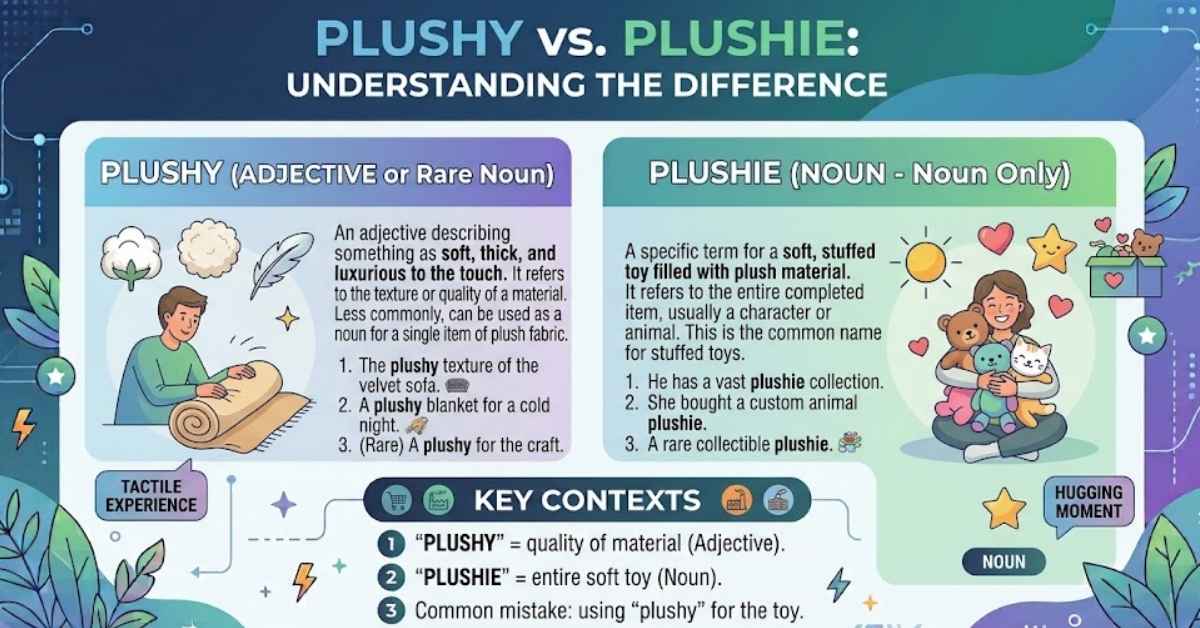
Plushy or plushie? Both are real English forms, but they are not normally used in exactly the same way. If you mean a soft stuffed toy, plushie is the clearest and most recognizable noun in modern U.S. English. Plushy is primarily an adjective describing something that is soft, thick, comfortable, or like plush, although informal noun use also occurs.
Cambridge defines plushie as a U.S. noun for a soft stuffed toy, while Collins defines plushy primarily as an adjective.
So if you’re asking “is it plushy or plushie?”, the simplest rule is:
Use “plushie” when you’re naming the stuffed toy. Use “plushy” when you’re describing a soft or plush-like quality.
For example:
- I bought a cute plushie.
- I bought a plushy blanket.
There is some overlap in informal usage, so plushy is not simply a misspelling of plushie.
Plushy or Plushie: Quick Answer
Here’s the distinction at a glance:
| Word | Usual role | Main meaning | Example |
|---|---|---|---|
| plushie | Noun | A soft stuffed toy | I bought a new plushie. |
| plushy | Adjective | Soft, thick, plush-like, or luxurious | The blanket feels plushy. |
| plushy | Informal noun use | A plush toy | She bought a cute plushy. |
| plush | Noun/adjective | Plush material or something soft/luxurious | It’s a plush toy. |
Cambridge specifically defines plushie as a toy made from cloth and filled with soft material, often in the form of an animal.
Collins defines plushy as an adjective meaning “of or like plush” and also records an informal U.S. sense associated with luxury.
The shortest answer
Talking about the toy? → plushie.
Describing softness or texture? → plushy.
Is It Plushy or Plushie?
The answer depends on what the word is doing in your sentence.
If it names the object, plushie is usually the natural choice:
I ordered a new plushie online.
My daughter sleeps with her favorite plushie.
He collects Pokémon plushies.
If it describes another object, plushy is usually appropriate:
The blanket feels plushy.
We bought a plushy sofa.
The toy has a soft, plushy exterior.
This noun-versus-adjective distinction is the most useful way to understand the two words.
Is It Spelled Plushie or Plushy?
If you’re asking how to spell the noun for a stuffed toy, plushie is the clearest choice.
plushie
Plural:
plushies
For example:
She has five plushies on her bed.
But plushy is also a legitimate English word. It is not merely a spelling mistake. Collins and Dictionary.com both recognize plushy as an adjective related to plush.
So these are both correctly spelled:
I bought a plushie.
The blanket is plushy.
The words are doing different jobs.
What Does “Plushie” Mean?
A plushie is a soft stuffed toy, often shaped like an animal, fictional character, mascot, or other recognizable figure.
Cambridge defines plushie as a toy made from cloth and filled with a soft material, often in the form of an animal.
Examples include:
- teddy bears
- stuffed dogs
- stuffed cats
- character toys
- anime plushies
- gaming plushies
- mascot plushies
- collectible plushies
- food-shaped plush toys
- handmade plush toys
For example:
I found a cute frog plushie at the store.
She collects character plushies.
He gave me a tiny bear plushie for my birthday.
The word has a distinctly casual and affectionate feel, which helps explain its popularity in toy collecting, fandoms, social media, and online communities.
What Does “Plushy” Mean?
Plushy is primarily an adjective.
It describes something that has qualities associated with plush: softness, thickness, comfort, richness, or a plush-like texture.
Examples:
The hotel had plushy carpets.
This blanket is incredibly plushy.
The chair has a plushy feel.
The toy has a plushy surface.
Dictionary.com defines plushy as “of, relating to, or resembling plush,” and also gives an informal sense related to luxury.
Collins similarly lists plushy as an adjective meaning “of or like plush,” with an informal U.S. meaning related to being luxurious or plush.
So plushy isn’t limited to toys.
You can describe:
- a blanket
- carpet
- furniture
- upholstery
- fabric
- towels
- clothing
- pillows
- cushions
- a toy
as plushy when you’re focusing on its texture or quality.
Plushie vs. Plushy: The Real Difference
The easiest way to understand the difference is grammatical.
Plushie = usually a noun
A noun names the thing.
I bought a plushie.
The word plushie is the object you bought.
Plushy = usually an adjective
An adjective describes the thing.
I bought a plushy blanket.
The word plushy tells us what the blanket is like.
Compare:
The plushie is soft.
Here, plushie names the object.
The plushie has a plushy texture.
Here, plushie names the object and plushy describes its texture.
That single comparison makes the distinction much easier to remember.
Can “Plushy” Mean a Stuffed Toy?
Yes, informal noun use of “plushy” exists.
This is where many online explanations become unnecessarily absolute.
Some current grammar pages tell readers that plushy is simply wrong when referring to a stuffed toy. That goes too far. Current dictionaries clearly establish plushy as an English word, and informal usage can extend it to the toy itself.
However, if your goal is maximum clarity, especially for a general U.S. audience, plushie is the safer noun for the toy.
Compare:
I bought a plushie.
This immediately sounds like the name of a stuffed toy.
I bought a plushy.
Some readers will understand it, particularly in informal toy or collector communities, but others may initially expect plushy to be an adjective.
So the distinction is:
Possible? Yes.
Clearer as a toy noun? Usually plushie.
Plushy or Plushie: Which Is Better?
If by “better” you mean which word should I choose when referring to a stuffed toy, plushie is generally the clearer choice.
If you mean which word is better for describing softness, use plushy.
Use “plushie” when:
- naming a stuffed toy
- discussing a character toy
- talking about collectibles
- writing a casual social-media post
- talking about a toy someone owns
- discussing a plush collection
Example:
I finally bought the plushie I’ve wanted for months.
Use “plushy” when:
- describing texture
- describing softness
- describing comfort
- describing thick material
- describing plush-like furniture or fabric
Example:
This blanket is so plushy and warm.
Use “plush toy” when:
- writing a formal product description
- creating retail terminology
- writing specifications
- addressing a broad audience
- you want maximum semantic clarity
Example:
The package contains one plush toy.
Is “Plushie” a Real Word?
Yes.
It is not merely internet slang or a typo.
Cambridge has a dedicated plushie dictionary entry and identifies it as a U.S. noun meaning a soft toy. Collins also has a plushie entry.
Cambridge gives examples such as a giraffe plushie and other plushies, demonstrating that the word is established enough to appear in dictionary material.
So if you write:
I bought a new plushie.
you are using a recognized English word.
Is “Plushy” a Real Word?
Yes.
This is another point where the answer is straightforward.
Collins lists plushy as an adjective and gives the forms plushier and plushiest. It defines the word as meaning “of or like plush” and also records an informal U.S. meaning associated with luxury.
Dictionary.com likewise lists plushy as an adjective.
So:
a plushy blanket
a plushy chair
a plushy carpet
are perfectly legitimate constructions.
The mistake is not using plushy. The mistake is assuming that plushy and plushie always perform the same grammatical function.
Why Do People Confuse Plushy and Plushie?
The confusion is understandable.
1. They look almost identical
The only obvious difference is the ending:
plushy
plushie
2. They are closely related
Both words are connected to plush.
3. They are associated with softness
A plushie is usually soft.
Something plushy is soft or plush-like.
So the meanings naturally overlap.
4. They are used in informal online language
Toy collectors, gamers, fandom communities, social-media users, and online sellers may use terminology more flexibly than a formal dictionary would. Current search results show this overlap clearly.
5. The distinction is grammatical, not merely visual
The most useful question isn’t:
“Which spelling looks right?”
Instead ask:
“Am I naming the toy or describing something?”
That usually solves the problem immediately.
Plushy or Plushie Examples
Here are natural examples of both.
Examples of “plushie”
I bought a plushie for my niece.
Her favorite plushie is a pink rabbit.
He keeps his collection of plushies on a shelf.
The character is available as a plushie.
I won this plushie at the arcade.
She has dozens of anime plushies.
In each example, plushie names the object.
Examples of “plushy”
The blanket feels plushy.
We bought a plushy rug.
The sofa has a plushy texture.
The towels are thick and plushy.
The toy has a soft, plushy exterior.
The fabric feels warm and plushy.
In these examples, plushy describes a quality.
Plushie as a Noun
Because plushie is normally a noun, it behaves like other countable nouns.
You can say:
- a plushie
- one plushie
- two plushies
- several plushies
- my plushie
- her plushie
- their plushies
Examples:
A plushie was sitting on the shelf.
She bought two plushies.
I washed my plushie yesterday.
Their collection contains dozens of plushies.
This is one of the clearest grammatical signals that plushie is functioning as a noun.
What Is the Plural of Plushie?
The standard plural is:
plushies
Examples:
She owns three plushies.
The store sells hundreds of plushies.
My children have too many plushies already.
This follows the familiar English spelling pattern in which a noun ending in consonant + y changes to -ies in the plural.
Is the Plural of Plushy “Plushies”?
It depends on how plushy is being used.
When plushy is an adjective, it does not normally have a plural form:
two plushy blankets
not:
two plushies blankets
But if plushy is being used informally as a noun meaning a plush toy, speakers may pluralize it as plushies.
That is another reason context matters.
For standard, unambiguous writing, if you’re talking about multiple stuffed toys, simply use:
plushies
Plushie vs. Plush Toy vs. Stuffed Animal
These terms overlap, but they’re not perfectly identical.
| Term | Typical meaning | U.S. usage |
|---|---|---|
| plushie | Soft stuffed toy | Casual/common |
| plush toy | Toy made from plush/soft materials | Neutral |
| stuffed toy | General stuffed object | Neutral |
| stuffed animal | Stuffed toy shaped like an animal | Very common |
| soft toy | Soft stuffed toy | More associated with British English |
| plush | Material, adjective, or product category | Broad |
For example, a stuffed Pikachu can naturally be called a plushie or plush toy.
But calling it a stuffed animal is less precise because the character is fictional rather than literally an animal.
Plushie or Plushy for American English?
For a U.S. audience, the distinction is mainly about usage, not a British-versus-American spelling rule.
Cambridge specifically labels plushie as a U.S. noun.
Collins lists plushy in American English as an adjective and records its informal U.S. luxury-related sense.
This is therefore not a situation like:
- color vs. colour
- center vs. centre
- favorite vs. favourite
Instead:
plushie and plushy have different typical grammatical functions.
For American readers, plushie is a very natural casual noun for the toy.
Is Plushie Formal or Informal?
Plushie is generally casual and conversational.
That does not mean it is incorrect or “bad English.”
It simply has a friendly tone.
It works naturally in:
- conversations
- social media
- blogs
- fandom communities
- toy collecting
- casual product copy
- online marketplaces
For a formal technical document, however, plush toy, stuffed toy, or stuffed animal may provide more neutral wording.
Compare:
We purchased 500 plushies for the event.
with:
The order contains 500 plush toys.
The second sounds more natural in procurement or formal business documentation.
What Should a Product Description Say?
If you’re writing an online product listing, the choice depends on the job each word needs to perform.
Product name
Custom Bunny Plushie
This clearly identifies the product.
Product category
Plush Toys
This is broad and commercially clear.
Texture description
Made with soft, plushy fabric
Here plushy describes the material.
Combined example
This adorable bunny plushie is made with soft, plushy fabric and durable stitching.
That sentence uses both words naturally:
- plushie = the product
- plushy = its tactile quality
This is a much better approach than forcing one spelling throughout the page.
What Should You Use for SEO?
If your page is specifically answering the query “plushy or plushie,” use both terms naturally because they represent the subject of the page.
But don’t treat SEO as a reason to force variations into every sentence.
A semantically strong page can naturally include:
- plushie
- plushy
- plush toy
- stuffed toy
- stuffed animal
- soft toy
- collectible plush
- character plush
- plushies
- plush fabric
- soft texture
The purpose of these terms is to clarify the conceptual relationships between the words, not to repeat keywords mechanically.
For a product page, the preferred primary term should reflect the actual product.
For a grammar page, the primary phrase should naturally be plushy or plushie.
Common Mistakes With Plushy and Plushie
Mistake 1: Saying “plushy” is always wrong
That’s too broad.
Plushy is a legitimate English adjective. Collins and Dictionary.com both document it.
Mistake 2: Assuming “plushie” is just internet slang
It isn’t.
Cambridge and Collins both recognize plushie as a noun for a soft toy.
Mistake 3: Using plushie as an adjective
Usually avoid:
a plushie blanket
If you mean the blanket is soft, plushy blanket is clearer.
Mistake 4: Assuming plushy can never be a noun
Informal noun usage does occur.
For maximum clarity, however, plushie is usually the better noun for the stuffed toy.
Mistake 5: Treating them as interchangeable
They’re related, but they usually perform different jobs.
I bought a plushie.
I bought a plushy blanket.
That distinction is more useful than memorizing a rigid “right/wrong” rule.
A Simple Memory Trick
Use this:
Plushie = the thing. Plushy = the quality.
Imagine someone asks:
“What did you buy?”
A plushie.
Now imagine someone asks:
“What is the blanket like?”
It’s plushy.
That simple question-and-answer test will solve most cases.
A Second Easy Test: “Name or Describe?”
Ask:
Am I naming something?
Use plushie.
This is my plushie.
Am I describing something?
Use plushy.
This blanket is plushy.
This is not an absolute rule because informal English can bend grammatical boundaries, but it is an excellent practical guide.
LEARN MORE: Momento or Memento
Quick Decision Table
| If you mean… | Use |
|---|---|
| A stuffed toy | plushie |
| Several stuffed toys | plushies |
| A soft texture | plushy |
| A thick, comfortable blanket | plushy |
| A soft sofa | plushy |
| A character toy | plushie |
| A collectible toy | plushie |
| A retail category | plush toy |
| An animal-shaped toy | stuffed animal |
| A formal product description | plush toy or stuffed toy |
Plushy or Plushie: Which Is Better?
There isn’t one universal winner because the words aren’t exact substitutes.
If you mean:
“What should I call the stuffed toy?”
Use plushie.
If you mean:
“How do I describe its soft texture?”
Use plushy.
If you need a neutral professional term:
plush toy
is often the clearest choice.
So the practical answer to “plushy or plushie which is better?” is:
For the toy itself: plushie.
The For describing softness: plushy.
For formal product terminology: plush toy.
Frequently Asked Questions
Is it plushy or plushie?
Both are legitimate words, but they usually serve different purposes. Plushie is the clearer noun for a stuffed toy. Plushy is primarily an adjective describing something soft, thick, plush-like, or luxurious.
Is it spelled plushie or plushy?
If you mean the stuffed toy, plushie is generally the clearest spelling. If you mean something that is soft or plush-like, plushy is appropriate.
Which is better: plushy or plushie?
For the name of a stuffed toy, plushie is usually the better choice. For describing texture or softness, plushy is better.
Is plushy a real word?
Yes. Plushy is a recognized English adjective. Collins and Dictionary.com both document it.
Is plushie a real word?
Yes. Cambridge and Collins both recognize plushie as a noun for a soft stuffed toy.
Can plushy mean a stuffed animal?
It can occur informally as a noun for a plush toy, but plushie is generally clearer when you’re specifically naming the toy.
What is the plural of plushie?
The standard plural is plushies.
I have three plushies.
Is “plushy” an adjective?
Yes. This is its primary grammatical role.
a plushy blanket
a plushy sofa
plushy fabric
Can “plushie” be an adjective?
It is normally used as a noun, not an adjective.
If you’re describing the texture of something, plushy is usually the better choice.
Is plushie formal English?
It is an established word, but it has a casual, friendly tone. In formal product or technical writing, plush toy or stuffed toy may be more neutral.
Is plushy formal English?
It is a legitimate adjective, but it is generally more conversational than a highly technical description of material properties.
What is the difference between plushie and plush toy?
A plushie is a casual noun for a soft stuffed toy. Plush toy is a more neutral product/category term.
What should I write: “cute plushie” or “cute plushy”?
If you’re naming the toy:
cute plushie
If you’re describing something as soft:
cute, plushy toy
Both can be grammatical, but the structure and meaning differ.
Final Answer: Plushy or Plushie?
If you only remember one rule, make it this:
A plushie is the toy. Plushy describes the feel.
So write:
I bought a cute plushie.
But:
I bought a soft, plushy blanket.
And don’t make the common mistake of saying plushy is always wrong. It is a legitimate English word, primarily an adjective, and informal noun usage exists. The more precise distinction is about grammar, meaning, and context, not simply right spelling versus wrong spelling.
For a stuffed toy aimed at a general U.S. audience, plushie is usually the clearest casual noun. For describing softness, thickness, comfort, or a plush-like texture, plushy is the natural choice. If you want the most neutral professional product term, plush toy is often the safest wording.