

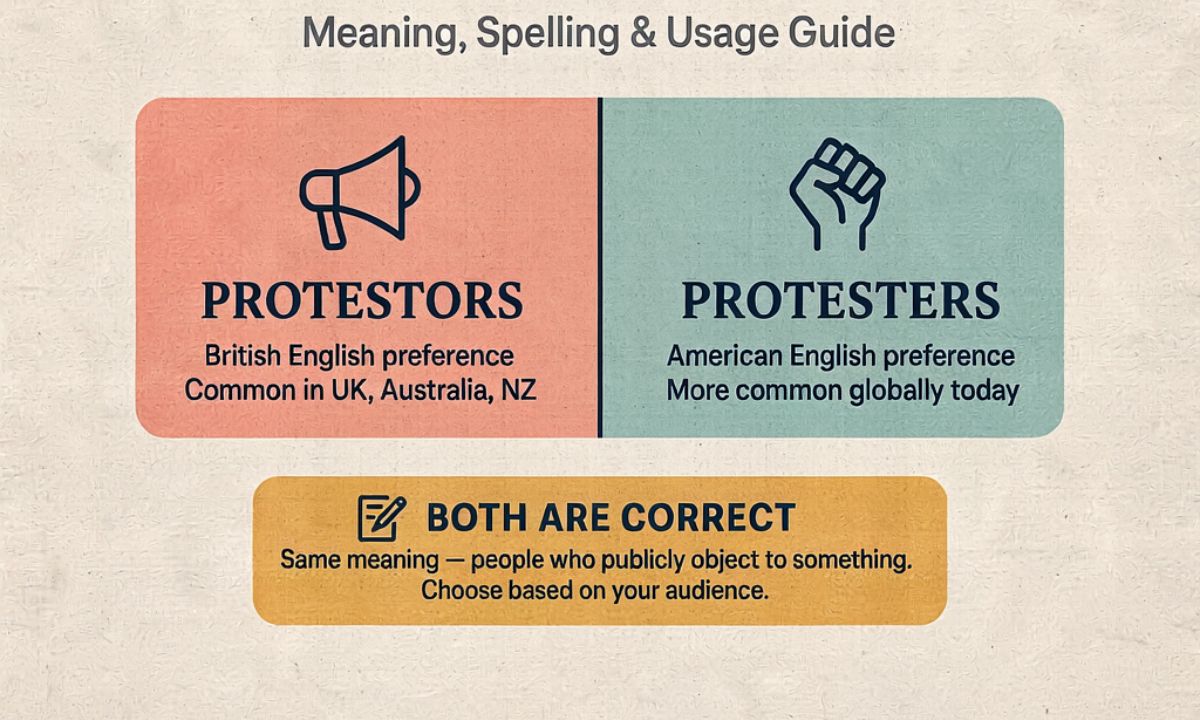
Flip through a newspaper article one day and spot “protesters” marching through downtown streets, then scroll social media the next morning and read about “protestors” gathering outside city hall. Both spellings show up constantly across news coverage, academic papers, and everyday conversation, leaving many readers wondering which version actually counts as correct.
This guide untangles the spelling debate completely, walking through where each version comes from, how regional English variations shape the choice, and which spelling fits best depending on your audience. You’ll also find real examples, a quick comparison chart, and practical tips for staying consistent throughout your own writing.
Getting this word right matters more than it might initially seem. News reports, academic essays, and even casual social media posts about current events rely heavily on this term, and inconsistent spelling within a single piece of writing can quietly undermine an otherwise strong, wellresearched article.
Meaning of Protestors or Protesters in Modern Usage
Both spellings refer to the same concept: someone publicly expressing disagreement or opposition toward a policy, decision, or event. Whether marching through a city square, holding signs outside a courthouse, or organizing an online campaign, these individuals share one clear goal, voicing dissent toward something they believe deserves change.
Real life example: “Hundreds of protesters gathered outside the government building to demand cleaner water regulations.”
Notice how the meaning stays identical regardless of which spelling appears in that sentence. Neither version changes the core definition, making this purely a stylistic and regional matter rather than a question involving different concepts entirely.
A Brief History of the Word “Protester”
Tracing this word back through etymology reveals roots in the Latin term “protestari,” meaning to declare publicly or bear witness. English absorbed this concept centuries ago, gradually shaping it into the verb “protest,” describing any formal or public objection against something.
As the noun form developed to describe someone performing this action, English speakers followed a common pattern seen throughout the language, adding “-er” to create an agent noun, much like “teacher” comes from “teach” or “writer” comes from “write.” Over time, however, alternate spellings using “-or” crept into circulation too, following a different but equally common English suffix pattern found in words like “actor” or “sponsor.”
This dual pathway explains why both forms exist today, each rooted in legitimate, if slightly different, corners of English word formation history.
Printed records from the eighteenth and nineteenth centuries show both spellings appearing sporadically, long before any formal style guide attempted to settle the matter definitively. Only as mass media expanded throughout the twentieth century did major publishing houses begin standardizing their internal preferences, gradually nudging the entire English-speaking world toward one dominant choice over the other.
Why Are There Two Spellings?
Several overlapping factors explain why this single concept ended up with two competing spellings still circulating widely today.
American vs British English Influence
American English strongly favors “protesters,” treating it as the standard, dictionary-preferred spelling across major news outlets and publishing houses. British English shows more flexibility, sometimes leaning toward “protestors” in certain contexts, though even UK style guides increasingly favor the “-er” version for consistency with similar agent nouns.
Language Evolution
English constantly absorbs new spelling patterns as speakers borrow suffixes from Latin influenced words. Since both “-er” and “-or” function as valid noun-forming suffixes elsewhere in the language, confusion naturally spreads whenever a newer term like this one starts circulating widely across different regions simultaneously.
Editorial Style Choices
Individual publications sometimes adopt their own internal style preferences, regardless of broader national trends. A smaller regional newspaper might continue using “protestors” out of longstanding habit, even after major style guides shifted firmly toward the alternate spelling decades earlier.
Grammar and Correct Usage in Sentences
Both spellings function identically within sentence structure, acting as the plural noun form describing people engaged in public opposition or demonstration. Neither version changes verb conjugation, sentence order, or grammatical role in any way.
Examples:
- “Protesters blocked the main highway during Friday’s rush hour traffic.”
- “Local authorities negotiated calmly with protestors camped outside the capitol steps.”
- “Several protesters carried handmade signs demanding immediate policy reform.”
- “News crews interviewed protestors about their reasons for joining the demonstration.”
Reading these examples side by side confirms that swapping one spelling for the other changes nothing about meaning, tone, or grammatical correctness within the sentence itself.
Regional Differences in Usage
Geography plays a surprisingly large role in determining which spelling feels more natural to a given audience. Understanding these regional patterns helps writers choose confidently based on where their readers live.
United States:
American publications, dictionaries, and style guides overwhelmingly favor “protesters.” Major outlets including the Associated Press, The New York Times, and most university writing centers treat this spelling as the accepted professional standard nationwide.
United Kingdom:
British usage shows more variation historically, though contemporary UK journalism increasingly mirrors American preference, adopting “protesters” across most mainstream newspapers. Older texts and certain regional publications still occasionally favor “protestors,” reflecting slower adoption of the now dominant spelling.
South Asia:
English language newspapers across India, Pakistan, and Bangladesh often display mixed usage, sometimes influenced by British colonial era spelling conventions still lingering within older institutional writing. Younger digital publications, however, increasingly align with international standard practice, favoring “protesters” for broader consistency with global English content.
Educational institutions across this region show a similar shift, with newer textbooks and university writing programs steadily adopting the American spelling to match international academic publishing standards. Students preparing for global exams or applying to international universities benefit from recognizing this trend early, since consistent, modern spelling choices tend to align more closely with what examiners and admissions committees expect.
Common Mistakes Writers Make
Inconsistency causes the most frequent problem, with writers switching between both spellings within a single article or document without realizing the shift. This creates an unpolished impression, suggesting careless proofreading rather than intentional stylistic choice.
Some writers also assume “protestors” carries a more formal or legal connotation, mistakenly reserving it for court documents or official statements. In reality, no genuine distinction exists between formal and informal contexts, since both spellings remain interchangeable regardless of the document’s tone or purpose.
Autocorrect software sometimes flags one spelling while ignoring the other, depending on regional language settings selected within a device. Writers switching between American and British keyboard configurations occasionally introduce accidental inconsistency without even noticing the underlying cause.
Search engine optimization suffers too when writers alternate spellings carelessly throughout online content. Splitting keyword relevance between two different versions of the same term can dilute a page’s ranking potential, since search algorithms sometimes treat each spelling as a slightly separate query rather than recognizing them as identical concepts.
Which One Should You Use?
Choosing the right spelling depends largely on your target audience, publication style, and personal or organizational preference established beforehand.
Use “protesters” when:
- Writing for an American audience or publication
- Following widely recognized international journalism standards
- Submitting academic papers expected to follow modern style guides
- Aiming for the broadest, most universally recognized spelling choice available
“Protestors” may appear in:
- Older British texts or historical archives
- Regional publications maintaining longstanding internal style preferences
- Casual writing where personal habit outweighs formal consistency
- Legal or governmental documents from certain English-speaking regions still using traditional spelling conventions
Quick Comparison
| Feature | Protesters | Protestors |
| Preferred region | United States, most global media | Some UK and South Asian texts |
| Dictionary status | Standard, primary entry | Recognized variant |
| News style guides | AP Style, most major outlets | Occasionally used regionally |
| Formality level | Suitable for all formal writing | Acceptable but less standardized |
| Example usage | “Protesters marched peacefully downtown.” | “Protestors gathered near the courthouse.” |
| Global trend | Increasingly dominant worldwide | Gradually declining in modern usage |
This table makes the decision simple whenever doubt creeps in. Defaulting to “protesters” almost always satisfies modern readers, editors, and search engines alike, regardless of where your audience happens to live.
How News Media and Style Guides Handle This Word
Major journalism organizations settled this question decades ago through their internal style guides. The Associated Press Stylebook, followed by thousands of newsrooms across the country, explicitly lists “protesters” as the correct spelling, and most American newspapers, television networks, and digital publications follow that guidance without exception.
International wire services distributing content globally also default to this same spelling, ensuring consistency across translated or syndicated articles appearing in multiple countries simultaneously. This widespread editorial agreement explains why “protesters” now dominates search results, academic citations, and professional writing far beyond just American borders.
Smaller independent publications occasionally deviate from this standard, particularly outlets rooted in regional traditions or older editorial habits established before the modern consensus solidified. Even so, the overwhelming trend across contemporary journalism continues pushing firmly toward one unified spelling.
Related Words: Protest, Protesting, and Protester Forms
Understanding the full word family helps reinforce correct spelling across related terms too. “Protest” functions as both a noun and verb, describing the act itself, as in “Thousands joined the protest downtown” or “Residents plan to protest the new zoning law.” “Protesting” serves as the present participle, appearing in sentences like “Workers spent the afternoon protesting outside company headquarters.”
The singular form follows the same pattern as its plural counterpart, meaning a single individual gets called a “protester,” never a “protestor,” under the now dominant American spelling convention. Keeping this entire word family consistent throughout a document strengthens overall polish, especially within longer articles discussing demonstrations, activism, or civil unrest across multiple paragraphs.
FAQs About Protestors or Protesters
What is the correct spelling: protestors or protesters?
Protesters stands as the dictionary preferred, widely accepted spelling across American English and most international journalism today. Protestors remains a recognized variant, though it appears far less frequently in modern professional writing.
Is there any difference in meaning?
No, both spellings describe exactly the same concept, someone publicly opposing or demonstrating against a policy, decision, or event. The difference remains purely stylistic, never affecting definition or context.
Why do some people still use “protestors”?
Older texts, regional habits, and certain British or South Asian publications sometimes retain this spelling out of longstanding tradition. Personal preference and inconsistent autocorrect settings also contribute to its continued, though declining, appearance.
Can I use both spellings in one article?
Technically yes, since neither spelling counts as grammatically wrong, but doing so looks inconsistent and unpolished to careful readers. Choosing one spelling and maintaining it throughout your entire document creates a far more professional impression.
Which spelling is better for exams or academic writing?
“Protesters” remains the safer, more universally accepted choice for academic papers, exams, and formal submissions worldwide. Most style guides taught in schools and universities favor this spelling as the modern standard.
Conclusion
Both protestors and protesters describe the exact same idea, yet “protesters” has emerged as the clear, dominant spelling across modern journalism, academic writing, and everyday digital content worldwide. Understanding the historical roots behind each version, along with regional preferences still lingering in certain texts, helps explain why both spellings continue circulating even today.
Whenever precision and professionalism matter, default confidently to “protesters,” and keep that choice consistent throughout your entire piece of writing. Small details like this one add up, shaping how polished and credible your work appears to readers, editors, and search engines alike.
Language continues shifting over time, and spelling conventions that feel settled today may evolve further down the road. For now, though, following the modern, dominant standard keeps your writing aligned with what most readers, publications, and academic institutions already expect to see.