

Walk into any HR meeting or budget review, and you’ll hear Headcount or Head Count tossed around constantly, yet plenty of professionals still pause before writing it down. Should it appear as one word, headcount, or split into two, head count? The confusion feels small, but getting it wrong in a report or email can make writing look inconsistent, especially inside formal business documents.
This guide clears up the spelling debate once and for all, explains what the term actually means in workplace settings, and shows you exactly how companies use it every single day. You’ll also find real sentence examples, a quick comparison table, and answers to the questions people search for most often.
Think about the last time you filled out a job application or read a company’s quarterly earnings summary. Chances are, this exact term appeared somewhere in that document, whether describing total staff numbers or projected hiring targets for the coming year. Understanding its correct spelling and proper context turns a small grammar question into a genuine writing skill worth mastering.
What Does Headcount or Head Count Mean?
Headcount refers to the total number of people within a specific group, most commonly employees working at a company, department, or project team. Businesses track this figure constantly, since it directly influences budgeting decisions, staffing plans, and overall organizational structure.
Beyond the workplace, the same concept applies anywhere a group needs counting, from classroom attendance to event planning. A wedding planner might confirm the final headcount before ordering catering, while a school administrator checks classroom headcount before assigning supplies for the semester.
Government agencies and research organizations rely on this same concept too, though they often phrase it differently depending on the field. Census workers, for instance, essentially perform a massive headcount across an entire country, tallying residents to guide public funding and policy decisions. Recognizing this shared thread across industries helps explain why the term feels so universally familiar, regardless of profession.
Key meaning in simple words:
Simply put, headcount means “how many people,” whether that group involves employees, students, guests, or any collection of individuals someone needs to track. The word itself carries no complicated jargon behind it, just a straightforward number representing people present or employed.
Headcount vs Head Count: Which One Is Correct?
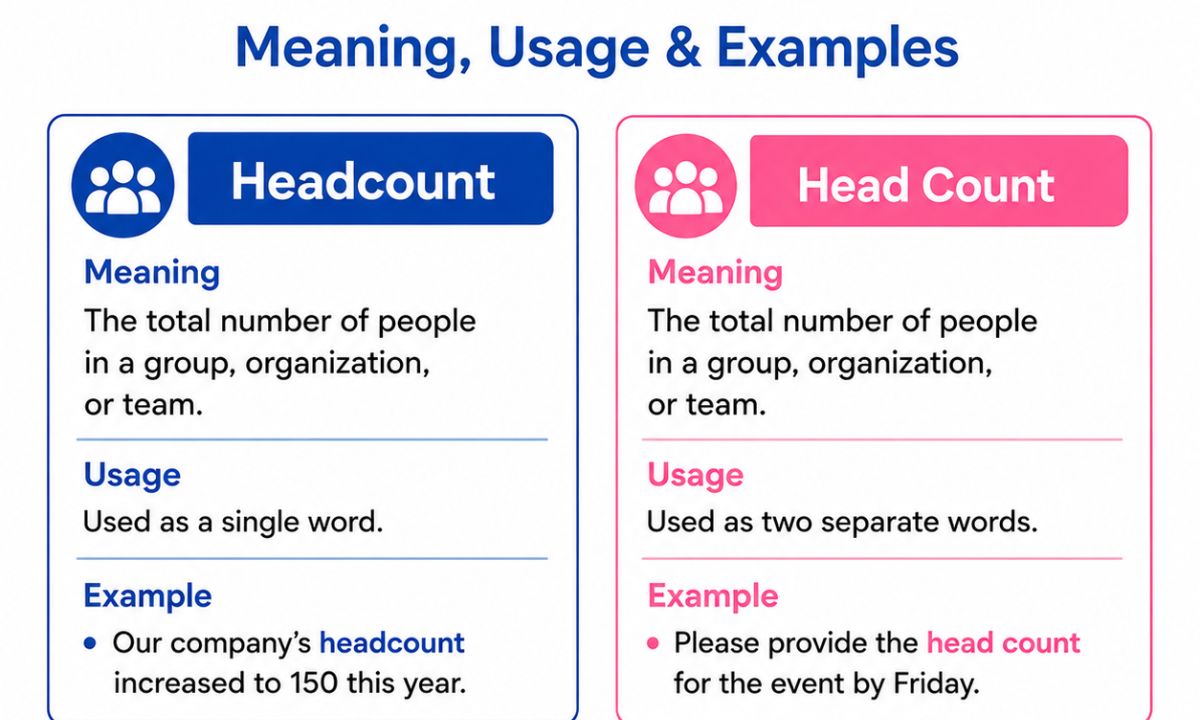
Both spellings appear across published writing, dictionaries, and business documents, though each version carries slightly different associations depending on formality and regional preference.
Headcount (Modern Usage)
Most contemporary style guides, business publications, and HR software platforms favor the single word spelling, headcount. This version dominates corporate reports, job postings, and internal company dashboards, reflecting how the term has solidified into standard business vocabulary over recent decades.
Real life example: “Our current headcount stands at 340 employees across three regional offices.”
Notice how naturally this word fits into a data driven, corporate sentence. Software platforms like Workday and BambooHR display this exact spelling throughout their dashboards, reinforcing headcount as the dominant professional standard.
Head Count (Traditional Usage)
The two word version, head count, reflects an older, more literal interpretation, treating the phrase as a simple action: counting heads. Some traditional style guides, along with certain government or academic documents, still prefer this separated spelling, particularly in contexts describing a physical tally rather than an abstract organizational metric.
Real life example: “The teacher took a quick head count before boarding the school bus.”
Here, the phrase describes an immediate, physical act of counting students one by one, rather than referencing a stored, ongoing statistic. This distinction helps explain why certain writers still reach for the two word form in specific situations.
Why Headcount Matters in Business
Companies rely on accurate headcount figures for far more than casual reference. This single metric touches nearly every major operational decision an organization makes throughout the year.
Workforce Planning
HR departments use headcount data to forecast hiring needs, identify staffing gaps, and plan for upcoming projects requiring additional talent. A rapidly growing startup might track weekly headcount changes to ensure recruitment keeps pace with expanding business demands.
Budget Allocation
Finance teams tie headcount directly to payroll expenses, benefits costs, and departmental budgets. Executives reviewing quarterly reports often examine headcount alongside revenue figures, checking whether staffing levels align properly with company growth or contraction.
Performance Tracking
Managers compare headcount against output metrics to evaluate productivity across teams. A department maintaining strong results with a smaller headcount often signals efficient processes, while ballooning headcount without matching output can raise concerns during leadership reviews.
Resource Management
Beyond salaries, headcount influences equipment needs, office space planning, and software licensing costs. Facilities teams calculate desk space based on projected headcount, while IT departments purchase software seats according to current employee numbers.
Common LSI Keywords Related to Headcount
Search engines reward content that naturally incorporates related terms, helping readers and algorithms alike understand the broader topic context. Words and phrases commonly appearing alongside headcount include workforce size, employee count, staffing levels, personnel numbers, team size, organizational structure, hiring plan, attrition rate, and full-time equivalents. Weaving these terms naturally throughout HR or business writing strengthens both clarity and search visibility.
Examples of Headcount in Sentences
Seeing the word applied across different situations helps cement proper usage in your own writing. Consider these varied examples:
- “The company froze headcount growth during the economic downturn last year.”
- “HR sent an updated headcount report to every department head this morning.”
- “Our restaurant needs an accurate headcount before finalizing tonight’s reservation.”
- “The nonprofit tracks volunteer headcount separately from paid staff numbers.”
- “Leadership approved additional headcount for the customer support team next quarter.”
Each sentence demonstrates how flexible this word remains, stretching comfortably across corporate reports, hospitality settings, and nonprofit organizations alike.
Common Mistakes People Make
Writers frequently misuse this term in a few predictable ways. Some assume headcount refers only to full time employees, forgetting that many companies include contractors, interns, and part-time staff within broader workforce totals. Others confuse headcount with turnover rate, mistakenly believing the term tracks how many people leave a company rather than simply how many currently remain.
Inconsistent spelling causes further trouble, especially within longer documents. Switching between headcount and head count throughout a single report looks careless, even though both spellings technically exist in published dictionaries. Choosing one version and sticking with it consistently avoids this easily preventable error.
Finally, some writers inflate headcount figures by counting vacant, unfilled positions alongside actual employed staff. Accurate reporting separates current headcount from open requisitions, since blending the two creates misleading impressions about actual staffing strength.
Another frequent slip involves forgetting seasonal or temporary workers entirely. Retail companies hiring extra staff during holiday seasons sometimes exclude these temporary employees from official headcount reports, creating an inaccurate picture of true operational capacity during peak periods. Including every active worker, regardless of contract length, produces far more reliable figures for leadership decisions.
How Is Headcount Calculated?
Calculating headcount seems simple on the surface, yet organizations often apply different methods depending on their reporting needs. The most basic approach counts every active employee on payroll during a specific date, often called a snapshot headcount.
Larger companies sometimes calculate average headcount instead, adding together the totals from the beginning and end of a reporting period, then dividing by two. This method smooths out fluctuations caused by seasonal hiring or sudden departures, offering a steadier figure for financial forecasting.
Some organizations also distinguish between full time equivalent headcount and raw headcount. Full time equivalent calculations convert part time hours into fractional employee units, giving finance teams a clearer picture of actual labor capacity rather than simply counting individual heads regardless of hours worked.
Headcount vs Similar Terms: Quick Comparison Table
| Term | Meaning | Common Setting | Example |
| Headcount | Total number of people in a group or organization | Corporate HR, business reports | “Headcount rose by twelve employees this quarter.” |
| Head Count | Literal act of counting people present | Schools, events, casual settings | “The guide did a head count before leaving the museum.” |
| Workforce size | Broader term for total labor capacity | Economic reports, industry analysis | “Workforce size across the sector grew steadily.” |
| Full-time equivalent | Converted measure combining part-time hours | Finance, payroll planning | “The office runs on 45 full-time equivalents.” |
| Turnover rate | Percentage of staff leaving over time | HR retention reports | “Turnover rate dropped after new benefits launched.” |
This table clarifies how headcount fits alongside related workplace terminology, helping writers select the most precise word for their specific context.
When to Use Headcount in Professional Writing
Formal business documents, including annual reports, HR presentations, and executive summaries, should default to the single word spelling, headcount, since it matches industry-standard software platforms and widely accepted style guides. Consistency matters enormously in professional writing, and readers expect the modern spelling throughout corporate communication.
Reserve the two word version, head count, for situations describing a literal, immediate act of counting people, particularly outside strict business contexts. A tour guide confirming passengers before departure, or a teacher checking students before a field trip, fits naturally with this older, more descriptive phrasing.
Headcount in Everyday Conversation (Beyond the Office)
While businesses dominate discussions around this term, everyday conversation borrows it just as often. Party hosts mention headcount when confirming how many guests plan to attend a dinner, while sports coaches reference headcount when organizing practice squads or travel rosters for away games.
Restaurants and event venues rely heavily on accurate headcount figures too, since kitchen staff need reliable numbers before preparing meals for a banquet or wedding reception. A caterer might ask, “Can you confirm your final headcount by Thursday?” ensuring enough food gets prepared without unnecessary waste. This everyday flexibility shows how thoroughly the term has spread beyond strictly corporate walls into daily life.
FAQs About Headcount or Head Count
Is headcount one word or two words?
Both versions exist in modern English, though headcount as a single word dominates business, HR, and corporate writing today. Head count as two words remains acceptable, particularly for literal, physical counting situations outside formal business contexts.
What does headcount mean in HR?
In human resources, headcount refers to the total number of employees working within a company, department, or specific team. HR professionals track this figure constantly to guide hiring plans, budget forecasts, and organizational restructuring decisions.
Is head count still correct?
Yes, the two-word spelling remains grammatically correct and appears in many dictionaries alongside the single word version. Some traditional style guides and casual writing contexts still prefer this older, more literal phrasing.
Why is headcount important in companies?
Headcount directly shapes budgeting, staffing strategy, and resource allocation across an organization. Executives rely on accurate headcount data to ensure payroll expenses align properly with revenue, productivity, and long-term growth plans.
Can headcount be used for students or groups?
Absolutely, headcount applies to any countable group of people, not just paid employees. Schools, nonprofits, event planners, and sports teams all use the term whenever they need an accurate total of participants or attendees.
Conclusion
Choosing between headcount and head count ultimately depends on your setting and level of formality. Corporate reports, HR software, and professional business writing overwhelmingly favor the single word spelling, while casual, literal counting situations still welcome the traditional two word version comfortably.
Whichever spelling you choose, staying consistent throughout your document matters just as much as picking the correct form in the first place. Sloppy switching between the two versions distracts readers and signals a lack of editorial care, especially inside longer reports meant for executive review.
Keep this guide handy, apply the examples shared above, and you’ll never second-guess this common business term again. Whether you’re drafting a hiring plan, confirming guests for a dinner party, or preparing a quarterly report for leadership, choosing the right spelling and applying it consistently will always make your writing look sharper and more professional.