

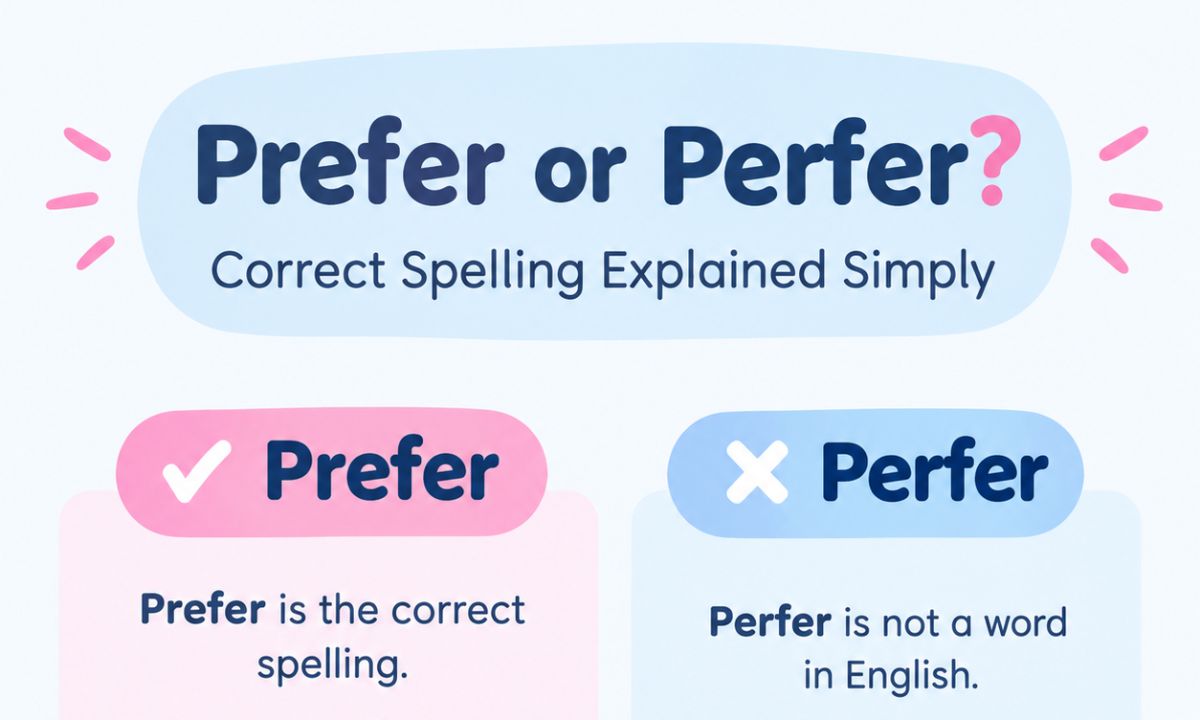
Typing quickly on a phone or dashing off a work email, plenty of people accidentally swap two letters and end up with “perfer” instead of “prefer.” Spellcheck usually catches it, but not always, and the mistake sneaks into resumes, essays, and casual messages far more often than most writers realize.
This guide settles the spelling question permanently, explains exactly what the correct word means, and walks through real sentence examples pulled from everyday conversation. You’ll also pick up simple memory tricks, a quick comparison table, and answers to the questions people search for most whenever this tricky word trips them up.
Consider how often this exact word appears throughout a normal day. Ordering food, filling out a survey, or writing a quick note to a coworker all involve stating a preference at some point. Since the word shows up so frequently, even a small spelling slip tends to repeat itself across dozens of messages before anyone notices the pattern.
What Does “Prefer” Mean?
Prefer describes choosing one option over another, usually because that choice feels more enjoyable, comfortable, or practical. Someone might prefer coffee over tea, prefer working from home instead of commuting, or prefer quiet evenings rather than crowded parties.
Real life example: “I prefer window seats whenever I fly, since the view helps calm my nerves.”
The word carries a gentle, personal tone, expressing individual taste rather than a strict rule or requirement. Friends use it constantly during casual conversation, deciding where to eat dinner or which movie to watch together over the weekend.
Prefer or Perfer: Why the Confusion Happens
Letter transposition explains most of this mistake. Fingers moving quickly across a keyboard sometimes swap the “r” and “e,” especially since both letters sit close together on a standard layout. This tiny slip happens so fast that many writers never notice it until reviewing their message later.
Phonetics play a role too. Some regional accents blend the middle sounds of “prefer” together, making the word sound almost identical whether pronounced correctly or slightly scrambled. Since spoken language doesn’t always match written spelling precisely, writers sometimes type what sounds right rather than what looks correct on the page.
Autocorrect inconsistency adds another layer of trouble. Certain keyboards flag “perfer” immediately, while others let it slide through unnoticed, particularly on devices with less aggressive spellcheck settings. This unpredictable safety net gives some writers false confidence that their spelling must already be correct.
Muscle memory reinforces the error further once it takes hold. After typing “perfer” incorrectly a handful of times without correction, fingers start reproducing that same wrong pattern automatically, almost bypassing conscious thought entirely. Breaking this habit usually requires deliberate, repeated practice with the correct spelling until new muscle memory replaces the old, mistaken pattern.
Is It Prefer or Perfer? The Clear Answer
Prefer stands as the only correct spelling recognized in English dictionaries, style guides, and formal writing standards worldwide. Perfer holds no legitimate place in the language, appearing only as an accidental misspelling rather than an alternative or regional variant.
Unlike some word pairs where both spellings carry historical validity, this situation involves a single accepted form. Any appearance of “perfer” in a document, email, or academic paper signals a typo that needs immediate correction, regardless of context or audience.
How to Use “Prefer” in Sentences
Understanding proper sentence structure helps reinforce correct spelling naturally over time. Below are three common ways this word appears throughout everyday writing and conversation.
Showing Preference
The most straightforward use simply states a personal choice or liking. “My sister prefers spicy food, while I lean toward milder flavors instead.” This pattern appears constantly in casual chats about food, hobbies, and daily routines.
Comparing Two Choices
Prefer often pairs with “over” or “to” when directly comparing two options. “Most employees prefer flexible schedules over rigid nine to five hours.” This structure highlights a clear choice between two specific alternatives.
Polite Expressions
Formal or polite requests frequently rely on this word to soften a statement. “I would prefer to reschedule our meeting, if that works for your calendar.” Customer service scripts and professional emails lean heavily on this gentler phrasing.
Grammar Tip to Remember the Spelling
Break the word into two simple syllables: “pre” and “fer.” Remembering that it starts with the prefix “pre,” meaning before, helps anchor the correct letter order firmly in memory. Many common English words share this same prefix, including predict, prepare, and prevent, all beginning with that identical three letter pattern.
Once that prefix feels automatic, the rest of the word follows naturally: “fer” attaches directly afterward, without any letter reversal. Practicing this two-step breakdown a few times usually locks the correct spelling into long-term memory.
Common Mistakes with “Prefer”
Beyond the basic spelling swap, writers sometimes stumble over related forms of this word. Doubling the final consonant incorrectly causes frequent errors, since English spelling rules around suffixes can feel inconsistent to non native speakers and native speakers alike.
Correct usage patterns:
- Prefer, preferred, preferring note the doubled “r” before adding “-ed” or “-ing”
- Preference, not “prefrence” or “preferance”
- Preferable, not “preferrable” in standard American English
- Preferably, used as an adverb describing a preferred method or timing
Misspelling these related forms happens almost as often as the original prefer versus perfer confusion, making it worth memorizing all four variations together as a complete set.
Prefer or Perfer in Everyday Writing
Casual texting and social media posts show this mistake surprisingly often, since people type quickly without pausing to double check spelling. A quick scroll through comment sections reveals sentences like, “I perfer chocolate over vanilla any day,” slipping past unnoticed by both the writer and countless readers scrolling past.
Workplace emails carry higher stakes, though the same mistake still creeps in occasionally. A rushed message stating, “I perfer meeting in the afternoon” undermines an otherwise polished, professional tone, potentially leaving a poor impression on colleagues or clients reading that communication.
Academic writing demands the strictest accuracy, since professors and editors notice spelling errors immediately. Students submitting essays or research papers containing “perfer” risk losing credibility, even when their actual arguments and analysis remain strong throughout the rest of the paper.
Why Correct Spelling Matters
Spelling accuracy shapes how readers perceive a writer’s credibility, regardless of the actual content quality behind the words. A single typo rarely ruins an entire message, but repeated errors accumulate, gradually eroding trust and suggesting carelessness rather than genuine mistake.
Professional settings amplify this effect considerably. Hiring managers reviewing resumes, editors evaluating submissions, and clients reading business proposals all form quick judgments based partly on writing polish. Correct spelling signals attention to detail, a quality many industries value highly when assessing overall competence.
Search engines factor spelling into rankings too, since accurately spelled content tends to match search queries more precisely and reads more naturally to human visitors. Publishing an article riddled with errors like “perfer” instead of “prefer” can hurt both readability and discoverability online.
Beyond professional consequences, correct spelling also speeds up communication itself. Readers pause slightly whenever they encounter an unfamiliar or incorrect word, breaking the natural flow of a sentence while their brain works to decode the intended meaning. Clean, accurate spelling keeps that flow smooth, letting ideas travel from writer to reader without unnecessary friction along the way.
Prefer in Different Tenses (Preferred, Preferring)
Verb tense changes introduce another common stumbling block alongside the original spelling confusion. Present tense uses the base form, prefer, as in “I prefer tea.” Past tense doubles the final consonant before adding “-ed,” producing preferred, as in “She preferred silence during her morning commute.”
Present participle follows the same doubling pattern, forming preferring, as in “He kept preferring the scenic route despite the extra travel time.” Remembering to double the “r” across these tense changes prevents a whole separate category of spelling mistakes that often accompanies the original prefer versus perfer confusion.
Prefer vs Similar Words: Quick Comparison Table
| Word | Meaning | Example Sentence | Common Mistake |
| Prefer | To like one option more than another | “I prefer tea over coffee.” | Written as “perfer” |
| Preference | A liking for something specific | “Her preference leans toward casual clothing.” | Written as “prefrence” |
| Preferred | Past tense of prefer | “He preferred silence to noise.” | Missing doubled “r” |
| Preferable | More desirable or suitable | “A refund seems preferable to store credit.” | Written as “preferrable” |
| Preferably | In a preferred manner | “Preferably, arrive before nine.” | Confused with “preferrably” |
This table groups the entire word family together, making it easier to spot and correct related errors across an entire document in one focused review.
Other Commonly Misspelled Words Like Perfer
Prefer isn’t alone in facing letter-transposition errors. Several everyday English words suffer from similar mix ups, often for the exact same phonetic or typing reasons.
- Definitely, frequently misspelled as “definately”
- Separate, often written incorrectly as “seperate”
- Occurred, sometimes missing its doubled consonants entirely
- Relevant, occasionally typed as “revelant” through letter swapping
- Perform, rarely but occasionally confused with “preform”
Recognizing this broader pattern helps writers develop a general habit of slowing down during proofreading, catching similar transposition errors before hitting send or submit on any important document.
Quick Memory Hacks
A handful of simple tricks make this spelling stick permanently. First, remember the phrase “prefer starts like predict,” anchoring the correct “pre” prefix through a familiar comparison word. Second, sound out the syllables slowly, “pre fer,” rather than rushing through the whole word at once.
Third, try the rhyme trick: prefer rhymes with transfer and refer, both sharing that identical “fer” ending without any letter reversal. Fourth, whenever typing quickly on a phone, pause briefly before hitting send, scanning specifically for this word if your personal writing history shows a pattern of this particular mistake.
FAQs About Prefer or Perfer
Is it prefer or perfer?
Prefer is the only correct spelling recognized in English. Perfer holds no legitimate place in the language and always represents an accidental typo rather than an acceptable variant.
Why do people write perfer instead of prefer?
Quick typing, letter transposition, and inconsistent autocorrect settings all contribute to this common mistake. Some regional pronunciation patterns also blur the middle sounds, encouraging writers to type based on how the word sounds rather than how it’s actually spelled.
What does prefer mean in simple words?
Prefer simply means liking one choice more than another available option. Someone might prefer tea over coffee, or prefer walking instead of driving on a short trip across town.
Is perfer a real English word?
No, perfer doesn’t exist as a legitimate English word in any dictionary or style guide. It functions purely as a spelling error, never as an alternative form or regional variation.
How can I remember prefer spelling easily?
Break the word into two syllables, “pre” and “fer,” connecting it mentally to familiar words like predict or prepare that share the same starting prefix. Practicing this small mental trick a few times usually locks the correct spelling into permanent memory.
Conclusion
Prefer stands as the only correct spelling, while perfer remains nothing more than a common typing slip caused by quick fingers, regional pronunciation habits, or inconsistent spellcheck tools. Understanding the word’s meaning, practicing its related forms like preferred and preference, and applying the simple memory tricks shared throughout this guide will keep this mistake out of your writing permanently.
Whether you’re drafting a casual text message, polishing a resume, or finishing an academic paper, taking a moment to double check this word pays off every single time. Small spelling details like this one add up, shaping how clearly and professionally your writing comes across to anyone reading it.