

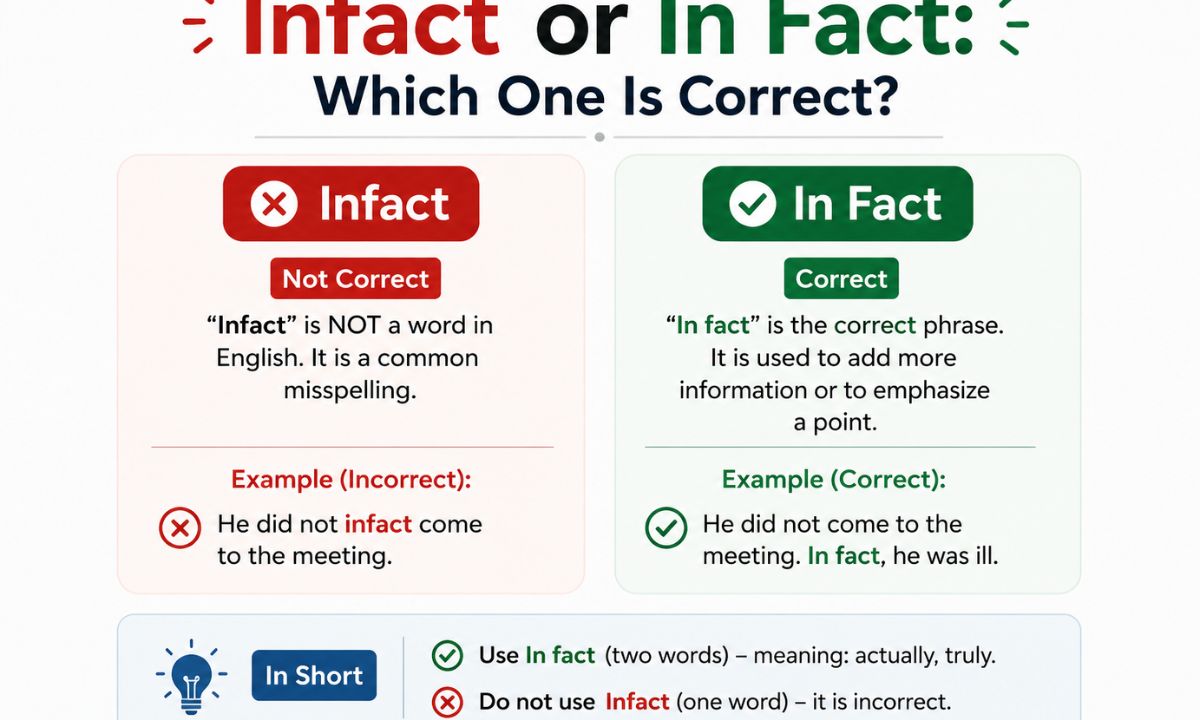
When writing in English, you may wonder whether the correct form is “infact” or “in fact.” These two forms look almost identical, so the confusion is understandable. However, standard English uses in fact as two separate words.
The form infact does not work as the standard spelling of this expression. Therefore, whenever you want to emphasize that something is true, provide additional information, or correct an earlier impression, use in fact.
For example:
“I thought the shop was closed. In fact, it was open.”
Here, in fact adds information that changes or corrects the previous idea.
This guide explains the meaning, grammar, correct usage, common mistakes, and everyday examples of in fact so you can use it confidently.
Is it infact or in fact?
The correct form is in fact.
In fact consists of two separate words:
- in — a preposition
- fact — a noun
Together, they form the expression in fact, which commonly means actually, indeed, or as a matter of fact.
Correct
“She is not angry. In fact, she is quite happy.”
Incorrect
“She is not angry. Infact, she is quite happy.”
The second version joins the two words together. Standard English does not normally use infact as the spelling of this expression.
| Form | Correct? | Meaning |
| in fact | ✅ Yes | Actually; indeed |
| infact | ❌ No | Incorrect spelling in standard English |
| in-fact | ❌ Usually no | Not the standard form |
| as a matter of fact | ✅ Yes | Similar meaning |
So, if you are ever unsure, remember: write “in fact” as two words.
Why “in fact” is the correct form
English contains many expressions made from two words that work together as a phrase. In fact is one of them.
Although the phrase has a combined meaning, English spelling does not combine the words into infact.
This pattern appears in many common expressions:
- in general
- in particular
- in reality
- in addition
- in fact
For example:
“In fact, I already finished the assignment.”
The two-word form is standard and natural.
Using infact can make writing look like a spelling error, especially in professional, academic, or formal contexts. Therefore, choosing in fact is the safest option.
Meaning and usage
In fact generally means actually, indeed, or in reality.
You can use it when you want to:
- Emphasize a fact
- Add supporting information
- Correct an assumption
- Strengthen a statement
- Introduce information that contrasts with what someone expected
Consider this example:
“The movie was not boring. In fact, it was exciting.”
The phrase introduces information that strengthens the first statement.
Another example:
“He looks young, but in fact, he is over thirty.”
Here, in fact emphasizes the actual situation.
Grammar breakdown
From a grammar perspective, in fact functions as an adverbial phrase or sentence adverbial.
It can appear in several positions.
At the beginning:
“In fact, we arrived early.”
In the middle:
“The answer is, in fact, quite simple.”
At the end:
“She knew the answer in fact.”
The first two patterns are especially natural in modern English.
When in fact appears at the beginning of a sentence, a comma commonly follows it:
“In fact, I have already seen that movie.”
When it appears in the middle, commas can set it apart as an interrupting phrase:
“The plan is, in fact, working well.”
Quick tip
Think of in fact as a phrase containing two words.
A useful memory trick is:
IN + FACT = IN FACT
Never join them into infact.
If you can replace the phrase with actually, you probably need in fact.
For example:
“In fact, I agree.”
can become:
“Actually, I agree.”
That substitution can help you remember the correct expression.
Simple examples of correct usage
The easiest way to learn in fact is to see it in real sentences.
Example : Correcting an assumption
“I thought Ali lived in Lahore. In fact, he lives in Islamabad.”
The phrase introduces the true information.
Example : Adding emphasis
“The test was difficult. In fact, it was one of the hardest tests this year.”
Here, in fact strengthens the previous statement.
Example : Everyday conversation
“I don’t dislike coffee. In fact, I drink it every morning.”
This sounds natural in casual conversation.
Example : School or college
“The chapter looks short. In fact, it contains several difficult concepts.”
The phrase adds an important detail.
Example : Work
“We expected the meeting to take an hour. In fact, it ended after thirty minutes.”
The phrase contrasts expectations with reality.
Example : Shopping
“I thought this shirt was expensive. In fact, it was on sale.”
Again, in fact introduces information that corrects an assumption.
Example : Family conversation
“I thought everyone had eaten. In fact, nobody had dinner yet.”
This is a natural everyday use.
Example : Social conversation
“She seems quiet. In fact, she is very talkative around her friends.”
The phrase highlights a difference between appearance and reality.
How to Use “In Fact” in Everyday English
You do not need formal writing to use in fact. Native and fluent English speakers use it in conversations, messages, presentations, and writing.
For example:
Friend: “Did you enjoy the restaurant?”
You: “Yes. In fact, I really liked the dessert.”
Or:
Friend: “I thought you were busy today.”
You: “I was. In fact, I just finished my work.”
These examples show that in fact can sound completely natural in casual conversations.
However, avoid adding it to every sentence. It works best when you want to emphasize information or make a clarification.
“In Fact” vs “Actually”
In fact and actually often have similar meanings, but they are not always interchangeable in every situation.
| Expression | Common meaning | Typical use |
| In fact | Actually; indeed | Emphasizing or correcting information |
| Actually | In reality; really | Correcting, clarifying, or adding information |
| Indeed | Truly; certainly | Stronger or more formal emphasis |
| As a matter of fact | Actually | Strong emphasis or clarification |
For example:
“I thought she was from Karachi. In fact, she is from Sahiwal.”
You could also say:
“I thought she was from Karachi. Actually, she is from Sahiwal.”
Both work, although in fact can place stronger emphasis on the factual information.
Can “In Fact” Start a Sentence?
Yes. In fact can naturally begin a sentence.
For example:
“The weather looked bad. In fact, it started raining within minutes.”
When it begins a sentence, a comma usually follows the phrase.
Another example:
“In fact, I had already completed the task.”
This structure works in both everyday and formal writing.
You can also use in fact after a conjunction:
“I wanted to go, but in fact, I decided to stay home.”
The exact punctuation can vary depending on sentence structure, but the phrase itself remains two separate words.
Why people still search “infact or in fact”
People search “infact or in fact” because the incorrect version feels natural when spoken.
When people hear the phrase, they may perceive it as one sound unit. English pronunciation often connects words in normal speech, so the boundary between in and fact can become less noticeable.
Typing habits also contribute to the confusion. If someone has seen infact online, they may assume that it is an alternative spelling.
Search engines can therefore receive queries such as:
- infact or in fact
- is infact correct
- infact meaning
- in fact meaning
- infact spelling
- is it in fact or infact
These searches reflect a spelling question rather than two equally accepted standard forms.
The answer remains simple: use “in fact.”
Common Mistakes With “In Fact”
Understanding common errors can make the correct spelling easier to remember.
Mistake : Joining the Words
❌ “Infact, I agree with you.”
✅ “In fact, I agree with you.”
Mistake : Adding an Unnecessary Hyphen
❌ “In-fact, the answer was correct.”
✅ “In fact, the answer was correct.”
Mistake : Using It Without a Clear Purpose
Sometimes writers add in fact simply because it sounds formal. However, the phrase should contribute meaning.
Compare:
“The shop is open. In fact, it is open.”
The second sentence adds little information.
A stronger example would be:
“The shop is open. In fact, it stays open until midnight.”
Now the phrase introduces useful additional information.
Is “In Fact” Formal or Informal?
In fact works in both formal and informal English.
You can use it in:
- Conversations
- Text messages
- Emails
- School assignments
- Articles
- Reports
- Presentations
- Academic writing
However, the tone depends on the surrounding sentence.
Casual:
“In fact, I really liked it.”
More formal:
“In fact, the available evidence supports this conclusion.”
Therefore, you do not need to avoid in fact in casual speech, nor do you need to reserve it only for formal writing.
FAQs
Is “infact” a correct word in English?
No. Infact is not the standard spelling of the expression. The correct form is in fact, written as two words.
Why do people write infact or in fact incorrectly?
People often join the words because they sound connected during normal speech. Typing habits and exposure to incorrect online spelling can also cause confusion.
Can “in fact” start a sentence?
Yes. In fact can begin a sentence naturally.
Example:
“In fact, I already knew the answer.”
Is “in fact” formal or informal?
It can work in both formal and informal English. The phrase commonly appears in everyday conversation as well as professional and academic writing.
What is a simple replacement for “in fact”?
Depending on the sentence, you can often use actually, indeed, or as a matter of fact.
Should “in fact” always have a comma?
Not always. A comma often follows in fact when it introduces a sentence or acts as an interrupting phrase. Punctuation depends on its position and the structure of the sentence.
Conclusion
The answer to “infact or in fact” is straightforward: in fact is the correct standard form.
Write it as two separate words whenever you want to mean actually, indeed, or in reality.
For example:
“I thought the store was closed. In fact, it was still open.”
You can use in fact in everyday conversations, schoolwork, professional emails, articles, and academic writing. It can emphasize a statement, correct an assumption, or introduce information that adds strength to an earlier point.
The easiest rule to remember is:
✅ in fact
❌ infact
Keep the two words separate, and your writing will follow standard English usage.