

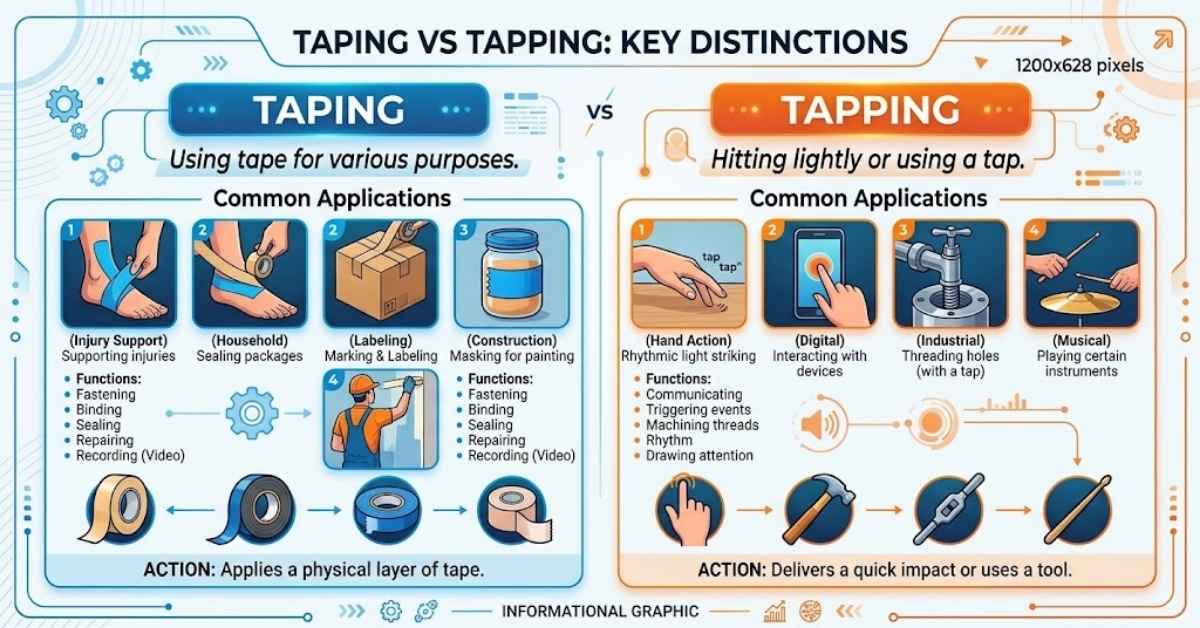
Taping vs tapping can be confusing because these words differ by only one letter, yet they have different meanings. Tapping comes from the verb tap and means touching or striking something lightly, such as tapping a phone screen or tapping your fingers on a desk.
Taping comes from the verb tape and usually means attaching or securing something with tape, or recording audio or video. The easiest way to remember the difference is this: tap becomes tapping, while tape becomes taping. Once you understand this simple spelling rule, you can choose the correct word confidently in everyday writing.
Taping vs. Tapping: The Quick Difference
Both words are correct in American English, but they are not interchangeable. The key difference is the action being described.
| Feature | Tapping | Taping |
|---|---|---|
| Base word | Tap | Tape |
| Meaning | Touching or striking lightly | Attaching something with tape or recording |
| Spelling rule | Double the final P | Drop the final E |
| Pronunciation | TAP-ing | TAY-ping |
| Common example | Tapping a phone screen | Taping a package shut |
| Figurative use | Tapping into new opportunities | Less common in figurative expressions |
Quick rule: If you mean touching, lightly striking, or accessing something, use tapping. If you mean attaching something with tape or recording something, use taping.
What Does Tapping Mean?
Tapping is the present participle of the verb tap. It describes making light contact with something, usually with a finger, hand, foot, or another object. Depending on the context, it can also mean selecting something on a digital screen, drawing liquid from a source, or making use of an available resource.
1. Tapping means touching or striking lightly
Tapping often describes a small, repeated movement that produces a light sound or makes brief contact.
Examples:
- She was tapping her fingers on the table while waiting.
- Someone was tapping on the door to get our attention.
- The rain kept tapping against the window throughout the night.
- He started tapping his foot to the rhythm of the music.
In each example, a person or object makes light contact with another surface. No adhesive tape is involved.
2. Tapping means touching a screen
In modern American English, tapping is especially common when describing smartphones, tablets, computers with touchscreens, and other digital devices.
Examples:
- She is tapping the screen to open the application.
- Tap the button to continue to the next page.
- I accidentally tapped the wrong icon on my phone.
- The user was tapping the screen several times because the app was not responding.
Notice the difference between these two sentences:
- Correct: He is tapping his phone screen.
- Different meaning: He is taping his phone screen.
The first describes touching the screen. The second suggests using tape on the screen, which is a different action.
3. Tapping can mean accessing resources
Tapping does not always describe a physical movement. It can also mean gaining access to or making use of something that is available.
The expression tapping into is particularly common in business, education, technology, and everyday communication.
Examples:
- The company is tapping into new markets to expand its business.
- Students can improve their skills by tapping into online learning resources.
- The organization is tapping into the experience of its employees.
- The project aims to tap into the community’s creativity.
In these sentences, nobody is physically tapping an object. The word describes using an opportunity, source, skill, or resource.
What Does Taping Mean?
Taping is the present participle of the verb tape. It commonly refers to using adhesive tape to attach, seal, cover, or secure something. It can also mean recording sound or video, especially in contexts where the traditional term remains established.
1. Taping means attaching or securing something
When you use adhesive tape to fasten two things together or hold an object in place, you are taping it.
Examples:
- She is taping a note to the wall.
- We spent the afternoon taping cardboard boxes for the move.
- He is taping the torn paper back together.
- The worker finished taping the package before shipping it.
In each case, tape is being used to attach, hold, or secure something.
2. Taping means recording audio or video
The word taping can also refer to recording a television program, interview, performance, or other event.
Although many recordings today are digital, the expression remains established in English.
Examples:
- The production team is taping an interview with the guest.
- We attended a taping of a television show.
- The crew spent the morning taping a special episode.
- The podcast’s live taping attracted a large audience.
In modern contexts, recording is often a more direct word when describing the creation of a digital video or audio file. However, taping remains appropriate in established expressions such as a television-show taping.
3. Taping in sports and practical settings
Taping is also used when adhesive or specialized athletic tape is applied to an area of the body for support or stabilization.
Examples:
- The athletic trainer was taping the player’s ankle.
- The coach checked the taping before practice.
- The athlete learned how to apply sports tape correctly.
This is still taping, because tape is being applied. The word does not mean lightly striking or touching the ankle.
Why Is Tapping Spelled With Two P’s?
The spelling becomes easier when you understand how English forms words ending in -ing.
The base word tap is a short, one-syllable word with a consonant-vowel-consonant pattern:
- T = consonant
- A = vowel
- P = consonant
When adding -ing to this type of short verb, English commonly doubles the final consonant.
The transformation is:
tap+ing→tapping
Other examples include:
| Base word | Correct -ing form |
|---|---|
| Clap | Clapping |
| Stop | Stopping |
| Run | Running |
| Sit | Sitting |
| Hop | Hopping |
| Tap | Tapping |
Therefore, tapping is the correct form when you mean the action described by the verb tap.
Writing taping when you mean repeatedly touching something changes the underlying word and can change the meaning of your sentence.
Why Is Taping Spelled With One P?
The word tape follows a different spelling pattern because it ends with a silent e.
When adding -ing to many verbs ending in a silent e, the final e is dropped.
The transformation is:
tape−e+ing→taping
This pattern appears in several familiar words:
| Base word | Correct -ing form |
|---|---|
| Make | Making |
| Write | Writing |
| Drive | Driving |
| Hope | Hoping |
| Save | Saving |
| Tape | Taping |
The final e disappears, but the remaining p is not doubled.
That is why taping has one P, while tapping has two.
LEARN MORE: Emasculate vs Demasculate
Taping vs. Tapping Examples in Sentences
The best way to understand the difference is to compare sentences in which the spelling changes the action being described.
| Tapping | Taping |
|---|---|
| She is tapping her fingers on the desk. | She is taping the paper to the desk. |
| He kept tapping the door. | He kept taping the cardboard box. |
| I was tapping the phone screen. | I was taping a note to the phone case. |
| The musician is tapping a rhythm. | The crew is taping an interview. |
| The company is tapping into new markets. | The worker is taping the package shut. |
How to correct common mistakes
Incorrect for the intended meaning: I was taping the screen to open the app.
Correct: I was tapping the screen to open the app.
Why? The action involves touching a digital screen, so the base verb is tap.
Incorrect for the intended meaning: She is tapping the poster to the wall with adhesive tape.
Correct: She is taping the poster to the wall with adhesive tape.
Why? She is attaching the poster using tape, so the base verb is tape.
A useful editing technique is to replace the disputed word with its base verb. If the sentence needs tap, use tapping. If it needs tape, use taping.
Common Mistakes to Avoid
1. Treating the words as alternative spellings
Taping and tapping are not regional variations of the same word. They come from different verbs and describe different actions.
2. Forgetting to double the P
When the intended verb is tap, the standard -ing form is tapping, not taping.
3. Keeping the E in taping
The standard form is taping, not tapeing. The final silent e is dropped before adding -ing.
4. Using the wrong word for digital actions
Touching a screen is normally described as tapping it. Attaching something to a screen with adhesive tape is taping it.
5. Overlooking figurative meanings
The expression tapping into resources means accessing or making use of them. It does not mean attaching something with tape.
Frequently Asked Questions
1. What is the difference between taping and tapping?
Tapping means touching or striking something lightly, selecting something on a touchscreen, or accessing a resource. Taping means attaching or securing something with tape or recording audio or video.
2. Is it tapping or taping a phone screen?
Use tapping when you touch the screen to select an icon, open an app, or press a digital button. Use taping only when you mean applying tape to the screen or attaching something to it.
3. Why does tapping have two P’s?
The verb tap follows a common consonant-doubling pattern when -ing is added. The final P doubles, producing tapping.
4. Why is taping spelled with one P?
The verb tape ends in a silent E. When -ing is added, the E is dropped, producing taping. The P is not doubled.
5. Is taping a real word?
Yes. Taping is the correct -ing form of tape. It can describe attaching something with adhesive tape or recording audio or video.
6. Does taping mean recording?
Yes. Taping can mean recording a television program, interview, or performance. In many modern digital contexts, recording is also a natural and direct choice.
7. What does tapping into resources mean?
Tapping into resources means accessing or making use of available resources, knowledge, skills, opportunities, or support. It is a figurative use of the verb tap.
8. Are tapping and taping pronounced differently?
Yes. In common American English pronunciation, tapping has a short A sound, as in cat, while taping has a long A sound, as in day. Listening for the vowel sound can help you distinguish the words.
Conclusion
The difference between taping vs tapping comes down to two different base verbs and two different actions. Use tapping when you mean lightly touching, striking, selecting, or accessing something. Use taping when you mean attaching something with tape or recording an event.
Remember the spelling rule: tap becomes tapping, while tape becomes taping. Once you recognize the action you want to describe, choosing the correct spelling becomes straightforward.