

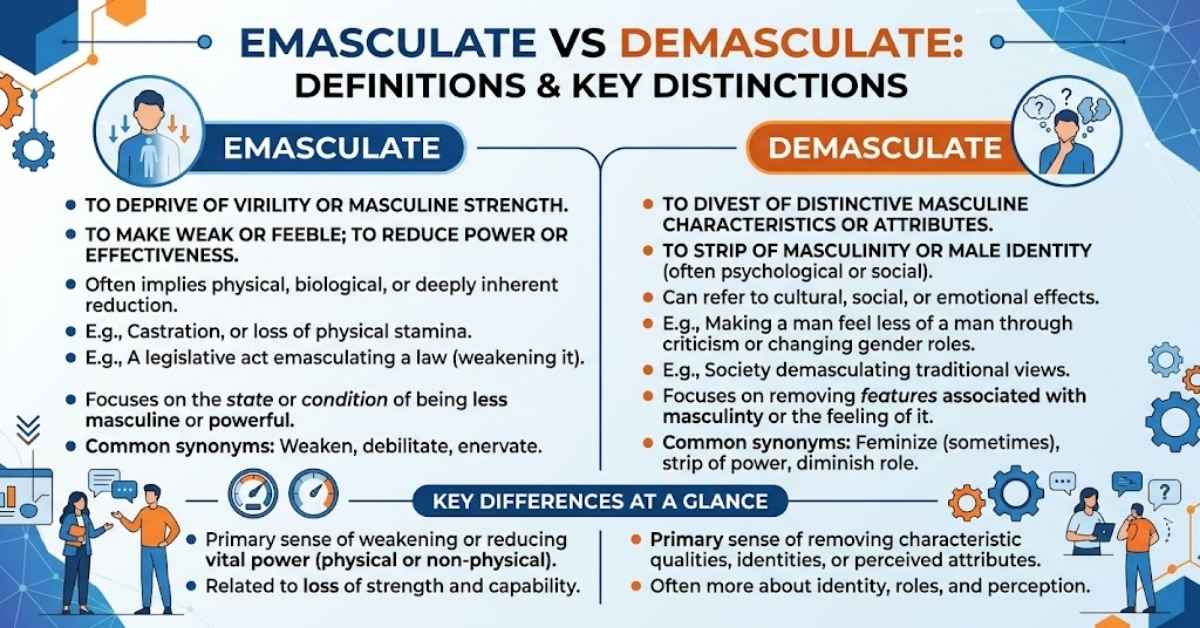
Emasculate vs demasculate is a common spelling and vocabulary question for writers who want to choose the correct word. In standard English, emasculate is the established word, while demasculate is rare and generally considered nonstandard in formal writing. Emasculate can mean to weaken someone’s confidence or authority, reduce the effectiveness of something, or, in a literal biological context, remove male reproductive capacity.
Although demasculate may look like a logical alternative because of the prefix “de-,” it is not the usual word for these meanings. If you are writing an essay, article, email, or professional report, emasculate is normally the safer and more accurate choice.
Emasculate vs Demasculate: The Quick Difference
The main difference between emasculate and demasculate is their status in standard English usage.
| Feature | Emasculate | Demasculate |
|---|---|---|
| Standard English usage | Established and recognized | Rare and generally nonstandard |
| Part of speech | Verb; also has an adjective use in dictionaries | Rarely encountered as a verb |
| Common meaning | To weaken, undermine, or deprive of strength or power | Usually intended to express a similar idea |
| Formal writing | Appropriate when the meaning fits | Generally best avoided |
| Recommended choice | Yes | Usually no |
Emasculate is recognized in major dictionaries, including Cambridge and Oxford. Its meanings include weakening a person or thing, undermining a man’s sense of masculinity, and removing male reproductive structures or characteristics in relevant biological contexts. The related word emasculation is a noun.
Demasculate, on the other hand, is not an established everyday alternative with the same level of recognition. Some online word references record rare usage, so it is more accurate to call it rare or generally nonstandard than to claim that it has never been used.
For ordinary American English, choose emasculate unless you have a specific reason to discuss the unusual form itself.
What Does Emasculate Mean?
Emasculate is a formal verb with several related meanings. It can describe weakening someone’s power, confidence, or authority; making a person feel deprived of masculine qualities; or removing male reproductive capacity in a literal context.
Understanding the context is important because the word can be used figuratively, biologically, politically, and scientifically.
1. To Weaken Someone’s Confidence or Authority
In everyday figurative usage, emasculate often describes making someone feel less powerful, confident, respected, or in control.
For example:
- Repeated public criticism made him feel emasculated in front of his colleagues.
- The manager’s refusal to let her team make decisions threatened to emasculate their authority.
- He felt emasculated when his contributions were repeatedly dismissed.
In these sentences, the word describes an emotional or social experience rather than a physical change.
The meaning can carry a strong emotional tone. Someone who feels emasculated may feel humiliated, undermined, powerless, or judged against expectations about masculinity. However, the word does not mean that a person’s actual identity or worth has objectively changed.
2. To Reduce the Effectiveness of Something
Emasculate can also describe weakening a law, policy, proposal, institution, or plan so that it loses some of its original force or effectiveness.
Examples:
- The final amendments emasculated the proposal, leaving it with few meaningful protections.
- Critics argued that the new restrictions would emasculate the agency’s authority.
- Excessive revisions emasculated the original argument by removing its strongest points.
This figurative meaning is useful in political reporting, legal commentary, academic writing, and business analysis.
When applied to an idea or institution, emasculate does not necessarily refer to masculinity. It means that something has been weakened or deprived of important strength or effectiveness.
Depending on the tone you want, alternatives such as weaken, undermine, dilute, diminish, or undermine the authority of may communicate the point more neutrally.
3. The Literal Biological Meaning
In a literal biological context, emasculate can refer to castrating a male or removing male reproductive parts. This is a specialized use rather than the meaning most readers encounter in everyday conversation.
In botany, the term has a separate technical application: removing the male reproductive parts, such as the stamens, from a flower to prevent self-pollination during controlled plant breeding.
For example:
- The breeder emasculated the flower before introducing pollen from the selected parent plant.
This technical meaning demonstrates why context matters. In a discussion about confidence, the word is likely figurative; in plant breeding, it can describe a specific scientific procedure.
What Does Demasculate Mean?
Demasculate is a rare form that some writers use when they intend to describe removing masculinity or weakening someone’s masculine identity. However, it is not the normal standard-English choice for that meaning.
The confusion is understandable. English frequently uses the prefix de- to express reversal, removal, or reduction, as in deactivate and devalue. A writer may therefore assume that adding de- to a form related to masculine creates the correct opposite of emasculate.
But English vocabulary does not always follow a predictable pattern. An apparently logical construction is not automatically an established standard word.
For example:
- Prefer in formal writing: The humiliating remarks made him feel emasculated.
- Generally avoid in formal writing: The humiliating remarks made him feel demasculated.
The first sentence uses the established verb. The second uses a rare, nonstandard form that may distract readers or be flagged by an editor.
If you want a more neutral alternative, you could write:
- The remarks undermined his confidence.
- The decision weakened his authority.
- The experience left him feeling powerless.
- The criticism made him feel humiliated.
These alternatives can be more precise because they describe the particular effect without relying on assumptions about masculinity.
Why Do People Confuse Emasculate and Demasculate?
Several factors explain why these words are easy to mix up.
1. The Prefix “De-” Seems Logical
The prefix de- often suggests removal, reversal, or reduction. Readers may assume that demasculate must be the correct word for removing masculinity.
However, standard usage depends on established vocabulary, not just logical word formation. English contains many words whose historical forms cannot be recreated simply by adding a familiar prefix.
2. Emasculate Is an Unfamiliar Word
Compared with everyday words such as weaken or undermine, emasculate is relatively formal. Someone who encounters it for the first time may try to reconstruct its spelling or meaning from the word masculine.
That can lead to a plausible-looking but nonstandard alternative.
3. Both Forms Look Similar
The two words share most of their letters, so a quick spell-check may not explain why one is the established choice. Writers who rely only on how a word looks may miss the difference in standard usage.
The solution is to check the word’s dictionary status and intended meaning rather than guessing from its appearance.
4. Online Usage Can Create Confusion
A word appearing in a social media post, forum, or informal glossary does not automatically make it appropriate for academic or professional writing.
Rare forms can circulate online without becoming standard vocabulary. When clarity matters, use the established term and choose a simpler synonym if the original word feels too formal.
Emasculate vs Demasculate Examples in Sentences
The following examples show how to choose a word that communicates the intended meaning clearly.
| Intended meaning | Recommended sentence |
|---|---|
| Undermining confidence | The constant ridicule made him feel emasculated. |
| Weakening authority | The new restrictions emasculated the committee’s decision-making powers. |
| Weakening a proposal | The extensive revisions emasculated the original plan. |
| Plant breeding | The researcher emasculated the flower before cross-pollination. |
| Describing humiliation without gendered language | The public criticism undermined his confidence. |
| Describing loss of control | The employee felt powerless after being excluded from every important decision. |
Notice that the last two examples avoid emasculate altogether. That may be the better choice when the intended meaning concerns confidence, dignity, or authority rather than masculinity specifically.
How to Correct a Sentence
Consider this sentence:
“His manager demasculated him by dismissing every idea he suggested.”
A more conventional version is:
“His manager emasculated him by dismissing every idea he suggested.”
However, a clearer and less emotionally loaded version might be:
“His manager repeatedly dismissed his ideas, undermining his confidence and authority.”
The best revision depends on your purpose. If you are discussing gender expectations or a person’s sense of masculinity, emasculated may be appropriate. If you simply mean that someone lost confidence or influence, a more specific expression may communicate the idea better.
LEARN MORE: Is It Brazil or Brasil?
Is Emasculate Always the Best Word?
Although emasculate is the standard choice in the comparison, it is not always the most precise word for every situation.
The word can sound strong, formal, or emotionally charged, particularly when applied to a person. In modern writing, it is worth asking whether you mean loss of confidence, loss of authority, humiliation, reduced effectiveness, or a literal biological change.
Choose a synonym that expresses your exact meaning.
| Alternative | Best used when you mean |
|---|---|
| Weaken | Reduce strength or effectiveness |
| Undermine | Gradually damage confidence, authority, or support |
| Humiliate | Make someone feel ashamed or degraded |
| Disempower | Reduce someone’s ability or authority to act |
| Diminish | Reduce importance, influence, or impact |
| Dilute | Make an argument, policy, or proposal less forceful |
| Castrate | Describe the specific literal biological act when accurate |
These words are not perfect substitutes in every sentence. For example, humiliate emphasizes embarrassment, while undermine focuses on weakening a person’s position or confidence. Select the word that best matches the actual situation.
Common Mistakes to Avoid
1. Treating demasculate as the standard spelling. The established word is emasculate. The alternative is rare and generally unsuitable for formal writing.
2. Assuming the prefix de- always creates the correct opposite. English vocabulary has historical conventions that cannot always be predicted from prefixes alone.
3. Using emasculate when you simply mean disagree. Disagreement does not necessarily weaken someone’s confidence or authority. Describe the actual effect rather than exaggerating it.
4. Confusing figurative and literal meanings. In ordinary conversation, emasculate often refers to confidence or power. In biological or botanical contexts, it can have a specific literal meaning.
5. Using gendered language when a neutral alternative is clearer. If the issue is loss of influence, undermine, weaken, or disempower may be more precise.
6. Assuming that a rare word is completely nonexistent. Rare forms can occur in informal or specialized sources. The practical question is whether the word is established and appropriate for the intended audience.
Frequently Asked Questions
1. What is the difference between emasculate and demasculate?
Emasculate is the established English word. It can mean to weaken someone or something, undermine a person’s confidence or authority, or remove male reproductive capacity in a literal context. Demasculate is rare and generally nonstandard, so it is usually avoided in formal writing.
2. Is demasculate a real word?
The form appears in some rare or informal usage, but it is not a standard everyday alternative to emasculate. For professional, academic, and carefully edited writing, use emasculate or a more precise synonym.
3. What does emasculate mean in simple English?
In simple terms, emasculate means to weaken or undermine someone or something. When used about a man, it can describe making him feel that he has lost power, confidence, or masculine status. The word also has specialized literal meanings.
4. What is the past tense of emasculate?
The past tense is emasculated. For example: “The changes emasculated the original proposal by removing its most important provisions.”
5. What is the noun form of emasculate?
The noun is emasculation. It can refer to the act or result of weakening someone or something, undermining authority, or a relevant literal biological process.
6. Can emasculate be used for a law or policy?
Yes. In figurative usage, emasculate can mean to reduce the force, authority, or effectiveness of a law, policy, proposal, or institution. For example: “The amendments emasculated the legislation.”
7. What are some synonyms for emasculate?
Depending on context, synonyms include weaken, undermine, diminish, disempower, dilute, and debilitate. If the meaning is specifically about embarrassment, humiliate may be more accurate.
8. Why do people write demasculate instead of emasculate?
The prefix de- often expresses removal or reversal, so demasculate may seem logically constructed. However, the established English word is emasculate. Familiarity with word formation does not guarantee that a newly formed expression is standard.
Conclusion
When comparing emasculate vs demasculate, the practical choice is clear: emasculate is the established standard English word, while demasculate is rare and generally nonstandard. Emasculate can describe weakening someone’s confidence or authority, reducing the effectiveness of a policy, or a specialized literal biological process.
If you are writing for an American audience, use emasculate when its meaning fits, or choose a more precise alternative such as undermine, weaken, or disempower. Understanding both the meaning and the context will help you write accurately and avoid an unnecessary vocabulary mistake.