

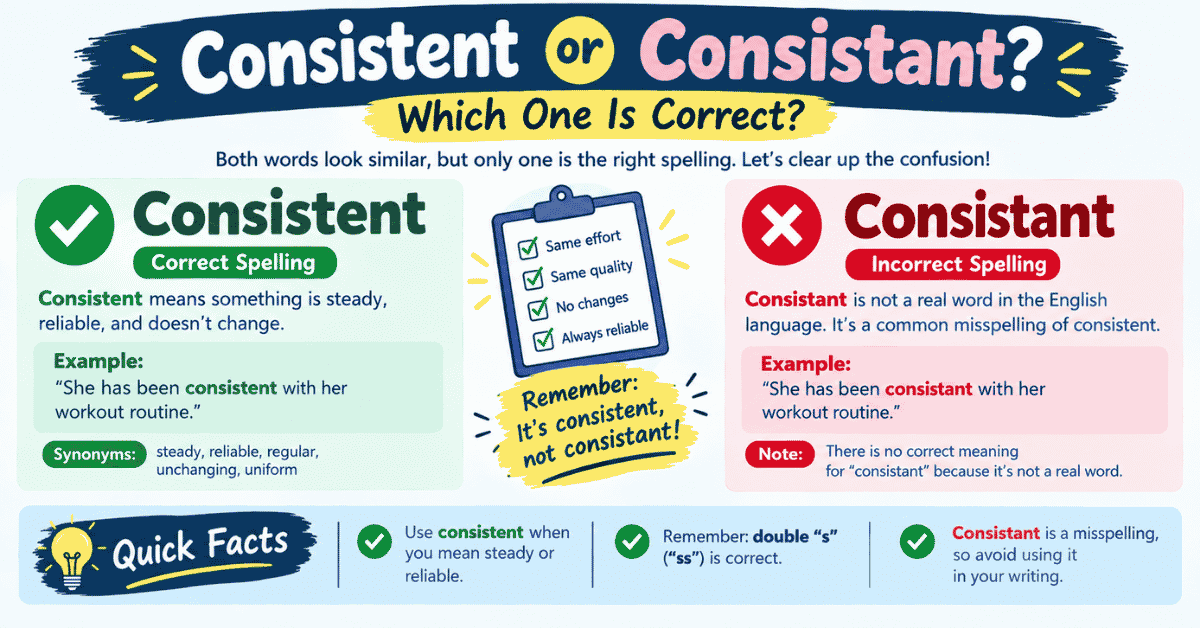
Consistent or consistant—which spelling is correct? Consistent is the only standard spelling when you mean steady, reliable, uniform or logically compatible. Consistant is a common misspelling and should be changed to consistent in American and British English.
The easiest spelling pattern to remember is:
consist + ent = consistent
The word ends in -ent, not -ant.
The Correct Spelling at a Glance
| Word | Correct? | Meaning |
|---|---|---|
| Consistent | Yes | Steady, regular, reliable or compatible |
| Consistant | No | A common misspelling of consistent |
Correct: Her work has been remarkably consistent.
Incorrect: Her work has been remarkably consistant.
If you are wondering how do you spell consistent or consistant, write it with an e in the final syllable: consistent.
What Does Consistent Mean?
Consistent is an adjective with several connected meanings. It can describe something that remains regular over time, agrees with other information or contains no internal contradiction.
Merriam-Webster associates the word with regularity, harmony, steady continuity and freedom from contradiction. Cambridge includes both repeated similar behavior and agreement with other facts. These meanings explain why the word appears in everyday, professional, scientific and logical contexts.
Regular or Reliable Behavior
The most common meaning of consistent is behaving or performing in a similar, dependable way over time.
- Ava is consistent with her exercise routine.
- The restaurant provides consistent service.
- He has been the team’s most consistent player.
- Regular practice leads to more consistent results.
In these examples, consistent does not mean perfect. It means that the person or result does not change unpredictably.
Agreement With Facts or Evidence
Consistent can also mean compatible with available information.
- Her statement is consistent with the security footage.
- The symptoms are consistent with seasonal allergies.
- These findings are consistent with earlier research.
- His explanation was not consistent with the known facts.
This construction expresses agreement or compatibility. It does not always prove that a conclusion is true. For example, symptoms may be consistent with several different conditions.
Freedom From Contradiction
An argument, belief or set of rules can be consistent when its parts do not contradict one another.
- The policy should be internally consistent.
- His final answer is consistent with his earlier reasoning.
- The two accounts are not mutually consistent.
- A logically consistent argument does not contradict itself.
This meaning frequently appears in philosophy, mathematics, law, research and formal reasoning.
Why Do People Write Consistant?
The spelling mistake is understandable because -ant and -ent are both common adjective endings.
Words ending in -ant include:
- important
- pleasant
- significant
- relevant
- constant
Words ending in -ent include:
- different
- dependent
- persistent
- excellent
- consistent
The final vowel often occurs in an unstressed syllable, which means the endings can sound similar in everyday speech. A writer who relies only on pronunciation may therefore choose the wrong vowel.
The similarity between constant and consistent creates additional confusion. Constant ends in -ant, but consistent ends in -ent.
How to Remember the Correct Spelling
Use this simple construction:
CONSIST + ENT = CONSISTENT
The complete word consist remains visible at the beginning. You only need to remember the ending -ent.
Another useful memory sentence is:
Excellent effort stays consistent.
Both excellent and consistent end in -ent.
You can also connect the word to its related forms:
- consistent
- consistently
- consistency
The same e appears throughout the word family.
Consistent, Consistently and Consistency
Understanding the word family can prevent several related spelling errors.
| Word | Part of speech | Meaning | Example |
|---|---|---|---|
| Consistent | Adjective | Regular, reliable or compatible | She produces consistent work. |
| Consistently | Adverb | In a regular or reliable manner | She consistently meets deadlines. |
| Consistency | Noun | The quality of being consistent | Her consistency earned trust. |
| Inconsistent | Adjective | Irregular or contradictory | The results were inconsistent. |
| Inconsistency | Noun | A lack of consistency | We found an inconsistency in the report. |
Consistently or consistantly?
Consistently is correct. Consistantly is incorrect.
- Correct: He consistently arrives on time.
- Incorrect: He consistantly arrives on time.
Consistency or consistancy?
Consistency is correct. Consistancy is a misspelling.
- Correct: Consistency is more valuable than occasional intensity.
- Incorrect: Consistancy is more valuable than occasional intensity.
Consistent With or Consistent To?
Use consistent with when describing agreement, compatibility or alignment.
- The decision is consistent with company policy.
- Your description is consistent with what we observed.
- The design is consistent with the brand’s visual identity.
- Her actions were not consistent with her promises.
Consistent to is generally not the standard construction for this meaning.
However, other prepositions may work in different sentence structures:
- Be consistent in your communication.
- She is consistent about enforcing the rules.
- He has been consistent throughout the season.
A useful distinction is:
- consistent with something
- consistent in doing something
Consistent Versus Constant
Consistent and constant are related, but they are not always interchangeable.
| Word | Core meaning | Example |
|---|---|---|
| Consistent | Regular, dependable or free from contradiction | She makes consistent progress. |
| Constant | Continuous, unchanging or occurring without stopping | The machine produces a constant hum. |
Someone who exercises consistently follows a reasonably regular pattern. They do not have to exercise constantly.
Compare:
- She gives consistent support whenever the team needs help.
- She needs constant support because assistance must always be available.
A business can deliver consistent quality across many orders without producing every item continuously.
Correct and Incorrect Sentence Examples
Everyday Examples
- Correct: I am trying to be more consistent with my sleep schedule.
- Incorrect: I am trying to be more consistant with my sleep schedule.
- Correct: The weather has been surprisingly consistent this week.
- Correct: His behavior is not consistent from one day to the next.
- Correct: Small, consistent actions can create meaningful progress.
Business and Résumé Examples
- Our team delivers consistent customer service.
- She maintained consistent sales growth across four quarters.
- I developed a consistent brand voice for all marketing channels.
- Managers should apply workplace policies consistently.
- The candidate demonstrated consistent attention to detail.
On a résumé, do not merely claim to be consistent. Connect the quality to evidence:
Maintained consistent on-time delivery across 50 client projects.
This is more persuasive than:
I am a very consistent worker.
Academic Examples
- Consistent study habits can improve long-term understanding.
- The teacher applied consistent grading standards.
- Your conclusion should be consistent with the evidence presented.
- Use consistent terminology throughout the paper.
- The student’s citation format was not consistent.
Scientific and Technical Examples
- The results were consistent across all three trials.
- The observations are consistent with the proposed explanation.
- Researchers followed a consistent methodology.
- The system produced consistent output under controlled conditions.
- The two measurements were not entirely consistent.
Remember that “consistent with” does not automatically mean “conclusive proof of.” It means the evidence is compatible with the stated possibility.
Is the Spelling Different in American and British English?
No. The accepted spelling is consistent in all major varieties of English.
- American English: consistent
- British English: consistent
- Canadian English: consistent
- Australian English: consistent
Consistant is not a British variant. It is normally a spelling or typing error.
Pronunciation of Consistent
In American English, consistent is commonly pronounced approximately:
kuhn-SIS-tuhnt
Its dictionary pronunciation is generally represented as /kənˈsɪstənt/.
The stress falls on the second syllable: SIS. Because the final vowel is unstressed, you may not clearly hear whether it should be written with an a or an e. That is why remembering consist + ent is more reliable than spelling purely by sound.
Synonyms for Consistent
The best synonym depends on the intended meaning.
For regular behavior or performance
- reliable
- dependable
- steady
- regular
- stable
- predictable
- uniform
The For agreement or compatibility
- compatible
- harmonious
- corresponding
- aligned
- coherent
For persistent effort
- persistent
- disciplined
- dedicated
- steadfast
These words are not perfect substitutes in every sentence. Predictable, for example, can sound negative, while dependable is usually positive.
Antonyms for Consistent
Common opposites include:
- inconsistent
- irregular
- unreliable
- erratic
- contradictory
- unstable
- unpredictable
- incompatible
Examples:
- The service became inconsistent during busy periods.
- His statements were contradictory.
- The machine produced irregular results.
LEARN MORE: Choosing or Chosing
Is Consistent Always Positive?
No. Consistent describes regularity or agreement, but the repeated quality can be positive, neutral or negative.
- Positive: She produces consistently excellent work.
- Neutral: The temperature remained consistent.
- Negative: The team was consistently late.
Being consistent does not necessarily mean being good. It means showing the same pattern reliably.
A Five-Second Proofreading Check
When you see consistant, use this framework:
- Find the base word consist.
- Add the correct ending -ent.
- Write consistent.
- Check related forms for the same e:
- consistently
- consistency
- inconsistent
- Ask whether you meant constant instead.
This correction works in emails, essays, résumés, reports, captions and website content.
Test Your Understanding
Choose the correct word in each sentence.
- Her performance has remained consistent / consistant.
- The evidence is consistent / constant with his statement.
- She consistently / consistantly meets her deadlines.
- The machine made a consistent / constant noise without stopping.
- The report contained an inconsistency / inconsistancy.
Answers
- consistent
- consistent
- consistently
- constant
- inconsistency
Frequently Asked Questions
Is it consistent or consistant?
Consistent is correct. Consistant is a misspelling and should not be used in standard English.
How do you spell consistent or consistant?
The correct spelling is c-o-n-s-i-s-t-e-n-t. Remember the construction consist + ent.
What is the consistent or consistant meaning?
Consistent means regular, reliable, uniform, compatible or free from contradiction. Consistant has no separate standard meaning because it is a misspelling.
Is consistant a real word?
Consistant may appear in informal writing, usernames or brand names, but dictionaries identify it as a misspelling when the intended word is consistent.
Why is consistent spelled with an e?
The established English spelling uses the -ent ending. Since the final syllable is usually unstressed, it can sound similar to -ant, causing the common error.
What is the noun form of consistent?
The noun form is consistency.
- Her consistency improved the team’s performance.
What is the adverb form of consistent?
The adverb is consistently.
- He consistently submits accurate work.
What is the opposite of consistent?
The direct opposite is inconsistent. Depending on context, alternatives include irregular, unreliable, contradictory and erratic.
Is consistent spelled differently in the UK?
No. Consistent is correct in both American and British English.
Should I use consistent with or consistent to?
Use consistent with to express agreement or compatibility:
- The findings are consistent with previous research.
What is the difference between consistent and constant?
Consistent means regular or dependable. Constant generally means continuous or unchanging. A person can exercise consistently without exercising constantly.
Final Spelling Reminder
Use consistent whenever you mean steady, regular, reliable, uniform or compatible. The form consistant is a spelling error.
CONSIST + ENT = CONSISTENT