

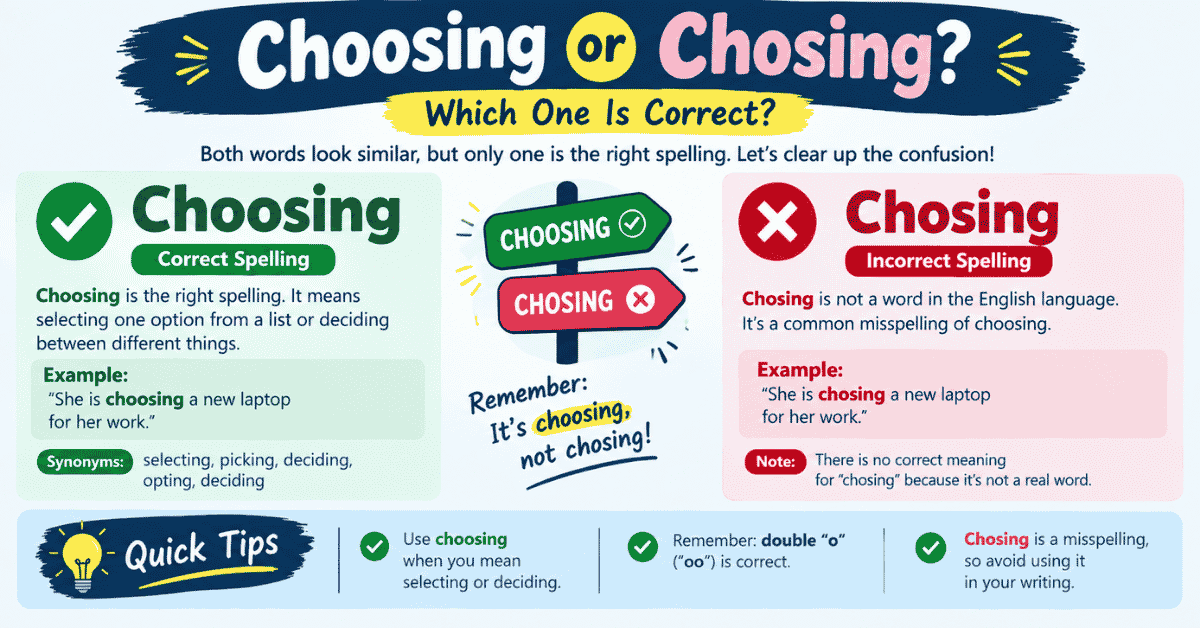
Choosing or chosing—which spelling should you use? Choosing is the correct spelling. Chosing is a common misspelling and should be corrected in standard American and British English.
Choosing is the -ing form of the verb choose, meaning to select, decide or pick between two or more possibilities. The correct transformation is choose − e + ing = choosing. You remove the final silent e, but you keep both o’s.
The short answer
| Word | Status | Meaning |
|---|---|---|
| Choosing | Correct | Selecting or deciding between options |
| Chosing | Incorrect | A misspelling of choosing |
Correct: We are choosing a new name for the project.
Incorrect: We are chosing a new name for the project.
If you are asking, “Is it choosing or chosing?”, the answer is always choosing when you mean making a choice.
Why choosing has two o’s
The spelling becomes easy when you start with the base verb:
choose + ing → choosing
More precisely:
- Begin with choose.
- Remove its final silent e.
- Add -ing.
- Keep the existing oo.
That produces choosing, not chosing.
This follows the familiar pattern used with many verbs ending in a silent e:
| Base verb | Remove final e | Add -ing |
|---|---|---|
| make | mak- | making |
| write | writ- | writing |
| use | us- | using |
| choose | choos- | choosing |
The rule removes the final e. It does not remove either o.
What does choosing mean?
Choosing means selecting, deciding or expressing a preference among available options.
Merriam-Webster defines choose as selecting freely after consideration or making a choice. Its listed forms include chose, chosen, and choosing. Merriam-Webster
Examples include:
- Maya is choosing a topic for her research paper.
- We are choosing between two health insurance plans.
- He spent the afternoon choosing a birthday gift.
- Choosing the cheaper option is not always the better decision.
- Customers are choosing products with less packaging.
Common synonyms include selecting, picking, deciding on, opting for and settling on. The best synonym depends on context. Picking usually sounds more casual, while selecting can sound more formal or deliberate.
Is choosing a verb or a noun?
Choosing can perform two grammatical jobs.
Choosing as a present participle
As a present participle, choosing helps form a progressive verb phrase. It usually appears with a form of be.
- I am choosing a new laptop.
- She is choosing her courses.
- They were choosing seats when we arrived.
In these sentences, choosing describes an action that is in progress.
Choosing as a gerund
As a gerund, choosing is an -ing verb form functioning like a noun.
- Choosing wisely takes patience.
- She enjoys choosing gifts for her family.
- Choosing a career can feel overwhelming.
In the first and third examples, the entire choosing phrase acts as the subject. In the second, it acts as the object of enjoys.
You do not need to identify the grammatical label during ordinary writing. In both uses, the spelling remains choosing.
Choose, chose, chosen and choosing
A major source of confusion is the irregular verb family. Chose and chosen legitimately contain one o, but choosing contains two.
| Form | Grammatical use | Example |
|---|---|---|
| Choose | Base or present form | I choose the blue one. |
| Chooses | Third-person present | She chooses carefully. |
| Chose | Simple past | We chose this plan yesterday. |
| Chosen | Past participle | They have chosen a winner. |
| Choosing | Present participle or gerund | She is choosing a dress. |
Choose versus chose
Use choose for a present action, command or infinitive:
- Please choose one answer.
- I usually choose tea.
- You need to choose carefully.
Use chose for a completed action in the past:
- I chose tea yesterday.
- The committee chose its finalist last week.
Chose versus chosen
Chose stands alone as the simple past form:
- We chose the larger room.
Chosen normally follows an auxiliary verb such as has, have or had:
- We have chosen the larger room.
- She had chosen before the deadline.
Choosing versus chosen
Use choosing for an ongoing activity or the general act of deciding:
- The panel is choosing a winner.
- Choosing a winner will take time.
Use chosen when the selection has been completed:
- The panel has chosen a winner.
- The chosen design will be announced tomorrow.
“Thank you for choosing” or “chosing”?
The correct phrase is:
Thank you for choosing us.
Not:
Thank you for chosing us.
After the preposition for, the gerund choosing fits naturally. Businesses commonly use the phrase to express appreciation after a purchase, booking, subscription or service decision.
Natural business examples
- Thank you for choosing us.
- Thank you for choosing our hotel for your stay.
- Thank you for choosing our team to manage your project.
- We appreciate you choosing our service.
- Thank you for choosing local.
- Thank you for choosing the annual plan.
More customer-focused alternatives
“Thank you for choosing us” is correct, but it can sound routine. A more specific message often feels warmer:
- Thank you for trusting us with your home.
- We appreciate the opportunity to support your business.
- Thanks for making us part of your trip.
- We’re glad you chose us and look forward to helping you.
Notice the final example uses chose because it refers to a completed decision.
Correct and incorrect examples
| Incorrect | Correct |
|---|---|
| I am chosing a new phone. | I am choosing a new phone. |
| She is chosing between two colleges. | She is choosing between two colleges. |
| Thank you for chosing our company. | Thank you for choosing our company. |
| Chosing the right answer takes time. | Choosing the right answer takes time. |
| They are chosing a team captain. | They are choosing a team captain. |
Everyday examples
- I’m choosing what to wear.
- Are you still choosing a movie?
- He had trouble choosing between the two offers.
- Choosing dinner should not be this difficult.
School examples
- The student is choosing a science project.
- Choosing reliable sources strengthens an essay.
- Before choosing an answer, read the entire question.
Professional examples
- The company is choosing a new software provider.
- Managers should explain the criteria used when choosing candidates.
- Choosing the lowest bid without reviewing quality can create additional costs.
Why do people spell choosing as chosing?
Three factors commonly produce the error.
1. Confusion with chose
The past tense chose has one o. Writers may incorrectly assume that the -ing form should follow the same pattern.
But these forms are created differently:
- choose → chose is an irregular tense change.
- choose → choosing is a regular suffix change.
2. Misapplying the silent-e rule
Writers correctly remember that a final silent e is normally dropped before -ing. They may accidentally remove an additional letter.
Only the final e disappears:
choose → choos + ing → choosing
3. Writing from sound
The pronunciation does not separately announce the two written o’s. Someone spelling entirely by sound may therefore type chosing.
The standard pronunciation is approximately CHOO-zing, represented as /ˈtʃuːzɪŋ/.
LEARN MORE: Courtesy or Curtesy
American and British spelling
There is no US–UK spelling difference here.
- American English: choosing
- British English: choosing
- Canadian English: choosing
- Australian English: choosing
Chosing is not a regional variant. If it appears in a post, message or informal publication, it is normally a typing or spelling error.
A memory trick that works
Remember this short line:
When choosing, keep the two choices—the two o’s.
You can also connect the word visually to its base form:
CHOOse → CHOOsing
Both words begin with choo.
For a grammar-based check, rebuild the word:
choose − e + ing = choosing
If you have written only one o, add the missing one.
Quick self-test
Choose the correct word for each sentence.
- We are choosing / chosing a new logo.
- She choose / chose the red coat yesterday.
- They have chose / chosen a supplier.
- Thank you for choosing / chosing our service.
- Choosing / Chosing carefully can prevent mistakes.
Answers
- choosing
- chose
- chosen
- choosing
- Choosing
Frequently asked questions
Is it choosing or chosing?
Choosing is correct. Chosing is a misspelling.
Which spelling is correct: choosing or chosing?
The correct spelling is choosing, with two o’s. It is the present participle and gerund form of choose.
How do you spell choosing?
Spell it c-h-o-o-s-i-n-g.
Is chosing a real word?
Chosing is not an accepted spelling of the -ing form of choose in standard English. It normally appears as a typo or misspelling.
Why does choosing keep two o’s?
Because both o’s belong to the base verb choose. When adding -ing, only the final silent e is removed.
Is choosing present or past tense?
Choosing is a present participle, but an -ing form does not establish tense by itself. Its helping verb supplies the time reference:
- She is choosing now.
- She was choosing yesterday.
- She will be choosing tomorrow.
What is the past tense of choosing?
The simple past form of choose is chose:
- Present: I choose carefully.
- Past: I chose carefully.
Is it “thank you for choosing us” or “chosing us”?
Write “Thank you for choosing us.” The spelling chosing is incorrect.
Is choosing spelled differently in the UK?
No. Choosing is standard in both US and UK English.
What is the difference between choosing and picking?
Both can mean selecting something. Picking often sounds more casual, while choosing may suggest comparison or deliberate thought. However, they overlap in many everyday contexts.
Final spelling reminder
Use choosing whenever you mean selecting, deciding or making a choice. Never remove either o.
Choose − e + ing = choosing