

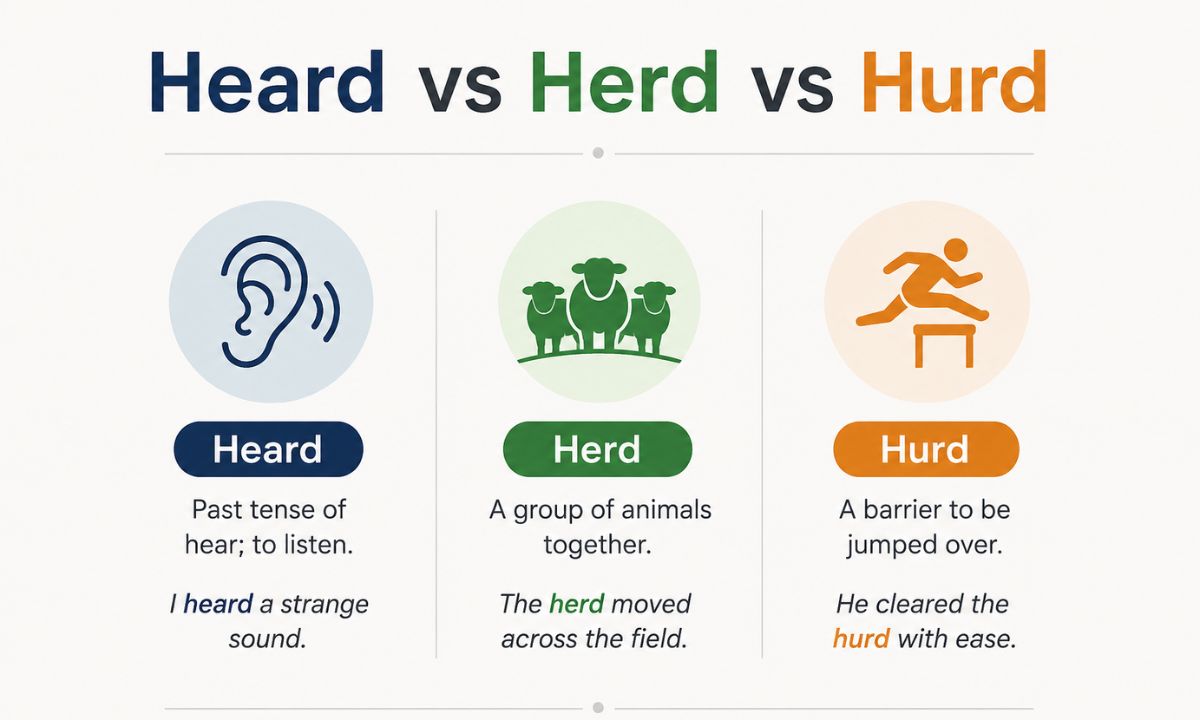
English is full of words that sound alike but have completely different meanings, and Heard vs Herd vs Hurd are a perfect example. Although these words may sound similar in many English accents, they have different meanings, spellings, and uses. Therefore, choosing the correct word is important, especially in formal or professional writing. Even a simple spelling mistake can change the meaning of a sentence and, as a result, make your writing appear less polished.
Among these three words, heard and herd are common English words that appear frequently in both everyday conversations and written English. In contrast, hurd is much less common and is usually used as a surname or proper noun rather than as a standard vocabulary word. For example, English learners sometimes write I herd you when they actually mean I heard you. As a result, this small spelling error can make an otherwise correct sentence grammatically incorrect.
Moreover, understanding the difference between these words can help you communicate more clearly. Whether you are writing an email, preparing for an English exam, creating professional content, or simply improving your grammar, knowing when to useHeard vs Herd vs Hurd is essential. In addition, learning their meanings through real life examples makes the differences easier to remember.
In this guide, we will explain each word in detail and show how it works in everyday English. Furthermore, you will learn when to use each term, see practical examples, identify common mistakes, and discover simple memory tricks. Ultimately, these tips will help you remember the correct spelling and use Heard vs Herd vs Hurd confidently in both speaking and writing.
What Does “Heard” Mean?
Heard is the past tense and past participle of the verb “hear.” It means to receive or notice a sound through your ears or to become aware of information by listening or being told.
It is one of the most commonly used irregular verbs in English and appears in everyday conversations, books, news articles, and professional writing.
Simple Definition
Heard = The past tense of “hear,” meaning you listened to or became aware of something.
Unlike many regular verbs that end in ed, hear changes to heard, making it an irregular verb that must be memorized.
Common Uses of “Heard”
You can use heard when talking about:
- Listening to a sound
- Receiving news
- Being informed about something
- Understanding spoken words
- Hearing music, voices, or noises
- Learning information from another person
Examples
- I heard someone knocking at the door.
- She heard the baby crying upstairs.
- Have you heard the latest news?
- We heard birds singing early this morning.
- He heard his name during the meeting.
- They heard a strange noise outside the house.
- I heard your presentation yesterday.
- She has heard that the company is hiring new employees.
In each sentence, heard refers to receiving sound or information.
Common Expressions with “Heard”
The word heard appears in many everyday English expressions.
Some common examples include:
- heard a rumor
- heard the news
- heard someone speaking
- heard from a friend
- heard on the radio
- heard on television
- heard through the grapevine
- heard a loud noise
- heard the announcement
- heard someone calling my name
These phrases are natural in both spoken and written English.
Example Sentences
- I heard from my cousin yesterday.
- We heard the announcement before boarding the plane.
- She heard a rumor about the new manager.
- Everyone heard the applause after the performance.
- I heard on the news that fuel prices are decreasing.
Grammar Note
Because heard is the past form of hear, it is used with both simple past and present perfect tenses.
Simple Past
- I heard a loud crash.
- They heard the alarm immediately.
Present Perfect
- I have heard that story before.
- She has heard about the new policy.
Past Perfect
- We had heard the news before arriving.
- He had heard the warning but ignored it.
Using heared is incorrect because hear is an irregular verb.
❌ Heared
✅ Heard
Common Mistakes with “Heard”
Many learners confuse heard with herd because both words sound almost identical.
Incorrect:
- I herd a strange noise.
Correct:
- I heard a strange noise.
Another common mistake is writing:
❌ I have heared it.
The correct sentence is:
✅ I have heard it.
Remember that irregular verbs do not follow the standard ed pattern.
What Does “Herd” Mean?
Unlike heard, which relates to listening, herd is primarily a noun that refers to a group of animals living, feeding, or moving together. It can also be used as a verb, meaning to gather, move, or control a group of animals or people.
The word is most commonly associated with livestock such as cows, sheep, goats, buffalo, deer, or elephants, but it can also be used figuratively to describe groups of people moving together in an unorganized way.
Simple Definition
Herd = A group of animals, or the act of gathering and controlling them.
Common Animals Found in a Herd
- Cows
- Buffalo
- Deer
- Goats
- Sheep
- Elephants
- Antelope
- Horses
- Reindeer
Although birds usually travel in a flock and fish swim in a school, many large land animals travel in a herd.
Examples
- A herd of elephants crossed the river.
- The farmer owns a large herd of cattle.
- We saw a herd of deer in the forest.
- The guide pointed toward a herd of wild buffalo.
- The sheep stayed close to the herd for protection.
In all of these examples, herd refers to a group of animals.
“Herd” as a Verb
As a verb, herd means to move, gather, or guide animals or sometimes people from one place to another.
Examples:
- The shepherd herded the sheep into the barn.
- Cowboys herd cattle across open fields.
- Rangers carefully herded the elephants away from the village.
- Security officers herded the crowd toward the exit.
When used with people, herd often suggests moving a group quickly or with little individual control.
Common Expressions with “Herd”
Some frequently used phrases include:
- herd of cattle
- herd of elephants
- herd mentality
- herd behavior
- herd immunity
- herd animals
- herd together
- herd management
These expressions appear in science, business, psychology, farming, economics, and everyday English.
What About “Hurd”?
If you’ve searched for heard vs. herd vs. hurd, you might be wondering whether hurd is actually an English word. The short answer is yes but not in the way many people think.
Unlike heard and herd, hurd is not a standard English vocabulary word used in everyday grammar. Most of the time, it appears as a surname (last name) or as part of a proper noun, such as the name of a person, place, or organization.
Because heard and herd are pronounced similarly, some people mistakenly spell heard as hurd. In normal writing, however, this spelling is almost always incorrect.
Simple Definition
Hurd = Usually a proper noun (surname or name), not a common English word used in everyday sentences.
For example:
- John Hurd was a respected professor.
- The Hurd family has lived in this town for generations.
- The award was presented by Dr. Hurd.
In these examples, Hurd is a name rather than a vocabulary word.
Is “Hurd” Ever Correct?
Yes, but only in specific situations.
You should use Hurd when referring to:
- A person’s last name
- A company or organization with “Hurd” in its name
- A geographical location named Hurd
- Historical references involving someone named Hurd
Outside these situations, hurd is generally not the correct spelling.
For instance:
❌ I hurd a strange sound.
✅ I heard a strange sound.
This is one of the most common spelling mistakes made by English learners because the pronunciation is so similar.
Heard vs Herd vs Hurd
Although these three words may sound alike, their meanings are completely different. Understanding their differences makes it much easier to choose the correct word in writing.
| Word | Part of Speech | Meaning | Example |
| Heard | Verb (past tense of hear) | Listened to or became aware of something | I heard the phone ring. |
| Herd | Noun / Verb | A group of animals or the act of gathering them | A herd of cows crossed the road. |
| Hurd | Proper Noun | Usually a surname or name | Professor Hurd gave the lecture. |
Quick Comparison
Think about what you’re trying to say:
- Talking about listening? → Heard
- Talking about animals or groups? → Herd
- Talking about someone’s name? → Hurd
This simple rule will help you avoid most mistakes.
Why People Confuse These Words
There are several reasons why these words are mixed up.
They Sound Similar
In many English accents, heard and herd are pronounced almost exactly the same. Because English has many homophones (words that sound alike but have different meanings), learners often rely on pronunciation instead of spelling.
Spell Check Doesn’t Always Help
If you accidentally write:
I herd the news yesterday.
Your spell checker may not flag the mistake because herd is a correctly spelled English word. The problem is grammatical, not spelling related.
Fast Typing
When typing quickly, people often choose the wrong word without noticing.
For example:
- I herd you yesterday.
- Have you herd about it?
These mistakes are common in emails, social media posts, and text messages.
English Has Many Similar Word Pairs
Words like these are common:
- Their / There / They’re
- Your / You’re
- To / Too / Two
- Hear / Here
- Heard / Herd
Because English contains so many confusing word pairs, careful proofreading is important.
Heard vs Herd in Sentences (Examples)
The easiest way to remember the difference is to see the words in real sentences.
Examples of “Heard”
- I heard someone calling my name.
- She heard the thunder before the rain started.
- Have you heard the latest news?
- We heard beautiful music at the concert.
- They heard the teacher’s instructions clearly.
- I heard a dog barking outside.
- He heard the door close behind him.
- Everyone heard the announcement.
Examples with “Herd”
- A herd of elephants crossed the road.
- The farmer owns a large herd of sheep.
- We watched a herd of deer in the forest.
- The cowboy herded the cattle into the field.
- Rangers herded the animals to a safer location.
- The herd stayed together during the storm.
- A herd of buffalo grazed peacefully.
- The guide pointed toward a distant herd.
“Hurd”Examples
- Mr. Hurd will lead today’s meeting.
- Sarah Hurd published a new research paper.
- The Hurd family attended the ceremony.
- We met Professor Hurd at the conference.
Notice that every example uses Hurd as a name rather than a common vocabulary word.
Common Mistakes to Avoid
Here are some mistakes that English learners frequently make.
❌ I herd the news yesterday.
✅ I heard the news yesterday.
❌ We heard a herd of music.
✅ We heard music.
❌ The farmer heard his cows across the field.
✅ The farmer herded his cows across the field.
❌ I hurd someone knocking.
✅ I heard someone knocking.
A Quick Self Test
Choose the correct word.
- I a loud noise last night.
- A of deer crossed the highway.
- Professor published a new book.
- Have you about the new policy?
- The shepherd the sheep into the barn.
Answers
- heard
- herd
- Hurd
- heard
- herded
Practicing with examples like these helps reinforce the correct usage much more effectively than memorizing definitions alone.
Pronunciation Differences
One of the biggest reasons people confuseHeard vs Herd vs Hurdis that they are pronounced almost the same in most English accents. When spoken quickly, it can be difficult to tell which word someone means without considering the context.
Because of this, writers often make spelling mistakes even though they know the correct meaning. The key is to remember that pronunciation alone cannot help you choose the right spelling you must think about the meaning of the sentence.
Do They Sound the Same?
In both American and British English:
- Heard sounds like herd.
- Hurd (when used as a surname) is usually pronounced the same as heard and herd.
These words are examples of homophones, which are words that share the same pronunciation but have different meanings and spellings.
Why Context Matters
Consider these sentences:
- I heard a loud crash.
- A herd of cows crossed the road.
- Professor Hurd gave today’s lecture.
Although the highlighted words sound alike, each has a completely different meaning. The surrounding words tell you which spelling is correct.
Trick to Remember the Difference
Learning a simple memory trick can save you from making these common mistakes.
Trick Think About the Letter A
The word heard contains the word hear.
- Hear → Heard
If the sentence is about listening, sounds, or receiving information, choose heard.
Example:
- I heard someone singing.
Trick Think About Animals
The word herd is connected with groups of animals.
Whenever you read words like:
- cows
- sheep
- elephants
- deer
- buffalo
- goats
the correct word is almost always herd.
Example:
- A herd of elephants crossed the road.
Trick Remember That “Hurd” Is Usually a Name
If you’re writing about a person named Hurd, then the spelling is correct.
Otherwise, you probably meant heard.
Example:
- Dr. Hurd published a new book.
Trick Ask Yourself One Question
Before choosing the word, ask:
Am I talking about hearing something?
✔ Yes → Heard
Am I talking about animals moving together?
✔ Yes → Herd
Am I writing someone’s name?
✔ Yes → Hurd
This simple question eliminates almost every mistake.
Regional Usage: British vs American English
Unlike many confusing word pairs, heard and herd have the same meanings in both British and American English.
There is no difference in grammar or usage between the two varieties of English.
For example:
American English:
- I heard the news yesterday.
- A herd of cattle crossed the highway.
British English:
- I heard the news yesterday.
- A herd of cattle crossed the road.
The only noticeable difference may be pronunciation depending on regional accents, but the spelling and meanings remain exactly the same.
Similarly, Hurd remains a surname or proper noun regardless of the country.
Common Mistakes Heard vs Herd vs Hurd
Even experienced writers occasionally confuse these words because they sound alike. Here are some of the most frequent mistakes and how to avoid them.
Mistake Writing “Herd” Instead of “Heard”
Incorrect:
- I herd your message yesterday.
Correct:
- I heard your message yesterday.
Remember, if the sentence is about listening or receiving information, the correct word is heard.
Mistake Using “Hurd” in Everyday Writing
Incorrect:
- I hurd someone laughing.
Correct:
- I heard someone laughing.
Unless you’re referring to a person’s surname, Hurd is rarely the correct choice.
Mistake Forgetting That “Herd” Can Be a Verb
Many people know herd as a noun but forget that it can also be used as a verb.
Example:
- The shepherd herded the sheep into the barn.
Here, herded means guided or moved a group of animals.
Mistake Depending Only on Pronunciation
Because all three words sound nearly identical, choosing the spelling based only on pronunciation often leads to mistakes.
Instead, focus on the meaning of your sentence.
Summary Table of Heard vs Herd vs Hurd
| Word | Meaning | Part of Speech | Common Context |
| Heard | Received sound or information | Verb | Listening, news, conversations |
| Herd | A group of animals or gathering animals | Noun / Verb | Farming, wildlife, biology |
| Hurd | Usually a surname or proper noun | Proper Noun | Names of people or places |
Quick Practice Quiz of Heard vs Herd vs Hurd
Choose the correct word to complete each sentence.
- We the fireworks from our backyard.
- The farmer owns a large of goats.
- Mrs. will be speaking at the conference.
- Have you about the new movie?
- Rangers carefully the elephants away from the village.
Answers
- heard
- herd
- Hurd
- heard
- herded
If you answered all five correctly, you’ve mastered the basic difference between these commonly confused words.
.
Frequently Asked Questions (Heard vs Herd vs Hurd)
What is the difference between Heard, Herd, and Hurd?
Heard relates to listening, while herd means a group of animals. However, hurd usually refers to a hurdle or barrier in specific contexts.
Is “heard” the past tense of “hear”?
Yes. Heard is the past tense of hear. For example, “I heard a strange sound.”
What does “herd” mean?
Herd means a group of animals that live or move together. For example, “The herd crossed the field.”
Is “hurd” a correct English word?
Generally, hurd is not a common modern English word. Instead, hurdle is the usual word for a barrier or obstacle.
Why are heard and herd confused?
Both words sound alike in many accents. Therefore, their spelling and meaning must be checked from the context.
How can I remember heard vs herd?
Think of heard with ear because it relates to hearing. Meanwhile, herd refers to animals grouped together.
Final Thoughts
AlthoughHeard vs Herd vs Hurdmay sound alike, they serve very different purposes in English. Heard is the past tense of hear and relates to listening or receiving information. Herd refers to a group of animals or the act of guiding them, while Hurd is generally a proper noun used as a surname or place name rather than a common vocabulary word.
By understanding these distinctions and practicing with real life examples, you’ll write with greater confidence and accuracy. Whether you’re a student, professional writer, or English learner, mastering these commonly confused words will improve both your grammar and your communication skills.