

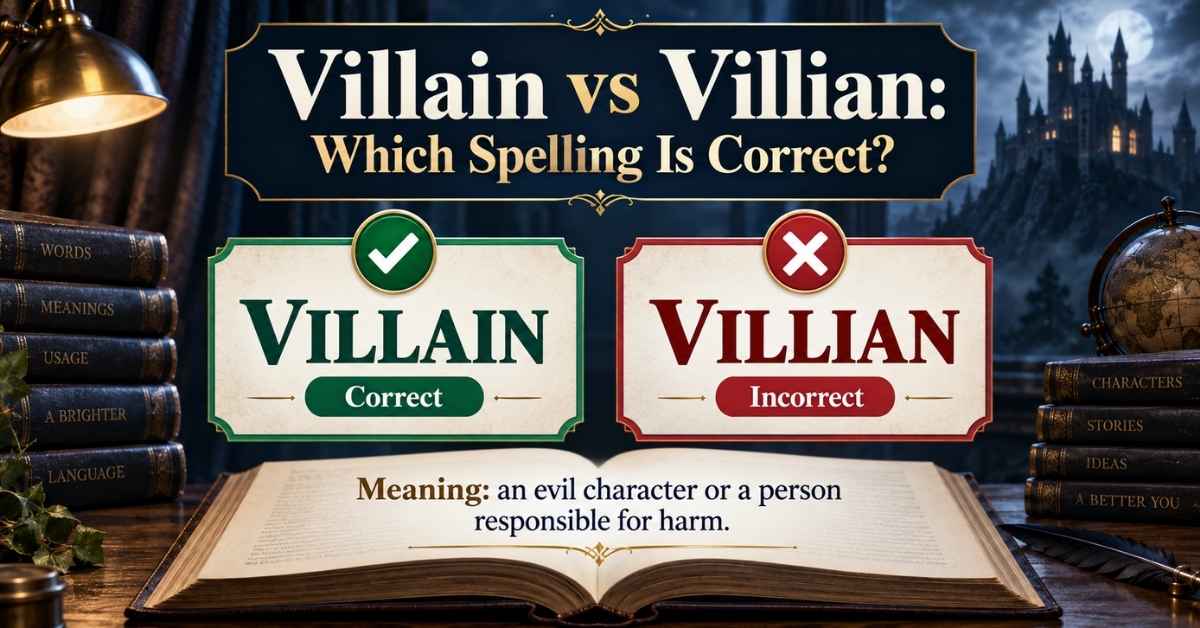
Villain vs villian — if you’ve paused mid-sentence wondering which one looks right, you’re in good company. Both versions look almost identical at first glance, and that’s exactly why this mix-up ranks among the most common spelling mistakes in English.
Here’s the direct answer: “villain” is correct, and “villian” is a misspelling. No major dictionary — not Oxford, not Cambridge, not Merriam-Webster — recognizes “villian” as a real word. The confusion comes down to one simple thing: the letters “a” and “i” swap places, and once you know the correct order, you’ll never second-guess it again.
This guide breaks down the real meaning of villain, where the word actually came from, why so many writers flip those letters, and how to lock in the correct spelling for good.
Villain or Villian: The Quick Answer
If you remember just one rule, make it this one: villain uses “ai,” not “ia.”
| Spelling | Correct? | Why |
|---|---|---|
| Villain | ✅ Yes | Standard, dictionary-recognized spelling |
| Villian | ❌ No | Common misspelling from reversed vowel order |
There’s no regional split here either. Unlike “color” versus “colour,” both American and British English spell it the same way: villain.
Why Do People Write “Villian” Instead of “Villain”?
This error isn’t random guessing. A few clear patterns explain why it happens so often:
- Vowel-order confusion — English speakers hear “vil-yan” when the word is spoken aloud, and the sound doesn’t clearly reveal whether “a” or “i” comes first.
- Fast typing — The letters sit close together conceptually, so quick typists sometimes swap them without noticing.
- Social media repetition — Once “villian” shows up often enough in posts and comments, some readers assume it’s an accepted variant, even though it isn’t.
- Learner unfamiliarity — ESL learners and younger writers often haven’t seen the word enough times in print for the correct spelling to feel automatic.
None of these reasons make “villian” acceptable in formal writing, but they explain why the mistake keeps spreading.
What Does “Villain” Actually Mean?
A villain is a person — real or fictional — who behaves in a cruel, dishonest, or evil way. In stories, movies, and games, the villain typically serves as the main opponent of the hero.
The word shows up across a few clear contexts:
- Fiction and film — The villain drives conflict against the protagonist (think comic book antagonists or movie bad guys).
- Real-life description — News writers sometimes call a person, company, or policy “the villain” of a situation to describe blame or harm.
- Metaphorical use — Abstract things like greed, pollution, or corruption often get labeled “the villain” in essays and speeches.
- Everyday speech — People jokingly call a friend “the villain of the story” during a lighthearted argument.
Where Does the Word “Villain” Come From?
The word traces back to the Old French word vilain, which itself came from the Latin villanus — meaning a person who lived and worked on a country estate or farm. Originally, it simply described a peasant or farm worker, with no evil connotation at all.
Over time, medieval writers began portraying villagers as rough, uncivilized, or dishonest characters in stories. That stereotype stuck, and the meaning gradually shifted from “farm worker” to “wicked person.” By the time the word settled into modern English, “villain” meant exactly what it means today: someone who does harm on purpose.
How to Use “Villain” Correctly in a Sentence
Here are a few natural examples showing the word in action:
- The villain plotted to take over the kingdom before the hero stopped him.
- Every great superhero story needs a villain worth remembering.
- The journalist described the corporation as the villain of the pollution crisis.
- She jokingly called her brother the villain of the family group chat.
Notice how the word works just as well in serious fiction as it does in casual, everyday conversation.
Villain vs Similar Words
A few related words often get grouped with villain, even though the meanings shift slightly.
- Villain vs. antagonist — An antagonist opposes the main character but isn’t always evil. A villain is specifically wicked or harmful.
- Villain vs. rogue — A rogue often has a mischievous, charming edge, while a villain carries a more clearly negative, harmful intent.
- Villain vs. scoundrel — Scoundrel leans toward dishonesty and trickery, while villain covers a broader range of harmful behavior, including violence.
- Villain vs. antihero — An antihero lacks traditional heroic qualities but still fights for good, unlike a villain, who works against it.
Common LSI Keywords Related to Villain
If you’re researching this word for writing or SEO purposes, here are terms commonly associated with it:
- Antagonist
- Bad guy
- Wrongdoer
- Evildoer
- Rogue
- Scoundrel
- Criminal
- Hero (opposite)
These words help map out the full range of meaning around “villain,” from lighthearted to genuinely sinister.
Memory Tricks to Avoid Misspelling It
Try one of these simple tricks if “villian” keeps slipping into your writing:
- Break the word into two chunks: VILL + AIN. Villains often cause pain, and both words share that “ain” ending — an easy mental link.
- Remember the rule directly: it’s “ai” before “n,” never “ia.”
- Run the word through a spell-checker once. Watching “villian” get flagged repeatedly trains your eye to catch it before you hit publish.
LEARN MORE: Stary or Starry
Is “Villian” Ever Acceptable to Use?
Not in formal writing, professional content, school assignments, or anything meant for publication. No standard dictionary lists it, and most spell-checkers flag it instantly.
A quick text to a friend won’t cause any real damage if the wrong spelling slips through occasionally. Still, the goal is knowing the correct form so it never appears in an article, resume, or anything representing your work professionally.
“Every good story needs a villain, but the best ones make you understand why.” This idea shows up again and again across storytelling advice — a well-built villain isn’t just correctly spelled, they’re memorable for a reason.
FAQs About Villain or Villian
Q: Villain vs villian — which is correct? A: “Villain” is always correct. “Villian” is a common misspelling caused by reversing the letters “a” and “i,” and no standard dictionary recognizes it.
Q: Spelling villain or villian — how do I remember it? A: Break the word into “VILL” and “AIN.” Villains cause pain, and both words end in “ain” — a simple, memorable connection.
Q: Is it villain or villian which is correct for formal writing? A: Villain is the only acceptable spelling in formal, professional, or published writing. Villian will get flagged by nearly every spell-checker and style guide.
Q: What does villain mean? A: A villain is a person, real or fictional, who acts in a cruel, dishonest, or harmful way — most often the main opponent of a story’s hero.
Q: Why do so many people misspell villain as villian? A: The pronunciation doesn’t clearly reveal letter order, so writers guess based on sound rather than spelling rules, and the mistake spreads further through social media.
Q: Does villain have different spellings in British and American English? A: No. Unlike words such as “color” and “colour,” villain stays exactly the same across every major English dialect.
Final Thoughts
So, villain vs villian — which one wins? Villain, every time. Villian isn’t a recognized word in any standard dictionary, no matter how often it shows up online. Now that you know the correct spelling, where the word came from, and a simple trick to remember it, that moment of hesitation shouldn’t slow you down again.
If this cleared things up, take a look at other commonly confused word pairs too, like “discard vs disgard” or “reinforce vs reenforce.” They follow the exact same kind of pattern, and even careful writers trip over them without a quick refresher.