

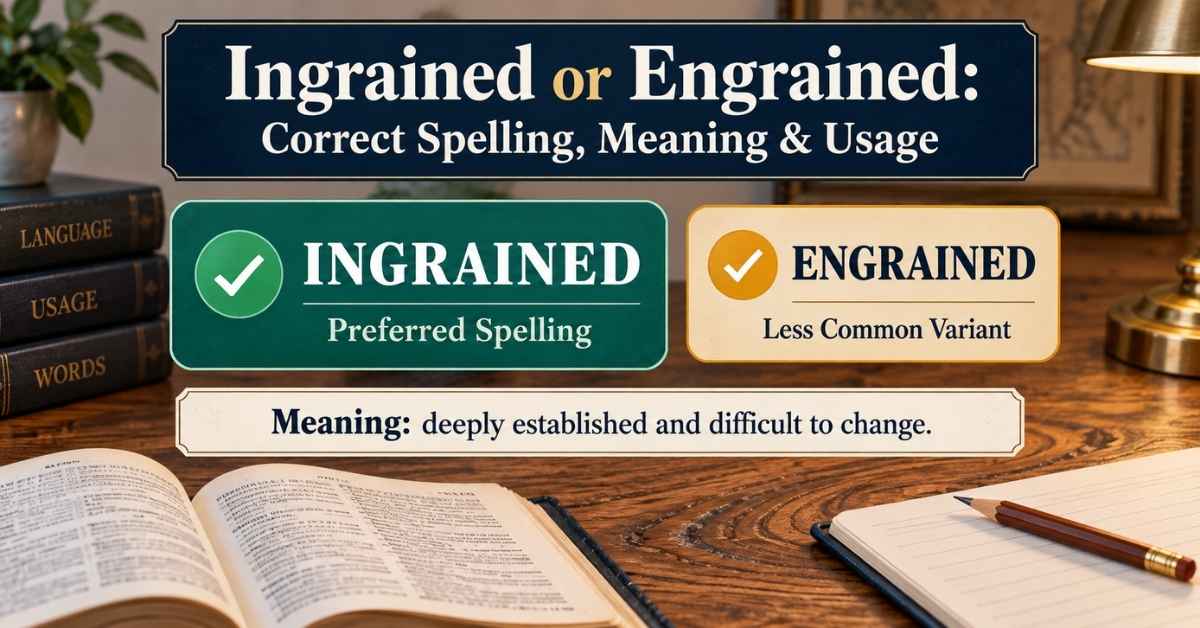
Ingrained or engrained — if you’ve paused mid-sentence wondering which one is right, you’re not alone, and here’s the short answer: ingrained is the correct and modern spelling. Engrained isn’t wrong exactly, but it’s the older, far less common cousin that’s mostly faded out of everyday writing.
Both words are pronounced exactly the same way, which is precisely why so many writers second-guess themselves at the keyboard. If you’ve ever typed one, deleted it, then typed the other — you already know the feeling.
This guide breaks down the ingrained or engrained meaning, where the confusion comes from, when (if ever) engrained is acceptable, and how to use the correct word with total confidence.
Quick Answer
| Question | Answer |
|---|---|
| Is it ingrained or engrained? | Ingrained — it’s the standard, modern spelling |
| Is engrained ever correct? | Yes, technically, but it’s rare and dated |
| Do they mean the same thing? | Yes — identical meaning, different age |
| Which should I use in formal writing? | Always ingrained |
Ingrained or Engrained: What’s the Difference?
Here’s the part that trips people up: ingrained or engrained difference isn’t really about meaning at all — it’s about usage frequency and era. Both words trace back to the same root and describe something so deeply embedded it’s difficult, if not impossible, to change.
The real distinction comes down to this:
- Ingrained is the spelling modern dictionaries, editors, and style guides recommend
- Engrained is a legitimate but old-fashioned variant that has quietly fallen out of favor
Think of it the same way you’d think of “grey” and “gray” — both technically valid, but one dominates in contemporary writing.
What Does Ingrained Mean?
Ingrained describes something deeply fixed, rooted, or embedded — so thoroughly established that it feels like a permanent part of a person, culture, or object. Picture a dark stain that’s worked its way into the fibers of white fabric. No amount of scrubbing removes it. That’s exactly the feeling ingrained conveys in language: permanent, deep, and stubborn.
Common ways you’ll see it used:
| Phrase | Meaning |
|---|---|
| Ingrained habits | Behaviors built up over years of repetition |
| Ingrained beliefs | Values absorbed since childhood |
| Ingrained bias | Attitudes so deep they feel like instinct |
| Ingrained traditions | Customs passed down across generations |
Example sentences:
“Honesty was ingrained in her from a young age.” “The fear of failure is deeply ingrained in many students.”
What Does Engrained Mean?
Engrained carries the exact same meaning as ingrained — deeply rooted, firmly established, resistant to change. The only real difference is age. Engrained was common centuries ago, before English spelling standardized, and today most dictionaries list it as a rare or archaic variant.
You’ll occasionally spot engrained in older literature, historical texts, or certain British publications — but in modern essays, business writing, or articles, it reads as outdated.
Ingrained vs Engrained: Comparison Table
| Feature | Ingrained | Engrained |
|---|---|---|
| Spelling status | Standard, modern | Dated, archaic |
| Meaning | Deeply rooted | Identical meaning |
| Dictionary listing | Primary entry | Rare/variant entry |
| Recommended use | Yes — always | No — avoid in formal writing |
| Usage ratio (US English) | ~19 out of 20 uses | ~1 out of 20 uses |
| Usage ratio (UK English) | ~12 out of 13 uses | Slightly more common than in the US |
| Found in | Modern writing, journalism, business | Older texts, historical documents |
That’s a meaningful gap — roughly 94–95% of published English text uses ingrained, according to corpus analysis of contemporary writing.
Pronunciation: Do They Sound the Same?
Yes — completely. Both words are pronounced /ɪnˈɡreɪnd/. Say either one out loud and your listener will hear no difference whatsoever. This is actually the root of the whole confusion: your ears register one sound, but your eyes have to choose between two spellings. It’s a purely visual problem, not an audible one.
Etymology and Origin
Both words descend from the same source: the Old French grein, which came from Latin granum, meaning “grain” or “seed.” Originally, “to ingrain” described dyeing fabric so deeply that the color became permanent and impossible to wash out.
English inherited two competing prefixes that both meant “into” — Latin gave us in-, while Old English contributed en-. Both prefixes survived the Norman Conquest of 1066 and continued competing throughout Middle English. By around 1530, both “ingrain” and “engrain” appeared side by side in written records, with no formal authority favoring one over the other.
The adjective form — ingrained/engrained — emerged in the 1600s, used to describe conditions that had become permanent: habits ingrained in character, prejudices ingrained in culture. As English spelling standardized through the 18th and 19th centuries, ingrained pulled decisively ahead, and by the late 1800s it had firmly won out as the preferred form.
American English vs British English Usage
American English shows a stronger, more decisive preference for ingrained. Noah Webster’s 1828 dictionary pushed American spelling toward greater consistency, and ingrained won that standardization race outright.
British English is a little more forgiving of variation — similar to how it tolerates “colour/color” or “centre/center” — so engrained survives slightly more often in British texts. Even so, ingrained still dominates in the UK by a wide margin.
Regional snapshot:
- United States: ingrained overwhelmingly preferred
- United Kingdom: ingrained preferred, engrained occasionally acceptable
- Canada & Australia: mixed, but lean toward ingrained
What Do Dictionaries Say?
Every major English dictionary agrees on the hierarchy here:
| Dictionary | Primary spelling | Engrained status |
|---|---|---|
| Merriam-Webster | Ingrained | Listed as a variant |
| Oxford English Dictionary | Ingrained | Listed as archaic/rare |
| Cambridge Dictionary | Ingrained | Rarely referenced |
None of them mark engrained as flat-out incorrect — but all three point readers toward ingrained as the standard choice.
How to Use Ingrained Correctly in a Sentence
Ingrained functions as an adjective, typically appearing before a noun or after a linking verb.
Before a noun: “She had an ingrained sense of responsibility.” After a verb: “The habit was deeply ingrained after years of practice.”
Quick memory tip: think of the word “in” — something ingrained is fixed deep inside you. That “in” at the start doubles as your anchor.
Synonyms for Ingrained (With Example Sentences)
| Synonym | Example sentence |
|---|---|
| Deep-seated | “His deep-seated distrust of strangers took years to soften.” |
| Entrenched | “Entrenched beliefs are the hardest to challenge in an argument.” |
| Rooted | “Her love of reading is rooted in childhood memories.” |
| Hardwired | “Curiosity seems hardwired into every toddler.” |
| Instilled | “Discipline was instilled in him by years of military training.” |
| Indelible | “The experience left an indelible mark on her worldview.” |
Each of these overlaps closely with ingrained but carries its own shade of meaning — entrenched leans slightly combative, indelible leans absolute, and deep-seated leans emotional.
Common Mistakes to Avoid
| Incorrect | Correct | The Fix |
|---|---|---|
| ingraned | ingrained | Keep both A’s — the “grain” root stays intact |
| engrane | engrained | Preserve “grain” fully before adding “-ed” |
| engraineed | engrained | The suffix is “-ed,” not “-eed” |
| Confusing “engrained” with “engraved” | Two separate words | Engraved means carved into a surface; engrained means embedded in character |
| Claiming engrained is flat-out wrong | Both are standard | It’s outdated, not incorrect |
One real mix-up worth calling out: people often assume engrained must relate to engraved (as in carving). It doesn’t. Both ingrained and engrained come from “grain,” not “grave” — they’re unrelated words that just happen to sound similar.
LEARN MORE: Villain vs Villian
A Quick Editorial Case Study
Editors run into this exact question more often than you’d think. In one documented editing case, a 400-page academic manuscript used “engrained” consistently throughout, and a junior editor flagged every instance as an error. After checking Merriam-Webster, the Oxford English Dictionary, and the Chicago Manual of Style, the senior editor confirmed both spellings were technically valid — but noted that using the less common form still creates what editors call “micro-distractions” for the vast majority of readers who expect the standard spelling. The author kept “engrained.” The book published fine — but reviewers still flagged the “unusual spelling choice.”
The lesson: being technically correct and being optimal for your reader aren’t always the same thing.
Memory Trick to Never Confuse Them Again
Here’s the simplest rule to lock this in for good: “IN” is what’s IN print. If you default to ingrained every single time, you’ll be right in virtually every context — formal writing, casual writing, emails, essays, and everything in between.
FAQs
Is it ingrained or engrained? Ingrained is the correct, modern, and widely accepted spelling in both American and British English.
Ingrained or engrained meaning — are they different? No. Both words carry the identical meaning: something deeply embedded, firmly established, or resistant to change.
Is it ingrained or engrained British? Both British and American dictionaries prefer ingrained. Engrained occasionally survives in older British texts but is still considered a dated variant.
Is engrained ever correct? It’s not wrong, but it’s outdated. Most editors and style guides recommend ingrained for formal or modern writing.
Ingrained or engrained — which is correct for a resume or professional document? Always use ingrained. It’s the expected form in business writing, resumes, and formal reports.
Can ingrained describe a person? Yes. You can describe someone as having ingrained patience, ingrained kindness, or an ingrained work ethic — qualities built deep into their character.
Is ingrained positive or negative? It can be either. Ingrained kindness is positive; ingrained prejudice is negative. The word itself is neutral — context determines the tone.
Conclusion
So, ingrained or engrained? The answer is simple: reach for ingrained every time. It’s the spelling modern dictionaries recommend, the one professional editors expect, and the one that keeps your writing looking sharp, current, and credible.
Engrained isn’t a mistake — it’s just a relic of an older English that most readers no longer recognize as the norm. When in doubt, remember: “IN” is what’s IN print.