

Autocorrect sometimes flags it, sometimes doesn’t, and plenty of writers type “curtesy” without realizing they’ve swapped two letters and landed on an entirely different word. This tiny mix up shows up in emails, essays, and even printed signage far more often than most people notice, quietly confusing readers along the way.
This guide breaks down exactly why these two words look so similar yet mean something quite different, walks through real sentence examples from everyday conversation, and gives you practical tricks for choosing correctly every single time. You’ll also find a quick comparison table and answers to the most common questions people ask about this frequently misspelled pair.
Unlike many word confusions that involve two equally common terms, this particular pair hides something unexpected. One word appears constantly across daily life, while the other survives almost exclusively within dusty legal textbooks, making this comparison genuinely interesting beyond just a simple spelling lesson.
Curtesy vs Courtesy: What’s the Real Difference?
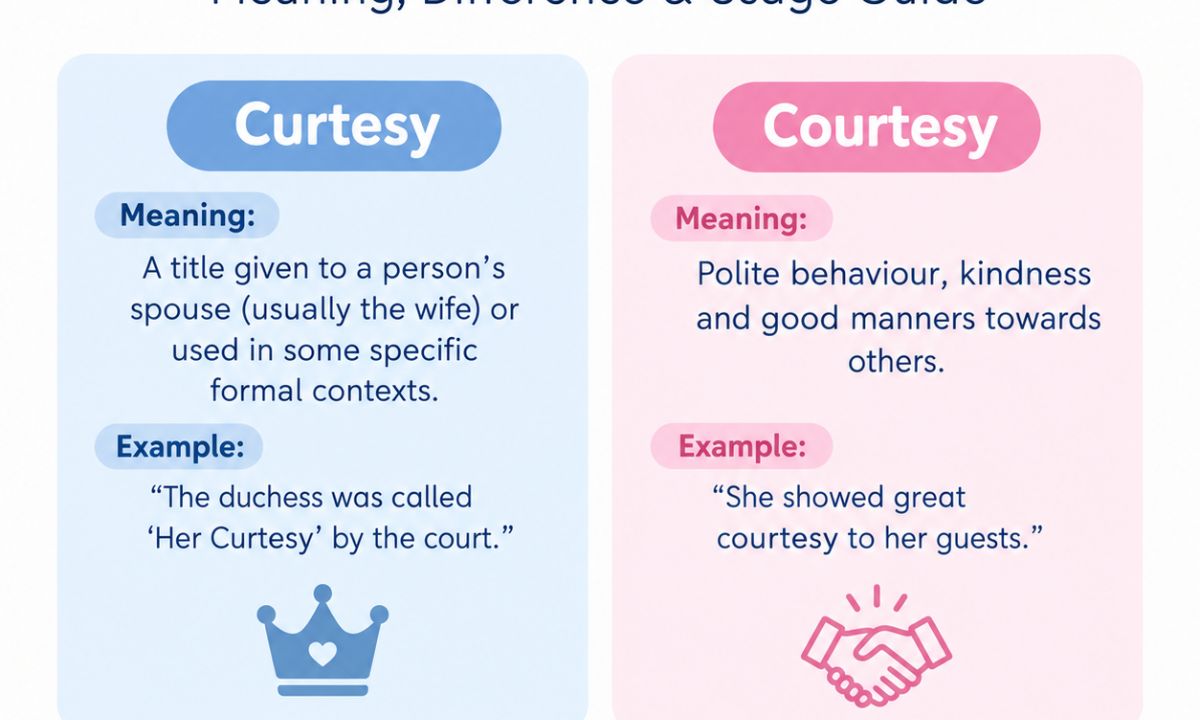
Courtesy describes polite, respectful behavior toward others, showing up constantly in daily interactions like holding a door open or thanking someone for their help. Curtesy, on the other hand, refers to an obscure legal term from common law tradition, describing a husband’s right to his deceased wife’s property under specific historical circumstances.
These words share a similar sound and spelling pattern, yet their meanings diverge completely, one belonging to everyday manners and the other buried deep within centuries-old property law. Understanding this distinction prevents an embarrassing mix up, especially in formal writing where precision matters.
What Does Courtesy Mean?
Courtesy refers to polite, considerate behavior extended toward other people, often reflecting good manners, respect, or thoughtfulness during everyday interactions. Someone offering their seat on a crowded train, saying “please” and “thank you,” or waiting patiently in line all demonstrate this quality naturally.
Real life example: “As a courtesy, the hotel staff upgraded our room without charging any extra fee.”
Businesses frequently use this word too, offering “courtesy calls,” “courtesy shuttles,” or “courtesy discounts” as small gestures of goodwill toward customers. The underlying idea always centers on kindness, respect, or thoughtful consideration shown freely toward someone else.
Examples of courtesy in daily life:
- Holding the elevator door for a stranger rushing to catch it
- Sending a quick reply confirming you received an important message
- Offering a guest something to drink before starting a conversation
- Letting another driver merge smoothly during heavy traffic
- Thanking a waiter by name after finishing a meal
Each example reflects small, considerate gestures woven naturally throughout ordinary life, reinforcing why courtesy remains one of the most frequently used words describing basic human kindness.
Is “Curtesy” a Real Word?
Yes, surprisingly, curtesy does exist as a legitimate English word, though it carries an entirely different meaning from its more familiar counterpart. Rooted in old common law tradition, curtesy historically described a widower’s legal right to lifetime use of property that belonged to his deceased wife, provided the couple had children together during the marriage.
This legal concept dates back centuries within English common law systems, later carrying over into early American property law before gradually fading from modern legal practice. Today, most jurisdictions have replaced or eliminated curtesy entirely, favoring more equal, gender neutral inheritance laws instead.
Because this term rarely appears outside specialized legal history or historical property disputes, most people encounter “curtesy” purely by accident, typing it when they actually mean the everyday word describing polite behavior.
The Legal Meaning and History of “Curtesy”
Understanding where curtesy originated helps explain why it still occasionally surfaces in historical or academic writing. English common law developed this doctrine sometime during the medieval period, granting a widower certain property rights over land his wife owned, but only once a child had been born to the marriage, ensuring an heir existed for future inheritance.
American colonies inherited this legal tradition directly from English common law, and curtesy remained part of property law across many states well into the nineteenth century. Reformers gradually challenged the doctrine, arguing it created unequal treatment between widows and widowers, since a parallel right called “dower” governed a widow’s more limited claim to her deceased husband’s property instead.
Modern legal systems across most English speaking countries have since abolished curtesy entirely, replacing it with statutes granting equal inheritance rights regardless of gender. Law students studying property history or historical case law might still encounter the term today, though practicing attorneys rarely reference it in current legal work.
A handful of jurisdictions technically kept remnants of curtesy on the books longer than others, sometimes blending it with dower rights into unified spousal inheritance statutes rather than eliminating the concept outright. Legal historians studying these transitions often cite curtesy as a useful example of how property law gradually evolved toward gender equality throughout the nineteenth and twentieth centuries.
Why People Confuse Curtesy vs Courtesy
Visual similarity explains most of this confusion instantly. Both words share nearly identical letters, differing only in that small internal vowel swap, “cur” versus “cour.” Quick typing, especially on mobile keyboards, makes this swap incredibly easy to overlook, since both versions look plausible at a passing glance.
Phonetic overlap adds further trouble, since many speakers pronounce both words almost identically in casual speech. Without a strong visual memory anchoring the correct spelling, writers sometimes default to whichever version feels more familiar based purely on sound rather than actual meaning.
Rarity of the legal term compounds the issue too. Since curtesy appears so infrequently in modern writing, most people never learn it exists as a separate word at all. This gap in awareness leads many writers to assume any appearance of “curtesy” must simply be a typo, when occasionally it genuinely reflects the intended historical or legal term.
How to Use Courtesy Correctly in Sentences
Courtesy fits naturally across countless everyday situations, appearing in both casual conversation and formal writing. “Please extend the same courtesy to our guests that you’d want shown toward yourself” demonstrates its use within a request for polite treatment.
Business communication relies heavily on this word too. “We’re offering a complimentary upgrade as a professional courtesy to loyal customers” shows how companies frame goodwill gestures using this exact term. Similarly, “Out of courtesy, please silence your phone during the presentation” reflects a polite request common in meetings, theaters, and classrooms alike.
Everyday speech leans on this word constantly as well, often without speakers even noticing how frequently it appears. A neighbor might say, “I’m just returning your ladder as a courtesy, since you lent it to us last month,” while a customer service representative might explain, “This replacement comes at no charge, purely as a courtesy for the inconvenience.” Both examples show how naturally this word threads through casual, spoken exchanges beyond just formal writing.
Common Mistakes to Avoid
Writers occasionally use “curtesy” when discussing basic politeness, unintentionally referencing an obscure legal doctrine instead of the intended everyday meaning. This mistake rarely causes serious misunderstanding in casual writing, since context usually clarifies intent, but it still signals a spelling error worth correcting before sharing formal documents.
Inconsistent spelling throughout a single piece of writing creates another common problem. Switching between both versions across different paragraphs looks careless, even if a reader eventually understands the intended meaning through context alone. Sticking with “courtesy” consistently, unless specifically discussing historical property law, avoids this issue entirely.
Some writers also assume “curtesy” represents a simply shortened or informal version of courtesy, similar to how some words develop casual variants over time. This assumption proves incorrect, since curtesy carries a completely separate, unrelated definition rather than functioning as an abbreviated form of the more common word.
Quick Tips to Remember the Difference
Remember that “courtesy” contains the word “our,” as in showing kindness toward “our” fellow people, connecting the spelling directly to its meaning about shared human consideration. This small mental link reinforces both the correct letters and the underlying concept simultaneously.
Associate “curtesy” exclusively with legal history, perhaps picturing an old courtroom or a dusty law book whenever that spelling comes to mind. Since this word rarely applies outside specialized legal contexts, treating any everyday appearance of “curtesy” as an automatic red flag for correction works well in practice.
Reading sentences aloud before finalizing important documents also helps catch this mistake. If the sentence discusses politeness, manners, or goodwill gestures, “courtesy” almost certainly belongs there instead of its rarely used legal counterpart.
Curtesy vs Courtesy in Modern English Usage
Contemporary writing overwhelmingly favors “courtesy” across nearly every context imaginable, from customer service scripts to wedding invitations describing polite guest behavior. Dictionaries list courtesy as the far more common entry, reflecting its dominant, everyday usage across spoken and written English worldwide.
“Curtesy” survives mainly within legal textbooks, historical documents, and academic discussions covering property law evolution. Outside those narrow, specialized circles, encountering this spelling almost always indicates an accidental error rather than intentional reference to its genuine historical meaning.
Curtesy vs Courtesy: Quick Comparison Table
| Feature | Courtesy | Curtesy |
| Core meaning | Politeness, respect, kindness | Historical legal property right |
| Common setting | Everyday conversation, business writing | Legal history, academic law texts |
| Frequency of use | Extremely common | Extremely rare |
| Modern relevance | Widely used today | Mostly obsolete, historical only |
| Example sentence | “Thanks for your courtesy during the delay.” | “Curtesy granted widowers certain land rights.” |
| Risk if misspelled | Reads as a simple typo | Rarely intended, usually accidental |
This table makes the distinction crystal clear whenever doubt creeps in. Unless you’re specifically discussing centuries-old property law, “courtesy” almost certainly represents the word you actually need.
FAQs About Curtesy vs Courtesy
What is the correct word: curtesy or courtesy?
Courtesy stands as the correct word for describing politeness, respect, or kindness in nearly every everyday situation. Curtesy exists too, but only as a rare, historical legal term unrelated to good manners.
Is curtesy still used today?
Rarely, since most modern legal systems abolished this historical property doctrine decades ago. The term survives mainly in academic legal history rather than active, everyday legal practice.
What does courtesy mean?
Courtesy means showing politeness, respect, or thoughtful consideration toward other people. It appears constantly in daily conversation, business communication, and simple acts of kindness between strangers or acquaintances.
Can I use curtesy in writing?
Only when specifically referencing the historical legal doctrine involving property inheritance rights. For any discussion involving manners, politeness, or goodwill gestures, always choose “courtesy” instead.
Why do people confuse curtesy vs courtesy?
Similar spelling, matching pronunciation, and general unfamiliarity with the rare legal term all contribute to this common mix up. Most writers simply never learn that curtesy exists as a separate, legitimate word with its own distinct meaning.
Conclusion
Courtesy and curtesy might look nearly identical on paper, yet they belong to entirely different corners of the English language, one describing everyday politeness and the other referencing an obscure, mostly obsolete legal doctrine. Recognizing this distinction ensures your writing stays accurate, whether you’re thanking a colleague for their help or researching historical property law.
Whenever in doubt, default confidently to “courtesy,” since it covers nearly every situation you’ll encounter in daily conversation, professional writing, or casual correspondence. Save “curtesy” strictly for legal or historical contexts, and you’ll never confuse these two similar looking words again.
Small spelling distinctions like this one rarely make headlines, yet they quietly shape how polished and credible your writing appears to careful readers. Taking a moment to double check before hitting send costs almost nothing, while the payoff, clear and accurate communication, lasts throughout every message you send afterward.