

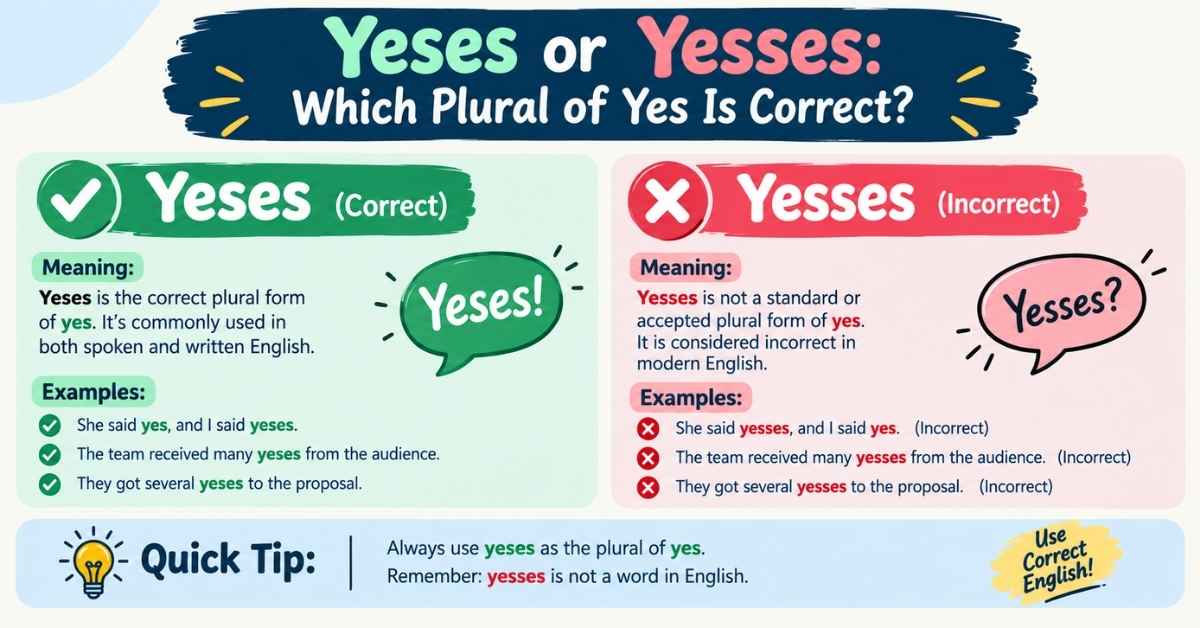
Yeses or yesses are both accepted plural forms of the noun yes, but yeses is the more common and generally preferred spelling in American English. Use yeses in professional, academic, and everyday writing. Although yesses is a legitimate variant, it is less familiar to many readers. Avoid yes’s as the ordinary plural unless a specific style guide requires an apostrophe for clarity.
Preferred: The proposal received six yeses.
Accepted variant: The proposal received six yesses.
Usually avoid: The proposal received six yes’s.
Merriam-Webster records the plural as “yeses also yesses,” and Dictionary.com says that both forms exist but yeses is more widely used.
Yeses vs. Yesses at a Glance
| Form | Accepted? | Recommended use | Example |
|---|---|---|---|
| Yeses | Yes | Preferred plural in U.S. writing | We received four yeses. |
| Yesses | Yes | Valid but less common variant | She heard several yesses. |
| Yes’s | Sometimes seen | Usually avoid as an ordinary plural | Rewrite it as yeses. |
| Yeses’ | Grammatically possible possessive | Usually rewrite for clarity | The meaning of the yeses |
| Yesses as a verb | Possible but rare | Means “says yes to” | She yesses every request. |
The practical answer is simple:
Choose yeses unless you have a specific reason to use yesses.
Why Does Yes Have a Plural?
Most of the time, yes functions as a complete affirmative response:
“Are you coming?”
“Yes.”
In that sentence, yes does not need a plural. It expresses agreement with the question.
However, yes can also function as a noun meaning:
- An affirmative answer
- A vote in favor
- An approval
- A confirmation
- A person voting affirmatively in some contexts
Once yes becomes a countable noun, it can refer to more than one response:
The board needed five yeses to approve the proposal.
Her question received three yeses and one no.
The word is therefore pluralized only when you are counting affirmative answers, approvals, or votes.
Why Yeses Is the Preferred Spelling
The simplest explanation is that yeses adds the regular plural ending -es to yes.
Compare:
- Bus → buses
- Gas → gases
- Class → classes
- Yes → yeses
Because yes already ends in an s sound, adding -es creates a pronounceable plural.
Dictionaries list yeses first, and contemporary edited writing generally favors it. Dictionary.com specifically identifies it as the more widely used form, while Merriam-Webster presents it as the primary plural before the alternative yesses.
This does not make yesses wrong. It means yeses has the stronger claim when a writer must select one standard form.
Is Yesses Correct?
Yes. Yesses is an accepted alternative plural of yes.
The children responded with enthusiastic yesses.
That sentence is grammatically defensible. Merriam-Webster, Dictionary.com, and Oxford-derived references recognize the form.
However, yesses is less common, and some readers may assume it is a spelling mistake. For that reason, editors usually prefer:
The children responded with enthusiastic yeses.
The distinction is between validity and preference:
- Yeses: valid and preferred
- Yesses: valid but less common
An article claiming that yesses is universally incorrect ignores established dictionary evidence.
Why Does Yesses Double the S?
The spelling yesses treats yes as though its final consonant should be doubled before adding the plural ending.
English has comparable spelling variation in words such as:
- Buses or busses
- Gases or gasses in certain uses
- Focuses or focusses
Usage eventually favors one spelling, but alternative forms may remain in dictionaries. In the case of yes, yeses has become the more familiar plural, while yesses remains an accepted variant.
Can Yesses Be a Verb?
Yes, although this use is rare.
English speakers sometimes turn yes into a verb meaning to say yes to, approve, flatter, or agree with.
He yeses every suggestion from the director.
The alternative spelling may appear as:
He yesses every suggestion from the director.
In this sentence, yesses is not a plural noun. It is a third-person singular present-tense verb.
Because this construction can sound awkward, a clearer rewrite is often better:
He agrees with every suggestion from the director.
He approves everything the director proposes.
Is Yes’s a Correct Plural?
In modern professional writing, yes’s is usually not recommended as the ordinary plural of yes.
An apostrophe normally performs one of two jobs:
- It marks omitted letters: do not → don’t.
- It marks possession: the committee’s decision.
Ordinary plurals generally do not need an apostrophe:
- Decision → decisions
- Vote → votes
- Response → responses
- Yes → yeses
Therefore:
Preferred: We counted seven yeses.
Usually avoid: We counted seven yes’s.
Some style authorities allow apostrophes when pluralizing a word mentioned as a word if the punctuation prevents confusion. You may consequently encounter:
The paragraph contains too many “yes’s.”
Even there, a clearer modern choice is:
The paragraph contains too many instances of “yes.”
Or:
The paragraph contains too many yeses.
A punctuation guide notes that apostrophized forms sometimes appear for clarity but identifies yeses and noes as the modern trend. The Punctuation Guide
Yeses vs. Yes’s: Plural or Possessive?
The apostrophe changes the grammatical function.
Yeses: More Than One Yes
The survey received 200 yeses.
This is a simple plural.
Yes’s: Something Belonging to One Yes
A singular possessive could theoretically be written:
One yes’s effect was greater than expected.
This construction is grammatical but visually awkward. A professional editor would probably rewrite it:
The effect of one yes was greater than expected.
Yeses’: Something Belonging to Multiple Yeses
The plural possessive is technically possible:
The yeses’ significance became clear later.
Again, the clearer version is:
The significance of the yeses became clear later.
Correct grammar does not always produce the most readable sentence. When a possessive form looks distracting, restructure it.
How Do You Pronounce Yeses and Yesses?
Both yeses and yesses are normally pronounced the same way:
YES-iz
The ending adds a second syllable.
- Yes: one syllable
- Yeses: two syllables
The identical pronunciation helps explain why both spellings developed. You cannot reliably determine the written form by hearing the word.
Correct Uses of Yeses
Votes and Elections
The motion passed with 12 yeses and three noes.
We need two more yeses before the measure can pass.
In formal legislative contexts, yeas and nays may be more conventional:
The clerk recorded 12 yeas and three nays.
Surveys and Questionnaires
The survey produced 84 yeses, 12 nos, and four unanswered questions.
Count the yeses in the first column.
If the responses are displayed as labels, quotation marks can help:
The “Yes” responses outnumbered the “No” responses.
This rewrite may look cleaner than a sentence containing unusual plurals.
Approvals and Decisions
The project cannot begin until we receive three yeses from the review panel.
After months of uncertainty, the team finally had enough yeses to proceed.
Dialogue and Repeated Answers
Every question was met with a series of cheerful yeses.
She gave so many yeses that nobody expected her final refusal.
Sales and Marketing
Sales teams sometimes use yeses to describe affirmative steps in a conversation:
The representative asked simple questions designed to produce several small yeses.
In this context, the word refers to multiple expressions of agreement rather than formal votes.
Consent and Permission
The organizers needed written yeses from all participants.
Although grammatically correct, written consents or signed approvals would sound more precise in a legal, medical, or administrative document.
Yeses and Noes or Yeses and Nos?
Both noes and nos appear as plural forms of no. The best choice depends on context and house style.
Common combinations include:
- Yeses and noes
- Yeses and nos
- Yeas and nays
- Affirmative and negative responses
Merriam-Webster uses an example with yeses and nos, while other editorial sources favor yeses and noes. Merriam-Webster
When to Use Yeses and Noes
This form visually distinguishes noes as a plural noun:
The yeses and noes were recorded separately.
Some readers, however, find noes unfamiliar.
When to Use Yeses and Nos
This is a shorter alternative:
Count the yeses and nos.
It is understandable but may initially resemble the abbreviation NOS in all-capital contexts.
When to Use Yeas and Nays
Use yeas and nays for formal recorded votes:
The chair called for the yeas and nays.
Be careful: yea and yes are related, but they are not always interchangeable in every context. Yea is particularly associated with voting and formal affirmation.
Clearest Professional Alternative
When visual clarity matters, write:
Affirmative and negative responses
Or:
Votes in favor and votes against
Should Yeses Be Placed in Quotation Marks?
Quotation marks are not required simply because yeses is unusual.
Correct without quotation marks:
We received more yeses than expected.
You may use quotation marks when discussing the actual word or displaying a response label:
The word “yes” appears five times.
The survey included “Yes” and “No” options.
Avoid cluttering an ordinary sentence with unnecessary punctuation:
Less natural: We received seven “yeses.”
Cleaner: We received seven yeses.
Should Yeses Be Capitalized?
Use lowercase in normal prose:
The proposal received four yeses.
Capitalize Yes when:
- It begins a sentence.
- It appears as a labeled survey option.
- It is part of a title or heading.
- A particular design or form requires title case.
Example:
| Response | Total |
|---|---|
| Yes | 86 |
| No | 14 |
When discussing several responses in prose, return to lowercase:
The survey contained 86 yeses.
When Yeses Is Not the Best Word
Even though yeses is correct, it may not be the clearest choice in every sentence.
Use Affirmative Responses
Instead of:
The questionnaire received 300 yeses.
Consider:
The questionnaire received 300 affirmative responses.
This is more formal and immediately clear.
Use Approvals
Instead of:
We need two yeses from management.
Consider:
We need two management approvals.
Use Votes in Favor
Instead of:
The amendment received 40 yeses.
Consider:
The amendment received 40 votes in favor.
Use Consents
Instead of:
The clinic needs the participants’ yeses.
Consider:
The clinic needs the participants’ written consent.
The best word depends on what each yes actually represents.
Yes as Different Parts of Speech
Understanding the word’s function explains why it sometimes needs a plural.
Yes as a Response Word
“Will you attend?”
“Yes.”
No plural is involved.
Yes as a Noun
We need a yes by Friday.
We received three yeses.
The word refers to a countable affirmative answer.
Yes as a Verb
She yesses every suggestion.
This use is rare and often better rewritten as accepts, approves, or agrees with.
Yes Used Attributively
Put a check in the yes column.
Here, yes modifies column. It does not need to be pluralized.
LEARN MORE: Swifty or Swiftie
Common Mistakes to Avoid
Mistake 1: Calling Yesses Universally Incorrect
Incorrect advice:
Yesses is never a word.
Accurate advice:
Yesses is accepted, but yeses is more common and preferred.
Mistake 2: Adding an Apostrophe Automatically
Incorrect:
The motion received ten yes’s.
Preferred:
The motion received ten yeses.
Mistake 3: Confusing Plural and Possessive Forms
- Yeses = more than one yes
- Yes’s = belonging to one yes
- Yeses’ = belonging to multiple yeses
Because the possessive forms look awkward, rewriting is often best.
Mistake 4: Using Yeses When Yes Is Not a Noun
Incorrect:
They yeses every proposal.
Possible but unusual:
She yesses every proposal.
Clearer:
She approves every proposal.
Mistake 5: Assuming It Is a U.S.–U.K. Difference
The variation is not neatly divided into American and British spellings. Both forms have appeared across English varieties, though yeses is the safer general choice for a U.S. audience.
Mistake 6: Ignoring House Style
If your publisher, professor, employer, or organization prescribes a spelling, follow that style consistently.
A Practical Decision Framework
Use this five-step test whenever the spelling looks uncertain.
Step 1: Are You Counting Affirmative Answers?
If no, you may not need a plural.
The answer is yes.
Step 2: Are There Multiple Answers, Votes, or Approvals?
If yes, use a plural noun.
We received four yeses.
Step 3: Which Accepted Form Should You Choose?
For U.S. writing, choose yeses.
Step 4: Are You About to Add an Apostrophe?
Do not add one merely to form the plural.
Step 5: Does the Word Distract From the Meaning?
Replace it with:
- Affirmative responses
- Approvals
- Agreements
- Consents
- Votes in favor
Quick Practice Test
Choose yeses, yesses, yes’s, or a clearer rewrite.
- The proposal received seven ___ and two noes.
- Both ___ and ___ are accepted plurals, but one is more common.
- The clinic needs every participant’s ___ before proceeding.
- We counted the ___ in the first survey column.
- She ___ every request made by her supervisor.
Answers
- Yeses — the preferred plural
- Yeses and yesses — both are accepted
- Written consent — clearer than a possessive construction involving yes
- Yeses — multiple affirmative responses
- Yesses is possible as a verb, but approves or agrees to is clearer
Frequently Asked Questions
Is it yeses or yesses?
Both are correct plurals of the noun yes. Yeses is more common and generally preferred.
What is the plural of yes?
The plural is yeses, with yesses accepted as an alternative.
Is yesses a real word?
Yes. It can be an alternative plural of yes. It may also be a rare verb form meaning “says yes to” or “agrees with.”
Is yeses grammatically correct?
Yes. Yeses is the preferred plural when referring to multiple affirmative answers, approvals, or votes.
Why is the plural yeses instead of yesses?
Yeses forms the plural by adding -es to yes. Yesses developed as a variant with a doubled consonant. Both survived, but usage favors yeses.
Is yes’s an acceptable plural?
It sometimes appears for visual clarity, but yeses is the better choice in normal professional writing. Apostrophes generally should not form ordinary plurals.
What is the plural of no?
Both nos and noes occur. Follow your house style or rewrite the phrase as negative responses.
Should I write yeses and noes?
Yeses and noes is acceptable. Yeses and nos also appears. In formal voting, yeas and nays may be more suitable.
How do you pronounce yeses?
Pronounce it YES-iz, with two syllables.
Can yes be a noun?
Yes. In “We need a yes by Friday,” yes is a noun meaning an affirmative answer or approval.
Should yeses be in quotation marks?
Not in ordinary usage. Use quotation marks when discussing the word itself or referring to a labeled “Yes” response.
Which spelling should I use in an American academic paper?
Use yeses, or choose a more formal alternative such as affirmative responses.
Final Verdict: Yeses or Yesses?
Yeses and yesses are both correct, but yeses is the preferred spelling for most American English writing.
Use:
- Yes for one affirmative answer
- Yeses for multiple affirmative answers
- Yesses as an accepted but less common variant
- Affirmative responses when formal clarity matters
Avoid yes’s as a routine plural. If the word still looks distracting in an important document, rewrite it rather than forcing readers to pause.