

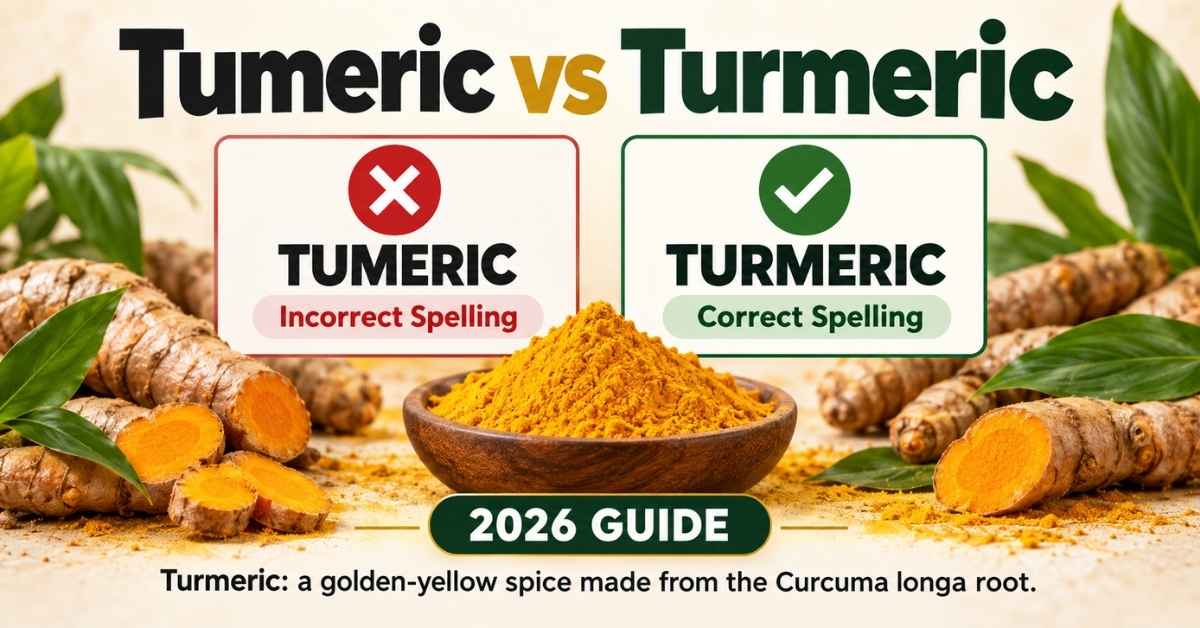
Tumeric vs turmeric — if you’ve typed both versions into a search bar wondering which one is right, here’s the short answer: turmeric, spelled with two R’s, is the only correct spelling. “Tumeric” is simply a common misspelling, not an alternate or regional variant.
Both words point to the exact same golden-yellow spice, so if you’ve ever bought a jar labeled “tumeric,” don’t worry — you got the real thing. What differs is only the writing, not the product itself.
This confusion is incredibly common, and once you understand why it happens, you’ll never second-guess your spelling again.
What Is Turmeric? (Quick Definition)
Turmeric is a bright yellow-orange spice made from the rhizome (underground stem) of Curcuma longa, a flowering plant in the ginger family. It has been used for thousands of years in South Asian cooking, traditional medicine, and as a natural dye. The plant is boiled, dried, and ground into the fine powder most people recognize from curry dishes and golden lattes.
Its signature color and much of its reputed health value come from curcumin, the active compound responsible for turmeric’s vivid hue and its antioxidant properties.
Tumeric vs Turmeric: Which Spelling Is Correct?
There’s no debate here — “turmeric” is the standard, dictionary-recognized spelling, appearing in every major reference source. “Tumeric” is a misspelling that has become so widespread online that it can look like an accepted variant, but it isn’t one in formal writing, food labeling, or academic contexts.
| Aspect | Turmeric ✅ | Tumeric ❌ |
|---|---|---|
| Correct spelling | Yes | No |
| Dictionary-recognized | Yes | No |
| Used in food labeling (USDA/EU) | Yes | No |
| Refers to the same spice | Yes | Yes |
| Common in casual writing | Somewhat | Very common |
| SEO/search visibility | Higher authority | Still searched often, but non-standard |
Think of it like “library” vs. “libary” — the mispronunciation shaped the misspelling, but only one version is technically correct.
Why Do People Misspell Turmeric as “Tumeric”?
The mix-up almost always comes down to pronunciation. Turmeric is pronounced roughly as TUR-muh-rik, but many speakers soften or drop the first “r” sound entirely, making it sound like TOO-muh-rik. Since people often spell words the way they hear them, “tumeric” naturally follows.
This is the same phenomenon behind other commonly mispronounced-then-misspelled words, where a soft or quick consonant sound gets lost in casual speech and eventually shows up as a typo in writing.
Word Origin and Etymology
The word turmeric traces back through Middle English turmerite, itself shaped by the Old French phrase terre mérite, meaning “meritorious earth” — a nod to the spice’s earthy, valuable, soil-like rhizome. Older roots connect to the Arabic word kurkum, also linked to the scientific genus name Curcuma.
Understanding this origin makes the double “r” easier to remember: the word literally comes from “earth” (terre) plus “merit” — both syllables carrying an “r.”
How to Pronounce Turmeric
If spelling feels tricky, pronunciation is the root cause. Try these accepted pronunciations:
- /ˈtər-mə-rik/ — TUR-muh-rik (most common in the US)
- /ˈtü-mə-rik/ — TOO-muh-rik
- /ˈtyü-mə-rik/ — TYOO-muh-rik
All three are considered acceptable spoken variants, even though only turmeric is the accepted written form.
Turmeric vs Curcumin: What’s the Difference?
This is where many articles stop short — but it’s one of the most searched follow-up questions. Turmeric is the whole spice — the dried, ground rhizome you’d find in a spice jar.
Curcumin is just one specific compound within turmeric, making up only about 2–5% of the raw spice by weight, yet it’s responsible for most of the color and the anti-inflammatory properties researchers study.
In simple terms: turmeric is the ingredient; curcumin is the star player inside it.
Health Benefits of Turmeric
Turmeric has a long history in traditional medicine, and modern research continues to explore its potential benefits, particularly linked to curcumin’s antioxidant and anti-inflammatory properties. Commonly cited areas of interest include:
- Supporting joint comfort and mobility
- Contributing antioxidant activity that may help offset oxidative stress
- Traditional use in digestive wellness
- A popular addition to “golden milk” and wellness drinks
As one nutrition writer summarized, research on turmeric’s isolated compound is promising but not yet conclusive enough to call it a proven treatment for any specific condition.
It’s worth noting: curcumin is poorly absorbed by the body on its own. Many nutritionists recommend pairing turmeric with black pepper, since a compound in pepper called piperine can significantly boost curcumin absorption. This is a genuinely useful, often-missed detail that most competitor content skips entirely.
Disclaimer: This is general information, not medical advice. Speak with a healthcare provider before using turmeric or curcumin supplements for any health condition.
Does the Spelling Affect the Product You Buy?
Not at all. Whether a label reads “turmeric” or the misspelled “tumeric,” you’re getting the same spice from the same plant. That said, spelling does matter in a few practical situations:
- Regulatory labeling: Official food labeling standards use “turmeric,” so a product consistently spelled “tumeric” may signal a less careful or less established brand.
- Professional and academic writing: Recipe developers, food scientists, and health writers are expected to use the correct spelling for credibility.
- Search behavior: Both spellings are searched online, but “turmeric” carries more authority and consistency across trusted sources.
Turmeric in Everyday Cooking
Beyond the spelling debate, turmeric earns its popularity in the kitchen. It’s a staple in curry powders, lends its warm color to rice dishes, and is the base ingredient in trendy “golden milk” lattes.
A pinch goes a long way — its flavor is earthy and slightly bitter, so most recipes use it in small, balanced amounts alongside cumin, coriander, and ginger.
LEARN MORE: Sheath or Muumuu NYT Crossword Clue
Quick Reference Table
| Question | Answer |
|---|---|
| Correct spelling | Turmeric |
| Common misspelling | Tumeric |
| Scientific name | Curcuma longa |
| Plant family | Ginger family (Zingiberaceae) |
| Active compound | Curcumin |
| Best absorption booster | Black pepper (piperine) |
| Common uses | Curry, golden milk, natural dye, traditional medicine |
Frequently Asked Questions
Is tumeric and turmeric the same thing? Yes. They refer to the identical spice from the Curcuma longa plant. Only the spelling differs, and “turmeric” is the correct form.
Why does turmeric have two R’s? The word evolved from terre mérite (“meritorious earth”), which explains both R sounds in its origin.
Is turmeric the same as curcumin? No. Turmeric is the whole spice; curcumin is just one active compound found within it.
Does turmeric help with inflammation? Some research suggests curcumin, turmeric’s key compound, may support anti-inflammatory processes, though more conclusive studies are still needed.
How do I remember the correct spelling? Link it to the word “merit” hidden inside “tur-MER-ic” — a small trick that reinforces the often-missed first “r.”
Conclusion
When it comes to tumeric vs turmeric, the takeaway is simple: turmeric is correct, “tumeric” is a widespread misspelling rooted in pronunciation, and both terms point to the same golden, curcumin-rich spice.
Now that you know the origin, the pronunciation, and the difference between turmeric and curcumin, you’re equipped to spell it, say it, and use it with confidence — in the kitchen or in your writing.