

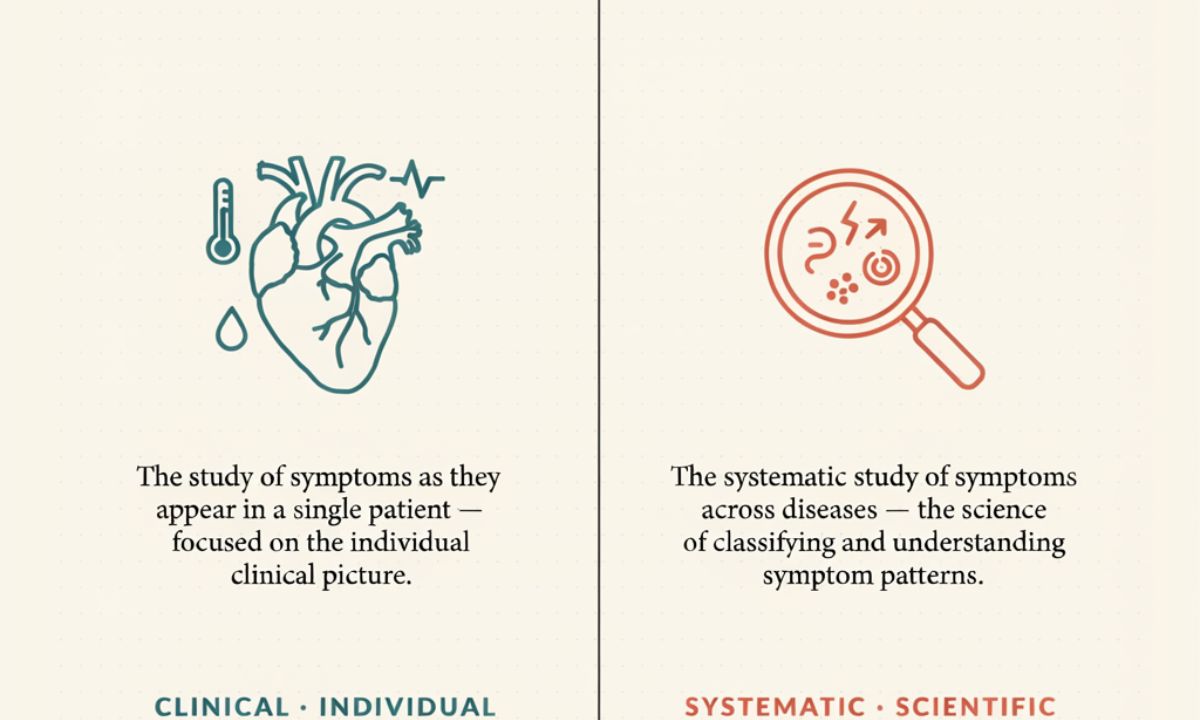
Medical language often confuses even careful writers, and few word pairs cause as much trouble as symptomology vs symptomatology. Both terms describe the study of symptoms, yet only one carries full acceptance in formal medical circles.
Doctors, nursing students, and health bloggers frequently mix them up, and that small error can undermine credibility in professional or academic writing.
This guide breaks down exactly where these two words come from, how each one gets used in real conversation, and why one term dominates textbooks while the other lingers in casual speech. You’ll walk away knowing precisely which word belongs in a research paper, a patient chart, or a quick chat with a colleague.
Consider a simple scenario. A nursing student drafting a case study reaches for the word describing a patient’s collection of symptoms, and pauses, unsure whether to type symptomology or symptomatology.
That brief hesitation happens to thousands of writers every single day, across hospitals, classrooms, and health websites worldwide. Understanding the distinction removes that hesitation permanently, replacing guesswork with confident, informed word choice.
What Is Symptomatology? (The Correct Medical Term)
Symptomatology refers to the branch of medicine focused on symptoms, including their classification, patterns, and significance in diagnosing illness. Physicians rely on this term constantly, since understanding a patient’s full symptom picture often points toward the correct diagnosis before lab results even arrive.
The word breaks down into two Greek roots: “symptoma,” meaning a happening or occurrence, and “logia,” meaning the study of something. Together, they form a term describing the systematic study of symptoms, much like cardiology describes the study of the heart or dermatology describes the study of skin.
Example in real use:
“The patient’s symptomatology included fatigue, joint pain, and a persistent low-grade fever, which pointed the rheumatologist toward an autoimmune condition.”
Notice how naturally this word fits inside a clinical sentence. Medical journals, textbooks, and diagnostic manuals all favor symptomatology because it follows the same linguistic pattern as thousands of other established medical terms. A nursing student writing a case report would use this word without hesitation, and any professor grading that report would expect nothing less
.Beyond diagnosis, symptomatology plays a role in treatment planning as well. A psychiatrist might track a patient’s symptomatology across several weeks, noting whether medication reduces anxiety, improves sleep, or lessens mood swings. Tracking these patterns over time helps clinicians adjust dosages, switch treatments, or confirm that a diagnosis remains accurate as new information emerges.
Everyday conversation among healthcare workers reflects this preference too. During hospital rounds, an attending physician might ask a resident, “Walk me through the patient’s symptomatology since admission,” expecting a structured rundown of observed signs. That single question demonstrates how deeply embedded this term has become within professional medical culture, far beyond just written documentation.
What Is Symptomology? (Common but Less Accepted Term)
Symptomology appears frequently online, in casual health articles, and occasionally in spoken conversation among non specialists. Many people assume it means exactly the same thing as symptomatology, and functionally, most readers do interpret it that way. However, this version lacks the same historical grounding and formal recognition within academic medicine.
Some linguists suggest symptomology emerged as a simplified, easier to pronounce variant, dropping the extra syllable found in symptomatology. Over decades of casual use, the shorter form spread through blogs, forums, and everyday speech, even though formal style guides rarely endorse it.
Example in real use:
“The article described the symptomology of seasonal allergies, listing sneezing, itchy eyes, and nasal congestion as common signs.”
This sentence reads smoothly to most casual readers, and nobody would likely question its meaning in a general audience blog post. Still, submit that same sentence to a peer-reviewed medical journal, and an editor would almost certainly flag the word for replacement.
Social media has accelerated this trend further, since health influencers and wellness accounts often prioritize catchy, easy to read phrasing over strict clinical accuracy. A skincare account might post, “Understanding acne symptomology can help you choose the right routine,” reaching millions of viewers who never question the terminology. That massive informal exposure keeps the shortened variant alive and thriving, regardless of what formal style guides recommend.
Important note:
Dictionaries increasingly list symptomology as a recognized variant, acknowledging its widespread use despite formal objections from linguists and medical style guides. That said, recognition in a dictionary doesn’t equal acceptance in professional medical writing, where precision and tradition still carry significant weight.
Correctness in Usage
Symptomatology remains the historically accurate, etymologically consistent term, built from established Greek roots shared across countless medical disciplines. Symptomology, while understandable and widely recognized, technically drops a syllable from that original root structure, making it a shortened variant rather than the original form.
Field of Use
Symptomatology dominates formal medical writing, including textbooks, clinical documentation, peer reviewed journals, and diagnostic manuals used by practicing physicians. Symptomology shows up more often in casual health blogs, everyday conversation, and informal patient-facing content where strict medical terminology feels unnecessary.
Linguistic Origin
Symptomatology follows the same word-building pattern found throughout medical vocabulary, pairing a root word with “-logy” through a connecting vowel, similar to physiology or pathology. Symptomology skips part of that connecting structure, which explains why purists consider it a linguistic shortcut rather than a fully accurate term.
Professional Acceptance
Medical schools, licensing boards, and academic journals overwhelmingly favor symptomatology, teaching it as the standard term from the very first year of study. Symptomology rarely appears in graded coursework or professional publications, though colleagues might still understand it perfectly well during an informal hallway conversation.
Publishing houses that print medical textbooks maintain strict style guides too, and those guides almost universally list symptomatology as the required spelling. Freelance medical writers quickly learn this rule after their first few assignments, since editors consistently request revisions whenever the shortened variant slips into a manuscript meant for clinical audiences.
Why Does This Confusion Exist?
Language naturally evolves as speakers search for easier ways to communicate complex ideas. Symptomatology contains five syllables, which feels clunky in fast paced spoken conversation, while symptomology trims that down to four, offering a smoother, quicker alternative. Over time, this small convenience encouraged widespread informal adoption, especially outside strict academic settings.
Search engines have also contributed to the confusion. Because both terms return similar results online, casual readers rarely notice which spelling belongs to formal literature versus everyday writing. Content written for general audiences, rather than medical professionals, often prioritizes readability over strict terminology, further blurring the line between the two words.
Additionally, spellcheck tools and autocorrect software sometimes fail to flag symptomology as incorrect, since dictionaries have gradually added it as an accepted variant. This quiet acceptance creates a false sense of equivalence, leading writers to assume both words carry identical professional weight when they simply don’t.
How Medical Professionals Use Symptomatology
Inside hospitals, clinics, and research institutions, symptomatology appears constantly across patient records, referral letters, and academic publications. A cardiologist might document, “The patient presented with symptomatology consistent with early-stage heart failure,” ensuring the record aligns with standard medical documentation practices.
Medical students encounter this term from their earliest coursework, often memorizing symptom clusters tied to specific conditions under headings labeled symptomatology. Pharmaceutical companies also rely on this word heavily within drug trial reports, describing how a medication affects reported symptomatology across different patient groups over time.
Insurance companies and legal professionals working within healthcare settings favor symptomatology too, since formal documentation demands precise, universally recognized terminology. Using the shortened variant in a legal medical report could raise unnecessary questions about the author’s professional training, even if the meaning remains perfectly clear to most readers.
Beyond formal writing, many doctors still use symptomatology during verbal case discussions, particularly in academic hospitals where teaching rounds emphasize proper terminology. Residents learn quickly that consistent word choice signals professionalism, and that habit tends to stick throughout an entire medical career.
Common Mistakes People Make
Assuming both are interchangeable
Many writers treat these words as perfect synonyms, using whichever one comes to mind first without considering context. While readers will usually understand either version, professional settings demand more careful word selection, especially in written documentation meant for formal review.
Using symptomology in academic writing
Students sometimes submit papers using symptomology, only to receive feedback asking them to replace it with the historically accurate term. Professors and journal editors expect adherence to established medical vocabulary, and deviating from that standard can create an impression of carelessness, even when the underlying content remains strong.
Overthinking pronunciation
Some people avoid symptomatology simply because it feels harder to say aloud, opting for the shorter alternative purely for convenience. While pronunciation difficulty is a valid personal preference, it shouldn’t dictate word choice in formal writing where accuracy matters more than ease of speech.
Not checking medical sources
Writers researching health topics sometimes copy terminology from general audience websites rather than verifying against authoritative medical sources. This habit spreads the less accepted variant further, reinforcing a cycle of confusion that makes the correct term harder to identify for future readers.
Ignoring context when publishing content
Content creators sometimes forget that audience expectations shift depending on platform and purpose. A term acceptable on a lifestyle blog might seem out of place in a downloadable patient education guide distributed by a hospital network, where consistency with clinical documentation matters far more than casual readability.
Quick Summary Table
| Feature | Symptomatology | Symptomology |
| Formal correctness | Historically accurate term | Informal shortened variant |
| Common setting | Medical journals, textbooks, clinical charts | Blogs, casual conversation, informal content |
| Syllable count | Five syllables | Four syllables |
| Professional acceptance | Universally accepted in medicine | Rarely accepted in formal writing |
| Everyday example | “Her symptomatology suggested lupus.” | “The blog listed flu symptomology.” |
| Dictionary status | Standard entry | Recognized variant |
| Best used by | Doctors, researchers, students | General audiences, casual writers |
This table makes the choice simple whenever doubt creeps in. Formal documentation calls for symptomatology, while relaxed, everyday writing tolerates symptomology without causing real confusion among general readers.
FAQs About Symptomology vs Symptomatology
Is symptomology a real word?
Yes, most modern dictionaries recognize symptomology as a valid variant, though it remains less formal than symptomatology. Readers will understand it easily, even though medical professionals generally prefer the historically accurate alternative.
What is the correct term in medicine?
Symptomatology stands as the accepted standard across medical schools, journals, and clinical documentation worldwide. Students, researchers, and practicing physicians should default to this term whenever writing formal healthcare content.
Can I use symptomology in academic writing?
Generally, no, since professors and journal editors expect adherence to established medical terminology throughout formal submissions. Switching to symptomatology avoids unnecessary corrections and signals stronger attention to professional standards.
Why do people confuse symptomology vs symptomatology?
Casual speech favors shorter, easier words, and symptomology trims one syllable from its formal counterpart, making it more convenient during everyday conversation. Widespread informal use, combined with dictionary recognition, has blurred the line between these two terms over time.
What does symptomatology study?
Symptomatology examines the classification, patterns, and clinical significance of symptoms across various diseases and conditions. Physicians use this branch of study to connect observed symptoms with likely diagnoses, guiding further testing and treatment decisions.
Conclusion
Choosing between symptomology and symptomatology ultimately depends on your audience and setting. Formal medical writing, academic papers, and clinical documentation call for symptomatology, since it reflects proper etymology and professional tradition built over generations. Casual conversation and general health content tolerate symptomology comfortably, given its widespread recognition among everyday readers.
Whenever precision matters, especially in a classroom, hospital, or published research setting, reach for symptomatology without hesitation. Save the shorter variant for relaxed conversation, and your writing will always strike the right professional tone, no matter who ends up reading it.