

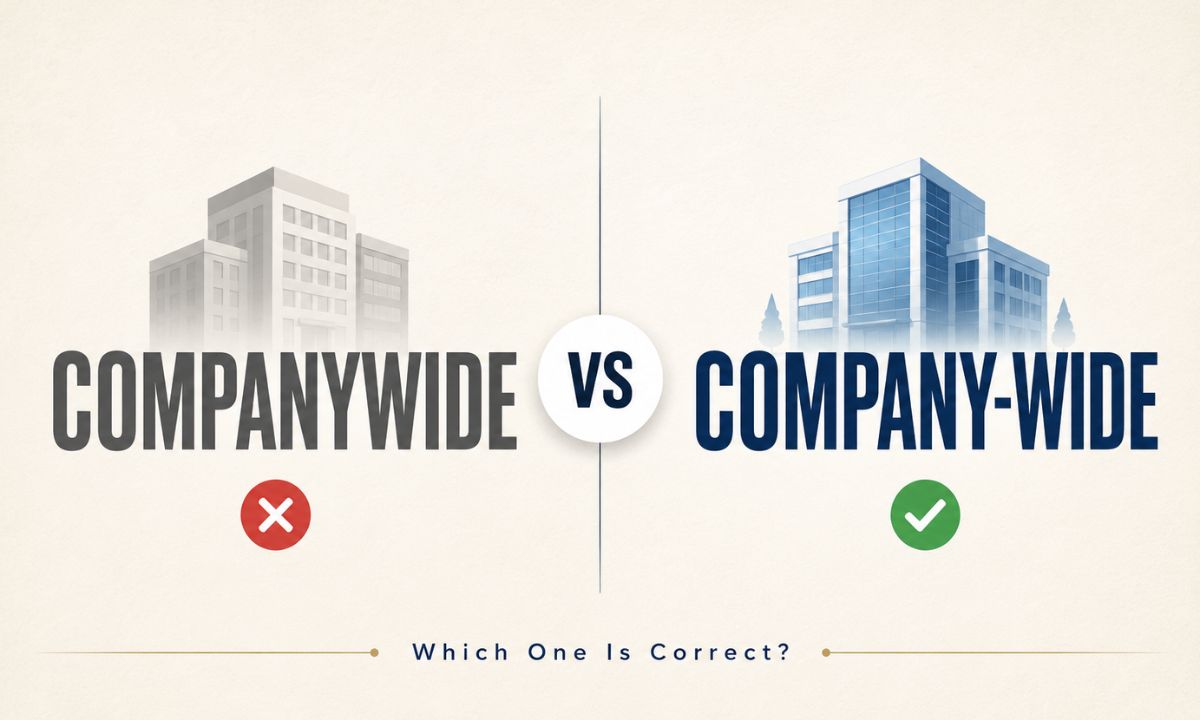
Choosing between Company-wide or Companywide may seem like a minor grammar decision, but it can affect the professionalism and consistency of your writing. Whether you’re drafting an employee handbook, sending an internal email, creating a business report, or publishing content online, using the correct form helps build credibility and makes your message easier to understand.
The confusion exists because both versions appear in professional writing. Some organizations prefer the hyphenated company-wide, while others use the closed compound companywide based on their internal style guide. Understanding when each form is appropriate prevents inconsistencies across documents.
This guide explains the meaning of both forms, when to use each one, the major style guide recommendations, practical examples, and best practices for business writing so you can write with confidence.
Quick Answer
Company-wide is the most widely accepted spelling in professional writing, especially when following AP Style and many corporate style guides. Companywide is also considered correct by several dictionaries and organizations, particularly when used consistently as a closed compound adjective. The most important rule is to follow your organization’s editorial style and remain consistent throughout your document.
What Does Company-wide or Companywide Mean?
Featured Snippet Definition
Company-wide or Companywide refers to something that affects, includes, or applies to an entire company rather than a single department, office, or team. The phrase commonly describes policies, announcements, meetings, initiatives, benefits, or decisions that involve every employee across the organization.
In simple terms, if every employee is included, the action is considered company-wide.
Examples include:
- A company-wide meeting
- A company-wide policy
- A company-wide training program
- A company-wide software upgrade
- A company-wide celebration
Is There a Difference Between Company-wide and Companywide?
The meaning is exactly the same.
The primary difference is spelling and editorial preference.
| Company-wide | Companywide |
| Hyphenated compound adjective | Closed compound word |
| Preferred by many editors | Accepted by several dictionaries |
| Common in journalism | Common in some corporate writing |
| Often recommended by AP Style | Often used in internal brand style guides |
Because English evolves over time, many hyphenated words eventually become closed compounds. Words such as email, website, and online followed this pattern. Some language experts believe companywide is undergoing a similar transition, although company-wide remains more common in published business writing.
Why Does This Question Cause Confusion?
Many English words change over time.
For example:
- decision-making → decision making
- e-mail → email
- on-line → online
Compound words often begin with hyphens before eventually becoming one word. During this transition, both spellings may appear in books, websites, business documents, and online articles.
As a result, writers frequently encounter both Company-wide or Companywide, making it difficult to know which version to choose.
When Should You Use Company-wide?
In most professional situations, company-wide is the safest choice.
It is especially appropriate for:
- Business reports
- Press releases
- Employee communications
- HR documentation
- Corporate policies
- News articles
- Website content
- Marketing materials
Many editors prefer the hyphen because it immediately shows that company and wide work together as one descriptive term.
Examples
- The CEO announced a company-wide restructuring.
- We introduced a company-wide wellness program.
- Employees received a company-wide email yesterday.
- The company launched a company-wide cybersecurity initiative.
- Every department participated in the company-wide training session.
When Is Companywide Appropriate?
Some organizations intentionally remove the hyphen for consistency with modern branding or internal editorial standards.
Using companywide is appropriate when:
- Your company’s style guide requires it.
- Your preferred dictionary lists it as acceptable.
- Your brand consistently avoids hyphenated compounds.
- You maintain the same spelling throughout all documents.
For example:
Our companywide sustainability program reduced paper waste by 40%.
This sentence is grammatically acceptable if it aligns with the chosen editorial style
Why Consistency Matters More Than the Spelling
Readers rarely notice whether you chose company-wide or companywide.
They do notice inconsistency.
Imagine reading the following document:
- company-wide policy
- companywide initiative
- company-wide meeting
- companywide communication
Switching back and forth makes the writing appear less polished.
Instead, choose one version and use it consistently across:
- Employee handbooks
- Company websites
- Blog posts
- Email templates
- Marketing campaigns
- HR documents
- Training manuals
Consistency creates a stronger brand voice and improves readability.
Company-wide in Business Communication
The expression is especially common in workplace communication because organizations regularly announce initiatives that affect every employee.
Typical examples include:
Human Resources
- Company-wide benefits updates
- Company-wide leave policies
- Company-wide performance reviews
Information Technology
- Company-wide software rollout
- Company-wide password reset
- Company-wide cybersecurity training
Leadership
- Company-wide town hall meetings
- Company-wide strategic goals
- Company-wide performance updates
Marketing
- Company-wide branding changes
- Company-wide customer service standards
- Company-wide product launch
Using the term clearly tells employees that the message applies to everyone, not just a single department or location.
How Company-wide Works in a Sentence
The phrase almost always functions as an adjective because it describes a noun.
Examples include:
- company-wide initiative
- company-wide strategy
- company-wide survey
- company-wide training
- company-wide announcement
Notice that the phrase appears immediately before the noun it modifies.
Can Company-wide Be Used After a Verb?
Yes.
Although it most commonly appears before a noun, it can also appear after linking verbs.
Examples:
- The policy is company-wide.
- The initiative became company-wide last year.
- The new software rollout is company-wide rather than department-specific.
This usage is natural and common in business English.
Step-by-Step Guide to Choosing the Right Version
When deciding between Company-wide or Companywide, follow these simple steps:
- Check your organization’s style guide.
- Review your preferred dictionary or editorial manual.
- Choose one spelling.
- Apply it consistently throughout the document.
- Proofread before publishing to ensure every instance matches.
Following these steps eliminates confusion and creates a more professional final document.
Real-World Examples
Here are examples from everyday business situations.
Example HR Announcement
We are introducing a company-wide parental leave policy beginning next quarter.
Example CEO Email
Next Friday, we’ll hold a company-wide meeting to discuss our annual goals.
Example IT Department
A company-wide security update will be installed overnight.
Example Marketing Campaign
Our company-wide rebranding project will launch next month.
Example Employee Recognition
The organization hosted a company-wide awards ceremony celebrating employee achievements.
These examples demonstrate how naturally the phrase fits into professional communication across different departments.
Benefits of Company-wide Initiatives
Whether you choose company-wide or companywide, the phrase often describes programs that affect every employee. Organization-wide initiatives help create consistency, improve communication, and align teams toward shared goals.
Some of the biggest benefits include:
- Better communication: Everyone receives the same information at the same time.
- Consistent policies: Employees follow the same standards regardless of department or location.
- Stronger company culture: Shared initiatives encourage teamwork and a sense of belonging.
- Greater efficiency: Standardized processes reduce confusion and duplicate work.
- Improved accountability: Clear expectations make it easier to measure progress across the organization.
For example, a company-wide cybersecurity training program ensures every employee understands the same security practices, reducing overall business risk.
Common Mistakes to Avoid
Even experienced writers make mistakes when using Company-wide or Companywide. Here are the most common ones.
Mixing Both Spellings
Incorrect:
- company-wide policy
- companywide announcement
- company-wide training
Correct:
Choose one spelling and use it consistently throughout the document.
Ignoring Your Style Guide
Many organizations maintain editorial standards. If your company has a preferred spelling, follow it across all communications.
Using the Phrase Unnecessarily
Avoid repeating company-wide in every sentence. Instead, vary your wording with alternatives such as:
- organization-wide
- across the company
- throughout the organization
- business-wide (when appropriate)
- enterprise-wide (for larger organizations)
Natural variation improves readability while maintaining SEO quality.
Forgetting the Hyphen (When Required)
If you’re following AP Style or your organization’s style guide, omitting the hyphen may create inconsistency.
Compare:
- company-wide initiative ✅
- companywide initiative ✅ (if your style guide allows it)
- company wide initiative ❌
Overusing the Phrase
Repeating the focus keyword too often makes content sound unnatural. Use related terms where appropriate to keep your writing engaging and easy to read.
Expert Tips for Professional Writing
Use these best practices whenever you write business documents or website content.
Keep Your Style Consistent
Once you’ve selected company-wide or companywide, use that form everywhere.
Think About Your Audience
Journalists and public relations professionals often prefer the hyphenated form, while some businesses adopt the closed compound for branding consistency.
Update Older Documents
If your company changes its editorial style, revise older materials to match the new standard.
Use Plain Language
Avoid overly complex wording. Clear, direct language improves readability for employees, customers, and search engines alike.
Best Practices
Follow these recommendations to improve both clarity and professionalism.
- Create an internal editorial style guide.
- Train employees on preferred writing standards.
- Use grammar-checking tools during editing.
- Review templates regularly.
- Proofread before publishing.
- Keep terminology consistent across departments.
These simple habits strengthen your organization’s communication and reinforce a professional brand image.
Pros and Cons
| Pros of Company-wide | Cons |
| Widely recognized in professional writing | Slightly longer to type |
| Preferred by many editors and style guides | Some brands prefer closed compounds |
| Easy for readers to recognize | May differ from internal branding |
| Common in journalism and business publications | — |
| Pros of Companywide | Cons |
| Modern appearance | Less common in some publications |
| Matches some corporate style guides | May conflict with AP Style |
| Cleaner visual style for branding | Readers may expect a hyphen |
Neither option is inherently wrong. The best choice depends on your organization’s editorial standards.
Myths vs. Facts
| Myth | Fact |
| Only company-wide is correct. | Both spellings are accepted in many contexts. |
| Companywide is a grammar mistake. | Many dictionaries recognize it as a valid compound word. |
| Search engines prefer one spelling. | Search engines understand both forms and related terms. |
| Changing spellings improves SEO. | Consistency and helpful content matter more than spelling variation. |
| Every company should follow the same style guide. | Organizations can adopt different editorial standards. |
Latest Trends in Business Writing
Language changes over time, and compound words often evolve.
Recent trends include:
- More organizations are adopting simplified spelling for branding.
- Digital content favors clear, consistent language over rigid grammar debates.
- Editorial teams increasingly rely on internal style guides to maintain consistency.
- AI writing tools make consistency checks easier, but human editing remains essential.
- Search engines reward comprehensive, trustworthy content rather than minor spelling differences.
Despite these trends, company-wide remains the more familiar form in many business publications and media outlets.
Quick Answer Section
Which is correct: Company-wide or Companywide?
Both are correct. Company-wide is more widely used in professional writing and is commonly preferred by editorial style guides. Companywide is also accepted by many dictionaries and organizations. The most important rule is to choose one version and use it consistently.
Why the Hyphen Matters: Grammar Rule Breakdown
The hyphen in company-wide isn’t just a punctuation mark—it helps readers understand that two words work together as a single modifier. In English grammar, hyphens are often used in compound adjectives to make sentences clearer and prevent misreading.
For example, in the phrase company-wide policy, the hyphen shows that company and wide combine to describe the word policy. Without the hyphen, the phrase can appear less polished and may not align with certain editorial style guides.
Although both company-wide and companywide are accepted in many contexts, understanding why the hyphen is used helps you make better writing decisions.
What Is a Compound Adjective?
A compound adjective is made up of two or more words that work together to describe a noun. These words are often joined with a hyphen when they appear before the noun they modify.
Examples include:
- company-wide initiative
- long-term strategy
- well-known author
- full-time employee
- high-quality product
The hyphen tells readers that the words should be read as one descriptive unit rather than as separate words.
More Examples:
Here are some examples of company-wide used correctly in business writing:
- The CEO announced a company-wide hiring freeze.
- We launched a company-wide customer service program.
- Employees completed a company-wide compliance course.
- A company-wide software update will be installed this weekend.
- The HR team introduced a company-wide wellness initiative.
Expert Tip:
If you’re writing for a business, news outlet, or professional publication, company-wide is usually the safest choice because it aligns with common editorial practices and improves readability. If your organization prefers companywide in its brand style guide, use that version consistently across all documents instead of switching between both spellings.
Common Exceptions & Evolving Usage
English is constantly evolving, and many hyphenated words eventually become closed compound words. Over time, words such as email, website, and online lost their hyphens as they became more familiar to readers.
The same trend is happening with companywide. While company-wide remains the more common spelling in professional writing, some businesses and dictionaries now accept the closed compound version.
Where “Companywide” Shows Up:
You may see companywide used in:
- Internal corporate style guides
- Employee handbooks
- Business software interfaces
- HR documentation
- Marketing materials
- Annual reports
- Corporate blogs
Many organizations adopt the closed form to create a cleaner, more modern writing style.
Should You Use It?
Yes if it matches your organization’s editorial standards.
Choose companywide when:
- Your company style guide recommends it.
- Your preferred dictionary lists it as acceptable.
- Brand consistency is a priority.
- All business documents use the same spelling.
If no style guide exists, company-wide remains the safer and more widely recognized option.
From Corporate Communications:
Here are examples of how the term appears in workplace communication:
“A company-wide meeting will be held on Monday to discuss the new strategic plan.”
“Our companywide employee recognition program launches next quarter.”
“The new cybersecurity policy applies company-wide across every department.”
Each sentence communicates that the message applies to the entire organization, regardless of the chosen spelling.
Similar Hyphenated Terms to Know
Understanding similar compound adjectives can help you write more confidently and maintain consistency in professional documents.
Some commonly used hyphenated business terms include:
| Hyphenated Term | Meaning |
| Company-wide | Applies to the entire company |
| Organization-wide | Covers the whole organization |
| Enterprise-wide | Includes every part of a large business |
| Department-wide | Affects one department |
| Team-wide | Involves an entire team |
| Company-owned | Owned by the business |
| Full-time | Working standard business hours |
| Long-term | Continuing over an extended period |
| Well-trained | Properly trained or skilled |
| High-quality | Of excellent quality |
Learning these patterns makes it easier to recognize when a hyphen improves clarity and when a compound word can stand on its own. Whenever you’re unsure, consult your organization’s style guide or a trusted dictionary, and remember that consistency is more important than choosing one accepted spelling over another.
Frequently Asked Questions
Is company-wide grammatically correct?
Yes. Company-wide is grammatically correct and widely used in business communication. It functions as a compound adjective describing something that applies to an entire company, such as a company-wide policy or company-wide meeting.
Many editors and organizations prefer this spelling because the hyphen improves clarity.
Is companywide one word?
Yes. Companywide is also considered correct by several dictionaries and is commonly used in organizations with modern editorial styles.
Although it is less common than the hyphenated form in some industries, it carries the same meaning and is acceptable when used consistently.
Which version does AP Style recommend?
AP Style generally favors hyphenated compound modifiers when they improve clarity, making company-wide the preferred form in many journalistic and professional contexts.
If your organization follows AP Style, using the hyphenated version is usually the safest choice..
Can I use both spellings in the same article?
It’s best not to. Switching between company-wide and companywide can make your writing appear inconsistent
. Select one spelling based on your style guide and use it throughout the entire document.
When should businesses create a style guide?
A style guide becomes valuable as soon as multiple people contribute to company content.
It helps ensure consistent spelling, grammar, formatting, tone, and branding across websites, emails, reports, marketing materials, and employee communications.
What are good alternatives to company-wide?
Depending on the context, alternatives include organization-wide, enterprise-wide, across the company, throughout the organization, and business-wide. Choose the option that best fits your audience and maintains clarity.
Conclusion
Choosing between Company-wide or Companywide is less about right versus wrong and more about consistency and editorial style. While company-wide remains the more widely recognized form in professional writing, companywide is also accepted by many dictionaries and organizations. The key is to understand your audience, follow your preferred style guide, and use the chosen spelling consistently across all communications.
By applying the best practices, examples, and tips in this guide, you can create polished, professional content that builds trust with readers and reflects your organization’s standards. Before publishing your next document, review it for consistency and ensure your writing remains clear, accurate, and easy to understand.