

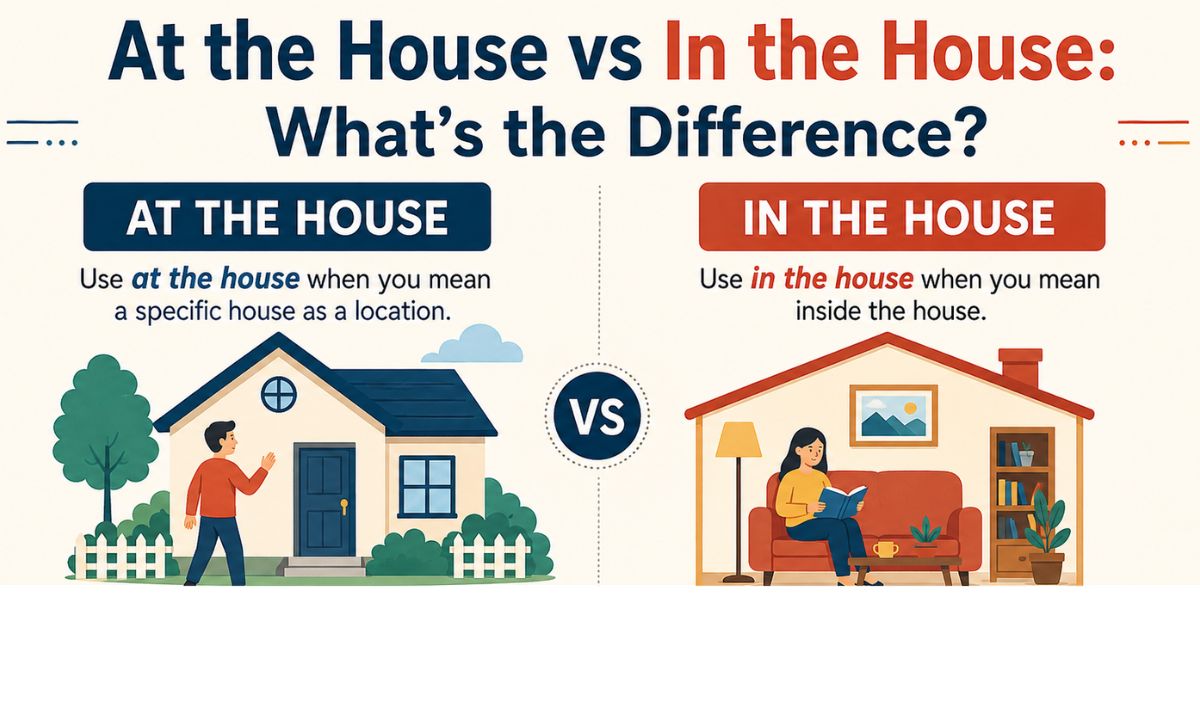
Choosing between At the House vs In the House may seem simple, but these two expressions have different meanings and are used in different situations. Because both refer to a house, many English learners mistakenly believe they can be used interchangeably. In reality, the choice depends on whether you’re talking about a location or being inside the building.
Understanding this small grammar difference can make your English sound much more natural in conversations, emails, school assignments, and professional writing.
In this complete guide, you’ll learn the meaning of each phrase, discover when to use them, compare their grammar, explore real life examples, avoid common mistakes, and master simple memory tricks that will help you choose the correct expression every time.
Quick Answer
“At the house” refers to someone’s location at or around a house, while “in the house” specifically means inside the house. If you are physically within the building, use in the house. If you’re referring to the location generally or someone’s presence at that place, use at the house.
What Does “At the House” Mean?
The phrase “at the house” refers to someone’s general location in relation to a house. It tells the listener where someone is, but it does not necessarily mean they are inside the building.
A person who is at the house could be:
- Inside the house
- Standing outside the front door
- In the driveway
- Working in the garden
- Sitting on the porch
- Waiting outside
- Parking a car nearby
The emphasis is on the location, not the exact position.
Simple Definition
At the house means located at or around a particular house, without specifying whether someone is inside or outside.
Examples of “At the House”
Consider these examples:
- I’m at the house waiting for the plumber.
- She’ll meet us at the house after work.
- The delivery driver arrived at the house around noon.
- Everyone is at the house preparing for the party.
- We stopped at the house before going to dinner.
Notice that these sentences don’t tell us whether the people are inside. They simply tell us their location.
Common Situations Where “At the House” Is Used
Native English speakers often use at the house when talking about:
- Giving directions
- Meeting someone
- Deliveries
- Arrivals and departures
- Visiting friends or relatives
- Talking on the phone about someone’s location
Examples:
- I’ll be at the house all afternoon.
- Is anyone at the house right now?
- Meet me at the house around six.
- The electrician is already at the house.
In each case, the exact position isn’t important. The speaker only wants to identify the location.
What Does “In the House” Mean?
Unlike at the house, the phrase “in the house” has a much more specific meaning. It tells us that someone or something is physically inside the building.
Whenever you want to emphasize that a person, animal, or object is within the walls of the house, in the house is the correct expression.
Simple Definition
In the house means inside the house or within the building.
This phrase focuses on position, not just location.
Examples of “In the House”
Here are some examples:
- The children are in the house watching television.
- I left my keys in the house.
- Nobody was in the house when we arrived.
- The dog is sleeping in the house.
- She stayed in the house because it was raining.
Each sentence clearly tells us that the person or object is inside the building.
Common Situations Where “In the House” Is Used
You’ll often hear this phrase when talking about:
- Family members
- Pets
- Furniture
- Lost objects
- Staying indoors
- Safety
- Weather
- Household activities
Examples:
- Everyone stayed in the house during the storm.
- There’s plenty of food in the house.
- I think my phone is in the house somewhere.
- We spent the entire weekend in the house.
In these situations, the exact interior location may not matter, but being inside the building does.
Why Do People Confuse These Expressions?
Many learners think at and in both simply describe location. While that’s true, each preposition highlights a different aspect of location.
- At points to a general place or destination.
- In points to being enclosed within something.
Because both expressions involve a house, they’re often mixed up. However, choosing the correct preposition makes your English more accurate and natural.
A simple question can help:
- Am I talking about the general location? → Use at the house.
- Am I talking about being inside the building? → Use in the house.
At the House vs In the House
Although “at the house” and “in the house” both refer to a house, they are not interchangeable. The difference depends on whether you’re describing a general location or a position inside the building.
The easiest way to understand the distinction is to think about where the speaker wants to focus the listener’s attention.
- At the house focuses on the location.
- In the house focuses on the inside of the building.
For example:
- I’m at the house. (My location is the house.)
- I’m in the house. (I’m inside the building.)
The first sentence could mean you’re standing outside, in the yard, or inside. The second sentence leaves no doubt that you’re indoors.
Quick Comparison Table
| Feature | At the House | In the House |
| Main Meaning | At or around the house | Inside the house |
| Focus | General location | Physical position |
| Inside Required? | No | Yes |
| Common Uses | Meetings, arrivals, directions | Family, objects, activities indoors |
| Formality | Standard English | Standard English |
At a Glance
| Situation | Correct Expression |
| Waiting outside the house | At the house |
| Sitting in the living room | In the house |
| Delivery driver arrives | At the house |
| Watching TV indoors | In the house |
| Meeting someone there | At the house |
| Looking for your phone inside | In the house |
Grammar Rules
The difference comes from the meanings of the prepositions at and in.
When to Use “At”
The preposition at usually identifies a specific place or destination.
It answers questions like:
- Where are you?
- Where will we meet?
- Where did you stop?
Examples:
- I’m at school.
- She’s at work.
- They’re at the airport.
- We’ll meet at the restaurant.
- I’m at the house now.
Notice that at doesn’t explain whether you’re inside or outside.
When to Use “In”
The preposition in shows that something is inside an enclosed space.
Examples:
- I’m in the classroom.
- She’s in the office.
- They’re in the car.
- We stayed in the hotel.
- He’s in the house.
Whenever something is enclosed by walls or boundaries, in is usually the correct choice.
Step by Step Guide
If you’re unsure which phrase to use, follow these simple steps.
Ask Yourself Where the Person Is
Is the person simply at the location?
If yes:
✅ At the house
Ask Whether They’re Inside
Are they physically inside the building?
If yes:
✅ In the house
Think About the Purpose
Are you describing:
- a meeting?
- an arrival?
- a visit?
- someone’s location?
Use:
✅ At the house
Are you describing:
- furniture?
- family members?
- pets?
- activities happening indoors?
Use:
✅ In the house
Real Life Examples
Understanding real situations makes the difference much easier.
Meeting a Friend
Your friend calls.
“Where are you?”
You reply:
“I’m at the house.”
This simply tells your friend your location.
Looking for Someone
Your mother asks:
“Where’s your brother?”
You answer:
“He’s in the house.”
Now everyone knows he’s inside.
Food Delivery
The delivery driver calls.
“I’m at the house.”
The driver might still be outside.
Family Dinner
Your guests arrive.
Everyone is in the house eating dinner.
This clearly means they’re indoors.
Gardening
Your father is cutting the grass.
You tell your friend:
“My dad is at the house.”
He’s outside, but still at the property.
Rainstorm
Heavy rain starts.
Everyone goes in the house.
Here, entering the building is the important detail.
Common Usage Patterns
Native English speakers naturally use these expressions in different situations.
Common Uses of “At the House”
- at the house all day
- at the house now
- arrive at the house
- stop at the house
- meet at the house
- wait at the house
- stay at the house
- someone is at the house
Example:
- I’ll be at the house until 5 p.m.
Common Uses of “In the House”
- in the house alone
- in the house together
- in the house today
- in the house somewhere
- inside the house
- everyone in the house
- nothing in the house
- food in the house
Example:
- Everyone stayed in the house because of the snow.
Common Mistakes
Many English learners confuse these phrases because they translate directly from their native language.
Here are some mistakes to avoid.
Mistake
❌ My keys are at the house.
This sounds possible, but if the keys are specifically inside:
✅ My keys are in the house.
Mistake
❌ Everyone is at the house watching TV.
More natural:
✅ Everyone is in the house watching TV.
Mistake
❌ Meet me in the house at 6.
If you’re arranging the meeting location:
✅ Meet me at the house at 6.
Mistake
❌ The electrician is in the house.
If you only mean he has arrived:
✅ The electrician is at the house.
If he has already entered:
✅ The electrician is in the house.
Both can be correct depending on the situation.
Why Context Matters
The surrounding words often tell you which expression sounds more natural.
For example:
Arrive → at the house
Meet → at the house
Wait → at the house
But:
Sleep → in the house
Cook → in the house
Watch TV → in the house
Eat dinner → in the house
Instead of memorizing rules, pay attention to how native speakers use these expressions in everyday conversations.
Why Using the Correct Preposition Matters
Choosing between at the house and in the house may seem like a small detail, but it can significantly improve the clarity and accuracy of your English. Prepositions help readers and listeners understand exactly what you mean. Using the wrong one may not always cause confusion, but it can make your English sound less natural.
Whether you’re writing an email, speaking with friends, preparing for an English exam, or creating professional content, using the correct preposition helps you communicate more confidently.
Benefits of Using the Right Expression
- Makes your English sound more natural.
- Improves grammar accuracy.
- Prevents misunderstandings.
- Strengthens your writing skills.
- Builds confidence in speaking English.
- Creates a more professional impression.
Small grammar improvements often have a big impact on overall communication.
Best Practices for Using “At the House” and “In the House”
Native English speakers don’t memorize long grammar rules every time they speak. Instead, they follow natural usage patterns. You can do the same by keeping these best practices in mind.
Use “At the House” When:
- Talking about someone’s location.
- Arranging a meeting.
- Giving directions.
- Referring to arrivals or departures.
- Discussing a visit.
- Mentioning the property in general.
Examples:
- Meet me at the house after work.
- I’ll be at the house all afternoon.
- The repair technician is at the house now.
Use “In the House” When:
- Talking about being indoors.
- Referring to people inside.
- Describing activities inside the home.
- Mentioning objects located indoors.
- Discussing safety during bad weather.
Examples:
- Everyone stayed in the house during the storm.
- I left my wallet in the house.
- The children are playing in the house.
Expert Writing Tips
Professional writers carefully choose prepositions because they add precision to a sentence.
Here are a few tips to help you write more naturally.
Think About Position
Ask yourself:
Is the person simply at the location, or are they physically inside?
If you’re talking about the general location, choose at.
If you’re emphasizing that someone is inside the building, choose in.
Read the Whole Sentence
Sometimes the surrounding words make the correct choice obvious.
Examples:
- The plumber arrived at the house.
- The plumber is working in the house.
The first sentence focuses on arrival, while the second describes where the work is happening.
Avoid Direct Translation
Many learners translate prepositions directly from their native language. Unfortunately, prepositions rarely translate perfectly.
Instead of translating word for word, learn common English expressions as complete phrases.
Practice with Everyday Situations
Imagine common scenarios:
- Visiting a friend
- Receiving a package
- Looking for your phone
- Staying home during rain
Practicing real life examples helps the correct preposition become automatic.
Pros and Cons
Although both expressions are correct, each has its own purpose.
| Expression | Advantages | Limitations |
| At the House | Flexible, useful for general locations and meetings | Doesn’t indicate whether someone is inside |
| In the House | Clearly shows someone or something is indoors | Can’t describe someone outside or arriving |
The best choice always depends on what you want to communicate.
Myths vs Facts
Many English learners have misconceptions about these expressions. Let’s clear them up.
| Myth | Fact |
| At the house means outside the house. | It can refer to someone inside or outside, as long as they’re at that location. |
| In the house and at the house mean exactly the same thing. | They have different meanings and are used in different contexts. |
| Native speakers use them interchangeably. | Native speakers choose the expression based on whether they’re describing location or position. |
| One expression is more grammatically correct than the other. | Both are grammatically correct when used in the appropriate context. |
Understanding these facts makes it easier to choose the right phrase.
American vs British English
A common question is whether American English and British English use these expressions differently.
The answer is not significantly.
Both varieties follow the same grammar rules.
American English
- I’ll meet you at the house.
- Everyone is in the house.
British English
- I’ll meet you at the house.
- Everyone is in the house.
Although regional accents and vocabulary may vary, the distinction between at and in remains the same.
Voice Search Tips
As more people use voice assistants like Siri, Google Assistant, and Alexa, conversational grammar questions have become increasingly common.
People often ask:
- Is it at the house or in the house?
- When should I say at the house?
- What’s the difference between at and in?
- Can I use at the house and in the house interchangeably?
The short answer is:
- At the house = the general location.
- In the house = inside the building.
This simple explanation is ideal for voice search and featured snippets.
Quick Reference Checklist
Before choosing the correct expression, ask yourself these questions:
Choose At the House if:
- You’re talking about a location.
- Someone has arrived.
- You’re arranging a meeting.
- The exact position isn’t important.
Choose In the House if:
- Someone is indoors.
- You’re talking about activities inside.
- You’re describing objects inside the home.
- You want to emphasize being within the building.
Keeping this checklist in mind will help you make the right choice every time.
Internal Linking Suggestions
If you run a grammar blog, these related articles would make excellent internal links:
- At Home vs In Home: What’s the Difference?
- Into vs In: Simple Grammar Rules Explained
- On the Bus vs In the Bus: Which Is Correct?
- At School vs In School: Understanding the Difference
- By Which vs In Which: What’s the Difference?
Conclusion
Understanding the difference between “at the house” and “in the house” is easier once you focus on what each preposition describes. At the house refers to a person’s general location at or around a house, while in the house specifically means being physically inside the building. Although the two phrases are closely related, they are not interchangeable in every situation.
A simple way to remember the rule is to ask yourself whether you’re talking about a location or an exact position inside the home. If it’s about the location, use at the house. If it’s about being indoors, use in the house.
By applying these grammar rules and practicing with real life examples, you’ll write and speak English more naturally and confidently. Keep this guide as a quick reference, and the next time you wonder which phrase is correct, you’ll know exactly which one to choose.