

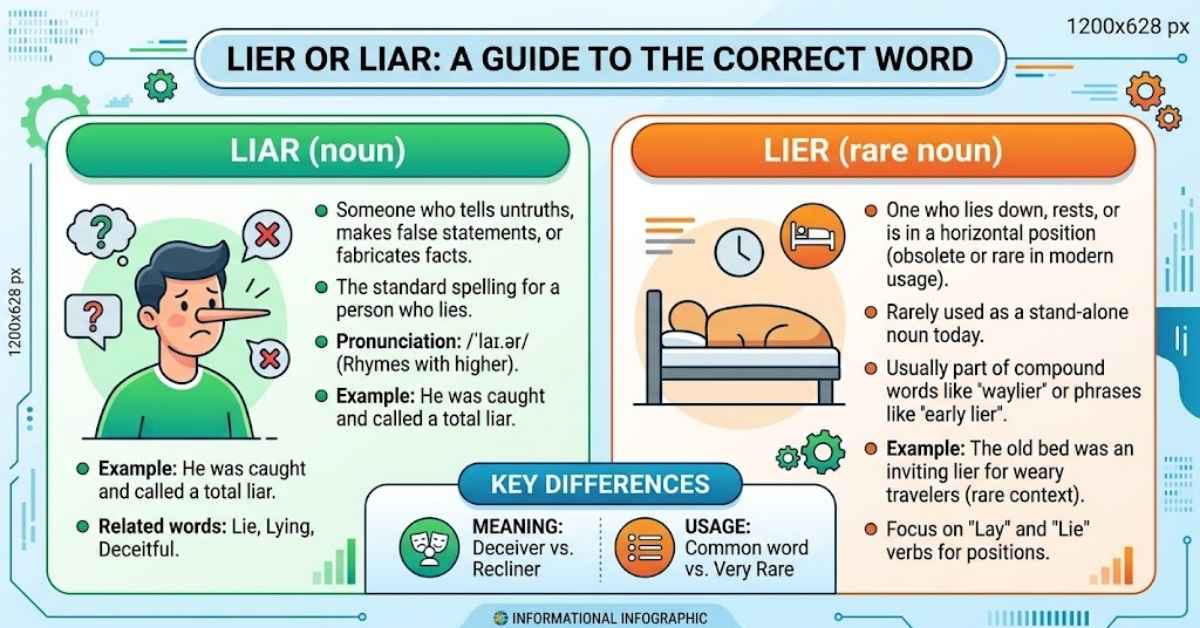
Lier or liar is a common spelling question because both words look almost identical and come from the verb lie. If you mean a person who tells lies or does not tell the truth, the correct word in ordinary English is “liar.” However, lier is also a real, uncommon English word with a different meaning related to someone or something that lies down, reclines, or, in some dictionary definitions, lies in wait.
That small difference matters because these words are not interchangeable. The easiest way to choose between them is to ask what you mean by lie in your sentence.
Lier or Liar: Quick Answer
| Word | Main meaning | Common in everyday U.S. English? | Example |
|---|---|---|---|
| liar | A person who tells lies | Yes | He is a liar. |
| lier | Someone or something that lies down or lies in wait | No, uncommon | The dictionary uses lier for one who reclines. |
So, if you are writing about dishonesty, false statements, deception, or someone who does not tell the truth, use “liar.”
If you encounter lier, it does not automatically mean the writer made a spelling mistake. Dictionaries record it as a legitimate but uncommon noun. Collins, for example, defines lier in American English in relation to reclining and also records the sense of someone or something that lies in wait.
What Does “Liar” Mean?
A liar is a person who tells lies or makes statements that are not true. Dictionary.com defines liar as a person who tells lies, while Collins gives the American English meaning as a person who tells lies.
The word is associated with the sense of the verb lie meaning to say something untrue.
For example:
- He is a liar.
- She admitted that she had lied.
- Nobody trusted the known liar.
- The witness was accused of being a liar.
- Calling someone a liar is a serious accusation.
In ordinary American English, liar is the spelling you will almost always want when describing a dishonest person.
Examples of “Liar”
Consider these sentences:
Mark told everyone that he had finished the work, but he had not. They called him a liar.
She caught him changing his story and realized he was a liar.
A person who repeatedly tells deliberate falsehoods may be described as a liar.
The important clue is the meaning: these examples concern truth and falsehood, not physical position.
What Does “Lier” Mean?
Lier is a real English word, but it is rare. Its meaning comes from another sense of the verb lie: to rest, recline, or remain in a particular position. Collins lists lier as a noun for one who lies or reclines and also records a person or thing that lies in wait. Dictionary.com similarly defines lier as a person or thing that lies, as in wait or in ambush.
This is why simply saying “lier is incorrect” is not completely accurate.
It is better to say:
“Lier is a legitimate but uncommon word. If you mean a person who tells lies, however, use liar.”
That distinction gives readers the information they actually need.
Examples of “Lier”
Because lier is uncommon, these examples may sound unusual to modern readers:
The old description referred to a lier resting quietly on the ground.
The text described a lier waiting in concealment.
In historical or specialized writing, a person lying in a particular position may be called a lier.
In modern everyday writing, writers will often choose a clearer expression such as person lying down, person reclining, or someone lying in wait instead of using lier.
Why Are Lier and Liar Confused?
The confusion becomes much easier to understand when you look at the verb lie.
English has two important meanings of lie involved here.
Lie meaning “to tell something untrue”
When lie means to tell an untruth, the related noun is:
lie → liar
Example:
He lies about his experience.
Therefore:
He is a liar.
Lie meaning “to rest or recline”
When lie means to be in a horizontal or resting position, lier can be formed as an agent noun:
lie → lier
For example, dictionaries document lier in the sense of someone or something that lies down or lies in wait.
This is the underlying reason the two spellings are so confusing: the same verb has different meanings, and the related nouns developed different forms.
Grammarly also explains the distinction by connecting liar with the “say something that is not true” sense of lie and lier with the horizontal-position sense.
Is It Lier or Liar?
If you are asking how to spell the word for someone who tells lies, the answer is:
Liar.
The spelling is:
L-I-A-R
For example:
He is a liar.
Not:
He is a lier.
The second spelling can exist as the uncommon noun described above, but it does not serve as the normal spelling for a dishonest person.
LEARN MORE: Paraplegic vs Quadriplegic
Lier or Liar: Which Is Correct in Everyday English?
For normal conversations, emails, schoolwork, articles, business writing, and most other modern English contexts, liar is the word to use when referring to someone who tells lies.
This is an important distinction because readers usually interpret liar immediately.
The word lier, although dictionary-recognized, is uncommon enough that many readers may initially assume it is a misspelling of liar. Grammarly makes the same practical observation: lier is a real word but is rarely used.
That does not make lier invalid. It simply means context and intended meaning matter.
How Do You Spell Liar or Lier?
Here is the easiest spelling comparison:
- Liar = someone who tells lies
- Lier = someone or something that lies down or lies in wait
The only difference is the vowel before the final r:
LIAR → A
LIER → E
If your sentence is about dishonesty, choose the A spelling:
The dishonest person was a liar.
If your sentence is specifically describing someone or something lying down or lying in wait, lier may be appropriate, although it is uncommon:
The dictionary records lier as a noun related to lying or reclining.
Do Lier and Liar Sound the Same?
In standard English pronunciation, lier and liar are generally pronounced alike or very similarly.
That is another reason the spelling can be difficult. When you hear the word in conversation, pronunciation usually will not tell you whether the speaker means liar or lier.
You need to understand the context.
For example:
“He is a liar.”
The context is dishonesty.
But a dictionary or historical text could use lier for someone who reclines or lies in wait.
Grammarist also notes that the two forms are pronounced the same despite their different spellings.
Lier vs. Liar Examples
The quickest way to understand the difference is to compare sentences.
| Sentence | Correct word | Why? |
|---|---|---|
| He is a ___ who constantly tells false stories. | liar | Dishonesty |
| Everyone knew she was a ___. | liar | She tells lies |
| The witness was called a ___. | liar | The accusation concerns truthfulness |
| The old text described a person lying down as a ___. | lier | Physical position |
| The passage referred to someone hiding and waiting as a ___. | lier | Lying in wait |
| Nobody trusted the habitual ___. | liar | Repeated dishonesty |
The first three examples represent normal modern usage. The lier examples illustrate the rarer dictionary sense.
An Easy Way to Remember Liar vs. Lier
Do not try to memorize the difference as an arbitrary spelling rule.
Instead, remember the meaning.
If the person lies about the truth → liar
Think:
lie = false statement → liar
She tells lies → She is a liar.
If the person lies down → lier can apply
Think:
lie = recline → lier
Someone who lies in a particular position may be described by the uncommon noun lier.
This method is more reliable because it connects the spelling to the actual meaning of the word.
LEARN MORE: Anteater vs Aardvark
Common Mistakes With Lier and Liar
Mistake 1: Writing “lier” for a dishonest person
Incorrect for the intended meaning:
He is a lier because he keeps changing his story.
Better:
He is a liar because he keeps changing his story.
Mistake 2: Assuming “lier” is never a word
This is also an oversimplification.
Dictionaries do recognize lier, particularly in meanings connected with reclining or lying in wait.
Mistake 3: Choosing based only on pronunciation
Because the words are pronounced alike or very similarly, listening alone may not solve the problem.
Look at the meaning of the sentence.
Mistake 4: Assuming every noun formed from “lie” follows the same spelling
English word formation is not always as predictable as simply adding -er to a verb. The historical development of liar and lier reflects different senses and word histories. Dictionary.com traces liar to Old English and Middle English forms, while lier has its own historical development from the reclining sense of lie.
Lier or Liar: Which One Should You Use?
Use this simple rule:
Use “liar” when you mean a person who tells lies.
Use “lier” only when the unusual noun meaning connected with lying down, reclining, or lying in wait is actually intended.
For most American English writing, liar is the word you are looking for when the topic is dishonesty.
If you are writing something formal and your intended meaning is physical position, it may be clearer to avoid the uncommon noun altogether and write “a person lying down” or “someone lying in wait.”
That removes ambiguity and makes the sentence easier to understand.
Frequently Asked Questions
Is “lier” a real word?
Yes. Lier is a real but uncommon English word. Dictionaries record it in meanings connected with someone or something that lies, including reclining or lying in wait.
Is “liar” the correct spelling for someone who lies?
Yes. If you mean a person who tells lies or does not tell the truth, the standard spelling is liar.
Is it lier or liar?
If you mean someone who tells lies, use liar. If you mean the uncommon noun associated with lying down or lying in wait, lier can be correct.
Lier or liar: which is correct?
Both are dictionary-recognized words, but they have different meanings. Liar is the normal everyday word for a person who tells lies. Lier is uncommon and relates to another sense of lie.
How do you spell liar or lier?
Liar is spelled L-I-A-R.
Lier is spelled L-I-E-R.
The correct spelling depends on the meaning.
How do you spell liar or lier when talking about dishonesty?
Spell it liar.
She is a liar.
Can I use “lier” instead of “liar”?
Not when you mean a person who tells lies. In that context, liar is the standard choice. Lier has a different and uncommon meaning.
What is the plural of liar?
The plural is liars.
Example:
The story involved several liars.
What is the plural of lier?
The plural form is liers when the uncommon noun lier is being used.
Why does “lier” look like it should be correct?
The confusion comes from the verb lie. It is natural to think that adding an ending to lie should produce lier. English, however, has separate established forms associated with the different meanings of the verb. For dishonesty, the established everyday noun is liar.
Final Answer: Lier or Liar?
If your sentence is about someone who tells lies, the answer is “liar.”
Lier is not simply a misspelling, though. It is a legitimate but uncommon word associated with someone or something that lies down, reclines, or lies in wait.
So the easiest rule is:
Dishonesty → liar
Reclining or lying in wait → lier, when that uncommon noun is specifically intended
For everyday American English, if you are describing someone who is not telling the truth, write liar.