

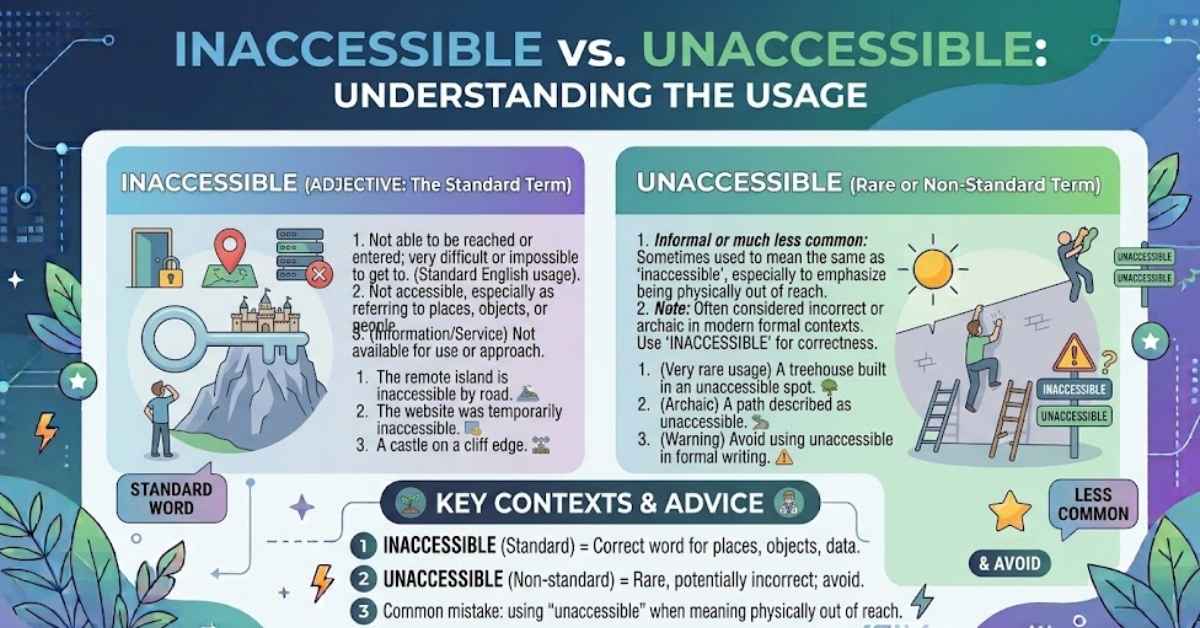
Inaccessible or unaccessible? In modern standard English, inaccessible is the correct and preferred form. It means difficult or impossible to reach, enter, obtain, use, or understand. Unaccessible has appeared in English, including older and rare usage, but it is not the normal spelling you should choose in contemporary American English.
If you are writing an email, school assignment, article, report, business document, or professional website, the safest choice is simple:
accessible → inaccessible
Inaccessible or Unaccessible: Quick Answer
| Word | Status | Meaning | Recommended today? |
|---|---|---|---|
| inaccessible | Standard modern English | Difficult or impossible to reach, get, use, or understand | Yes |
| unaccessible | Rare/older variant | Intended to mean not accessible | Generally no |
| accessible | Standard | Able to be reached, entered, used, or understood | Yes |
So, if you are wondering “inaccessible or unaccessible which is correct?”, use inaccessible.
The important point is that saying unaccessible has never existed would be too strong. Historical dictionary evidence records the form, and some modern resources still identify it as rare. The practical distinction is therefore standard modern usage versus rare or historical usage, not simply “real word versus fake word.”
What Does “Inaccessible” Mean?
Inaccessible is an adjective used when something is difficult or impossible to access.
The exact meaning depends on the context.
1. Difficult or impossible to reach
This is the most literal meaning.
The mountain road becomes inaccessible during the winter.
The road exists, but reaching it or traveling on it is difficult or impossible.
You can use inaccessible for:
- roads
- buildings
- islands
- rooms
- trails
- villages
- remote areas
- entrances
- locations
2. Difficult to obtain or use
Something can also be inaccessible when it exists but people cannot obtain or use it.
The records are inaccessible to the public.
The database is inaccessible without administrator permission.
This meaning is especially useful for information, services, resources, files, and technology.
3. Difficult to understand
Inaccessible also has a figurative meaning.
The textbook is inaccessible to beginners.
Here, the textbook is not physically locked away. Instead, its language or ideas are difficult for beginners to understand.
This is an important meaning that is sometimes overlooked in simple spelling articles.
4. Difficult to approach
The word can describe a person as well.
The manager seemed inaccessible to new employees.
In this context, the person may be difficult to approach, talk to, or get to know.
What Does “Unaccessible” Mean?
Unaccessible is understandable as a formation from un- + accessible. A reader will usually understand it to mean “not accessible” or “difficult to access.”
However, that does not make it the preferred modern form.
Some dictionary and historical sources record unaccessible as a rare or older form. Historical Webster material, for example, contains unaccessible but explicitly notes that inaccessible was already the form then being used.
So if you encounter unaccessible, don’t assume the writer’s intended meaning is impossible to understand. The form has a history. But if you are choosing the word yourself, inaccessible is the established modern choice.
Why Is “Inaccessible” the Standard Form?
The confusion makes sense because English frequently uses un- to create opposites:
- happy → unhappy
- clear → unclear
- fair → unfair
- safe → unsafe
- known → unknown
- available → unavailable
That makes this pattern look logical:
accessible → unaccessible
But English vocabulary is not completely predictable.
The established word is inaccessible, whose history goes back through French to the Late Latin inaccessibilis.
You therefore should not assume that every adjective can form its opposite by simply adding un-.
Compare:
- accurate → inaccurate
- complete → incomplete
- visible → invisible
- capable → incapable
- accessible → inaccessible
The useful rule is not “always use in-.” The useful rule is:
Use the established form of the word rather than inventing a negative form from a prefix pattern.
Inaccessible vs Unaccessible: What’s the Difference?
The basic intended meaning is usually the same: something that cannot be accessed easily.
The important difference is usage and status.
Inaccessible
Inaccessible is the normal word in contemporary standard English.
Use it in:
- everyday writing
- academic writing
- professional communication
- business documents
- technical writing
- websites
- journalism
- school assignments
Examples:
The website is inaccessible from my device.
The information is inaccessible to most users.
The road became inaccessible after the storm.
Unaccessible
Unaccessible may appear in:
- older texts
- historical sources
- rare dictionary entries
- occasional nonstandard modern writing
- discussions about the history of English
For ordinary modern writing, however, it is best to replace it with inaccessible.
Compare the two
Less standard today:
The website is unaccessible.
Preferred:
The website is inaccessible.
Less standard today:
The road became unaccessible after the flood.
Preferred:
The road became inaccessible after the flood.
Is “Unaccessible” Ever Correct?
This question deserves a nuanced answer.
If by “correct” you mean the normal word to use in contemporary American English, choose inaccessible.
If you mean has the form ever existed in English?, the answer is yes. Historical dictionary records document unaccessible, and modern WordWeb lists it as a rare form.
That distinction matters because a rare or historical word is not necessarily meaningless.
For example, you might encounter unaccessible while:
- reading an old book
- quoting a historical document
- studying historical English
- discussing word formation
- reproducing an original quotation
In those situations, preserving the original spelling may be appropriate.
But if you are writing a modern sentence yourself, use inaccessible.
LEARN MORE: Leach or Leech
How to Use “Inaccessible” Correctly
Knowing the spelling is only half the job. The word also has some useful sentence patterns.
“Inaccessible to”
Use inaccessible to when you identify the person, group, or thing that cannot access something.
The museum is inaccessible to wheelchair users.
The records are inaccessible to the public.
The information is inaccessible to ordinary users.
The service remains inaccessible to some communities.
This is one of the most useful structures to remember.
“Inaccessible by”
Use inaccessible by when you describe the method or means of reaching something.
The village is inaccessible by car.
The island is inaccessible by road.
The area is inaccessible by public transportation.
Both patterns are natural, but they emphasize different relationships.
Before a noun
Inaccessible can appear directly before a noun:
We found an inaccessible location.
They live in an inaccessible area.
The building has several inaccessible entrances.
After a linking verb
It can also come after verbs such as be, become, seem, and remain:
The road is inaccessible.
The website became inaccessible.
The information remains inaccessible.
Inaccessible vs Unavailable vs Unreachable
These words overlap, but they are not identical.
Inaccessible = access is difficult or impossible
The database is inaccessible without a password.
The database exists, but you cannot access it.
Unavailable = something cannot currently be obtained, used, or provided
The conference room is unavailable until Friday.
The emphasis is on availability rather than access.
Unreachable = something or someone cannot be reached or contacted
The manager was unreachable by phone.
Here, the emphasis is communication.
Another example:
The village became unreachable after the bridge collapsed.
That focuses on the inability to reach the village.
An easy way to choose
Ask yourself:
Can I access it? → inaccessible
Is it currently available for use or obtaining? → unavailable
Can I reach or contact it? → unreachable
There can be overlap, so context still matters.
Inaccessible in Technology and Digital Writing
Modern English frequently uses inaccessible for websites, apps, files, accounts, databases, and online services.
For example:
The website is currently inaccessible.
The file is inaccessible without the correct permissions.
The online records are inaccessible to unauthorized users.
The account became inaccessible after the security update.
There is also an important accessibility-related use.
A website may technically exist and load successfully but still be inaccessible to some users because of barriers involving navigation, assistive technology, keyboard access, visual presentation, or other usability issues.
That is a different issue from simply being offline.
Inaccessible in Academic and Professional Writing
Inaccessible works naturally in formal writing.
You might write:
The research database remains inaccessible to external users.
The article contains terminology that is inaccessible to non-specialists.
Several records are currently inaccessible because of privacy restrictions.
The remote facility is inaccessible by road during the winter.
The word does not sound too formal or too casual. It is a standard adjective that works across registers.
Common Mistakes
Mistake 1: Writing “unaccessible” because “un-” means “not”
This is the most understandable mistake.
You see:
accessible = able to be accessed
and naturally create:
unaccessible = not accessible
The logic makes sense, but English has an established form:
accessible → inaccessible
Mistake 2: Writing “inaccessable”
This is another common spelling error.
The correct spelling is:
inaccessible
Not:
❌ inaccessable
The ending is -ible, not -able.
Mistake 3: Assuming “inaccessible” only means physically unreachable
It can also mean:
- difficult to obtain
- difficult to use
- difficult to understand
- difficult to approach
For example:
The professor’s explanation was inaccessible to beginners.
The problem is understanding, not physical distance.
Mistake 4: Using “inaccessible” when you mean “unavailable”
Compare:
The website is inaccessible because users cannot open it.
with:
The meeting room is unavailable because someone else booked it.
The first concerns access. The second concerns availability.
Mistake 5: Using “inaccessible” when “unreachable” is more precise
If you mean that you tried to contact someone and received no response, unreachable may be the better word.
I called her several times, but she was unreachable.
That is more precise than saying she was inaccessible.
LEARN MORE: Resell or Resale
Examples of Inaccessible in Real Sentences
Here are examples covering different meanings:
- The mountain trail is inaccessible during heavy snowfall.
- The building is inaccessible to visitors after 8 p.m.
- The database is inaccessible without administrator approval.
- Some government records remain inaccessible to the public.
- The website became inaccessible after the server failed.
- The lecture was inaccessible to students without a technical background.
- The village is inaccessible by road during the rainy season.
- The service remains inaccessible to people in remote areas.
- The manager seemed inaccessible to junior employees.
- The file is inaccessible without the correct password.
Notice how the meaning changes with the context while the spelling remains the same.
A Simple Memory Trick
Don’t try to decide whether un- “should” work.
Remember the established pair:
accessible → inaccessible
That is the easiest pattern to memorize.
You can also connect the word with access:
If something cannot be accessed, it is inaccessible.
This works for a road, building, website, file, database, service, information, or idea.
FAQs
Is “inaccessible” the correct word?
Yes. Inaccessible is the standard modern English adjective.
Is “unaccessible” a word?
It has historical and rare usage and appears in some dictionaries or word references, but it is not the normal modern form. For contemporary writing, use inaccessible.
Is it “inaccessible or unaccessible”?
The preferred modern spelling is inaccessible.
What is the “inaccessible or unaccessible” meaning?
Both forms have been used to express the idea of not being accessible, but inaccessible is the standard modern form. It can mean difficult or impossible to reach, enter, obtain, use, or understand.
Is “unaccessible” wrong?
Calling it simply nonexistent would be inaccurate. Unaccessible is historically attested and can be found as a rare form. However, it is not the normal choice in modern standard English.
Why is it inaccessible and not unaccessible?
The established English word developed as inaccessible, from a Latin-based form. English does not always create negative adjectives by simply adding un-.
Is inaccessible formal or informal?
Inaccessible works in both everyday and formal English. You can use it in conversation, emails, academic writing, business documents, technical writing, and professional articles.
What is the opposite of accessible?
The standard opposite is inaccessible.
The building is accessible.
The building is inaccessible.
Is inaccessible the same as unreachable?
Not always. Inaccessible focuses broadly on access, while unreachable often focuses on physical reach, communication, or contact.
Is inaccessible the same as unavailable?
No. Inaccessible emphasizes difficulty or inability to access something. Unavailable emphasizes that something is not currently available for use, obtaining, or another purpose.
Should I write “inaccessible to” or “inaccessible by”?
Both can be correct.
Use inaccessible to when identifying who or what cannot access something:
The files are inaccessible to the public.
Use inaccessible by when identifying the method of reaching something:
The village is inaccessible by car.
Can I use “unaccessible” in an academic paper?
It is better to use inaccessible. Academic writing benefits from the established standard form.
What is the easiest way to remember the spelling?
Remember:
accessible → inaccessible
If you mean “not accessible,” choose inaccessible.
Final Answer: Inaccessible or Unaccessible?
When deciding between inaccessible or unaccessible, use inaccessible in modern American English.
Inaccessible is the established standard form and can describe something that is difficult or impossible to reach, enter, obtain, use, or understand.
Unaccessible is not simply a meaningless invention—it has historical and rare usage—but it is uncommon enough that it should generally be avoided in ordinary contemporary writing.
So the practical rule is:
Use “inaccessible.”
That choice is clear, natural, and appropriate for everyday, academic, professional, and technical writing.