

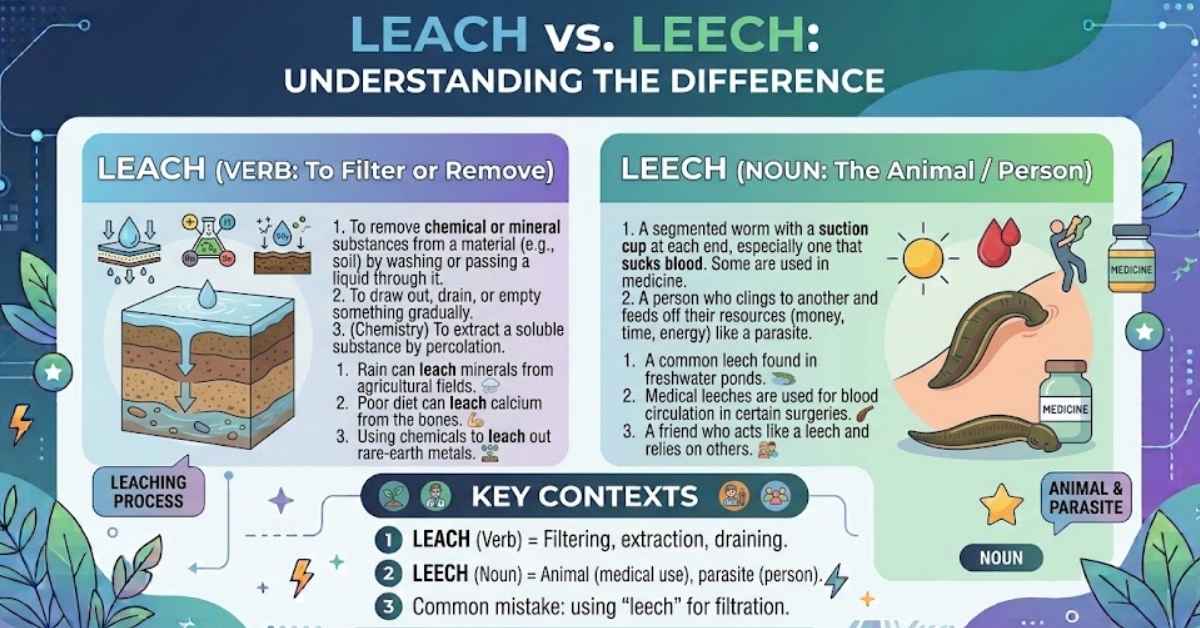
Leach or leech? Both are real English words, but they do not mean the same thing.
Use leach when you mean to remove or carry soluble substances away through a liquid, especially water. Use leech when you mean the blood-feeding worm or, figuratively, a person who takes money, help, attention, or other resources without giving much back. Both words are pronounced /liːtʃ/ in standard U.S. English, which is why they are so easy to confuse.
The quickest memory trick is:
Leach = liquid removes something. Leech = a creature or person that clings and takes.
Leach vs. Leech: The Quick Answer
| Word | Meaning | Typical context | Example |
|---|---|---|---|
| leach | Remove soluble material through liquid | Soil, water, chemicals, agriculture | Rain can leach nutrients from soil. |
| leech | A blood-feeding worm | Biology, animals, medicine | A leech attached to his leg. |
| leech | A person who takes from others | Informal/figurative | He was acting like a leech. |
So, if you are asking “is it leach or leech?”, the answer depends on what you mean—not on which spelling is universally “correct.”
Both spellings are correct. The context determines the word.
Is It Leech or Leach?
Ask yourself what is happening in the sentence.
If water or another liquid is removing a substance, use leach.
- Rain can leach nutrients from farmland.
- Water may leach minerals from rock.
- Chemicals can leach into groundwater.
- Excess irrigation can cause fertilizer to leach from soil.
The If you are talking about the animal, use leech.
- A leech attached itself to the swimmer.
- The pond contains several species of leeches.
- The hiker found a leech on his leg.
If you are describing a person who takes from others, use leech.
- He was accused of being a leech.
- She did not want to leech off her parents.
Cambridge defines leach in terms of substances being removed by water and defines leech as both a worm and, figuratively, someone who obtains money or support from others.
Leach or Leech Meaning
What Does “Leach” Mean?
Leach is primarily a verb describing the removal or movement of soluble material through a liquid.
It is especially common in environmental science, agriculture, chemistry, geology, and soil science.
For example:
Heavy rain can leach nitrogen from the soil.
Here, rainwater moves through the soil and carries soluble nitrogen compounds with it.
Cambridge specifically defines leach as a process in which a chemical substance is removed from material, particularly soil, by water passing through it.
What Does “Leech” Mean?
Leech has two important modern meanings.
First, it is a worm-like animal that attaches to humans or animals and feeds on blood.
Second, it can describe a person who takes money, support, resources, or other benefits from someone else without contributing fairly.
For example:
He keeps borrowing money from everyone and never pays anyone back. He is acting like a leech.
The figurative meaning comes naturally from the image of a parasite attached to a host.
Are Leach and Leech Homophones?
Yes.
In standard U.S. English, leach and leech are pronounced the same: /liːtʃ/. Cambridge lists the same U.S. pronunciation for both words.
That makes them homophones: words that sound alike but have different spellings and meanings.
This is also why ordinary spellcheck can fail to catch the mistake.
For example:
“A leach attached itself to my leg.”
There is nothing wrong with leach as a spelling. It is a legitimate English word. The problem is that the sentence requires leech.
A spellchecker can recognize spelling. It cannot always determine the meaning you intended.
What Does “Leach” Mean in a Sentence?
Here are some natural examples:
- Rainwater can leach nutrients from the soil.
- Heavy rainfall may leach minerals into deeper layers of soil.
- Certain chemicals can leach into groundwater.
- The process was designed to leach salt from the soil.
- Some substances may leach out of a material when exposed to water.
Notice the semantic pattern: a liquid is involved in moving or removing something.
Dictionary.com likewise defines leach around dissolving soluble constituents through percolation and lists related forms such as leached and leaching.
What Does “Leech” Mean in a Sentence?
Leech as an Animal
- A leech attached itself to his ankle.
- The hiker discovered a leech after walking through wet vegetation.
- Some leeches feed on the blood of animals.
Leech as a Person
- He has become a financial leech.
- She accused him of leeching off his friends.
- Nobody wanted to support someone who continually leeched off others.
The figurative use is normally disapproving because it suggests someone is benefiting from another person without making a fair contribution. Cambridge explicitly marks this sense as disapproving.
To Leech or Leach?
Both expressions can be grammatically correct, but they describe different actions.
To leach
To leach means to remove or extract soluble material through a liquid.
Water can leach minerals from rock.
You can also use it in the passive:
Valuable nutrients were leached from the soil.
To leech
To leech means to behave like a leech—to take from another person or source.
A particularly common construction is leech off:
He continues to leech off his parents.
Cambridge lists leech off as a verb meaning to obtain money, food, or other things from other people without working for them or otherwise deserving them.
So:
- Water leaches minerals from soil.
- A person leeches off another person.
Those are completely different meanings.
Leach vs. Leech: Verb Forms
The forms can make the distinction easier to see.
Leach
- leach
- leaches
- leached
- leaching
Examples:
Water leaches chemicals from the material.
The soil was heavily leached.
Researchers are studying leaching in agricultural soil.
Leech
- leech
- leeches
- leeched
- leeching
Examples:
The parasite leeches nutrients from its host.
He leeched off his friends.
She accused him of leeching off her success.
The doubled e in leech stays with the word throughout its forms.
Leach or Leech Animal: Which Spelling Is Correct?
If you mean the animal, the correct spelling is:
Leech
A leech is a type of worm-like animal that lives in wet environments and can attach to humans or other animals to feed on blood.
So write:
A leech attached to my leg.
Not:
A leach attached to my leg.
The second sentence uses a real English word, but it has the wrong meaning.
Why is it called a “leech”?
The animal’s name has a long association with medicine because leeches were historically used in bloodletting. The modern word also developed a figurative sense for someone who takes from others.
That makes the spelling leech especially useful to remember when the subject is a living creature.
Leach Field or Leech Field?
This is one of the most useful distinctions to remember if you live in the United States and are dealing with a septic system.
The standard term is:
Leach field
You may also see:
- drainfield
- drain field
- soil absorption field
- leaching field
- leach bed
The U.S. Environmental Protection Agency describes a conventional septic system as using a septic tank and a drainfield, with effluent released through perforated pipes into a leach field or similar system so it can move into the soil.
EPA documentation also explicitly uses leach field as a term for a subsurface wastewater infiltration system.
Cambridge similarly lists leach field as a synonym for leach bed, describing the area where liquid from a septic tank gradually flows into the ground.
So is “leech field” wrong?
For standard septic-system terminology, leach field is the spelling to use.
Why?
Because the term is related to leaching: liquid wastewater passes through soil, where the soil provides filtration and treatment.
It has nothing to do with the blood-feeding animal.
So:
Correct:
The house has a septic tank and a leach field.
Not the standard term:
The house has a septic tank and a leech field.
This is an especially important distinction because “leech” sounds plausible when you hear “leach field,” but the underlying concept is liquid movement through soil.
Why Do People Confuse Leach and Leech?
There are several reasons.
1. They sound exactly alike
This is the biggest reason.
When someone hears the sentence rather than sees it written, there is no spelling clue.
2. Their spellings are almost identical
Only one vowel differs:
- leach
- leech
That tiny visual difference creates a surprisingly large semantic difference.
3. Both can involve “taking”
This is a less obvious source of confusion.
Leach can describe something being removed from a material.
Leech can describe an organism or person taking something from a host.
Compare:
Water leaches minerals from soil.
with:
A parasite leeches nutrients from a host.
The conceptual relationship can actually make the words feel similar, even though their uses are different.
4. Spellcheck may not help
Both are legitimate words.
A writing application may not flag:
“The chemicals will leech into the groundwater.”
because leech is spelled correctly.
The error is contextual, not typographical.
Leach vs. Leech in Science
In scientific and environmental writing, leach and leaching are especially common.
You may encounter phrases such as:
- chemical leaching
- nutrient leaching
- nitrate leaching
- metal leaching
- pesticide leaching
- soil leaching
- contaminant leaching
- leaching into groundwater
- leached from soil
- leaching through soil
For example:
Heavy rainfall can increase nutrient leaching from agricultural soil.
Cambridge’s examples include chemical substances, nitrate, groundwater, soil and leaching processes, reinforcing the strong environmental-science association of leach.
A useful grammar pattern
You will frequently see:
[substance] + leach + into + [destination]
Chemicals leach into groundwater.
Or:
[liquid] + leach + [substance] + from + [material]
Rainwater leaches minerals from soil.
These patterns are much more useful than simply memorizing a dictionary definition.
Leach vs. Leech in Medicine
Medicine can involve both words, which makes context especially important.
Leech in medicine
Medicinal leeches have been used in medicine because they feed on blood. The word leech therefore remains relevant in medical contexts involving medicinal leech use.
Leach in medicine
Medical and public-health writing can also use leach when discussing substances moving out of materials.
For example:
Researchers investigated whether chemicals could leach from packaging into food.
Here, the subject is chemical movement—not an animal.
LEARN MORE: Plushy or Plushie
Leach vs. Leech in Academic Writing
Precision matters in academic writing because the reader cannot rely on your pronunciation.
Compare:
Heavy rainfall can leach nutrients from soil.
This is appropriate for environmental science.
Now compare:
A leech attaches to its host.
This is appropriate for biology.
And:
The student was accused of leeching off his classmates.
This is figurative and belongs to ordinary/social language rather than scientific terminology.
The best choice is therefore not determined by whether your writing is “formal” or “informal.” Meaning determines the spelling.
Common Mistakes With Leach and Leech
Mistake 1: “A leach attached to my leg.”
Use:
A leech attached to my leg.
The animal is a leech.
Mistake 2: “Chemicals leech into groundwater.”
For the environmental process, use:
Chemicals leach into groundwater.
Mistake 3: “He leaches off his parents.”
Use:
He leeches off his parents.
The verb meaning “take from someone parasitically” is leech.
Mistake 4: “Leech field”
For a conventional septic-system term, use:
leach field
Mistake 5: Assuming one spelling is correct and the other is wrong
This is the fundamental mistake.
Leach is correct. Leech is correct.
They simply have different meanings.
Leach or Leech Difference: A Simple Mental Test
When you’re stuck, don’t stare at the spelling.
Ask:
Is a liquid doing the removing?
Use LEACH.
Rainwater leaches minerals from soil.
Is a creature attached to a host?
Use LEECH.
A leech attached itself to the swimmer.
Is a person taking from someone without contributing?
Use LEECH.
He keeps leeching off his friends.
Is it a septic-system drainage area?
Use LEACH FIELD.
This four-part test handles most real-world cases.
A Better Memory Trick for Leach vs. Leech
Try associating the extra e in leech with an entity—something living.
LEECH → living creature
Then:
LEACH → liquid process
It is not a linguistic rule, but it is a useful memory device.
Another way to visualize it:
Leach = wash out. Leech = latch on.
One involves material moving through or from something.
The other involves something clinging to a host or source.
American English: Is the Spelling Different?
No.
For U.S. English, use:
- leach for the liquid-removal process
- leech for the worm and figurative “taker”
- leach field for the septic-system term
There is no American-versus-British spelling switch comparable to color/colour.
Cambridge provides U.S. pronunciations and definitions for both words while retaining the same spellings.
So if you’re writing for a United States audience, you do not need a regional spelling adjustment.
“Leach” vs. “Leech” in Everyday Contexts
Here is a practical cheat sheet.
| If you’re talking about… | Use |
|---|---|
| Chemicals leaving soil | leach |
| Minerals removed by water | leach |
| Nutrients washing out of soil | leach |
| Chemicals entering groundwater | leach |
| A septic drainfield | leach field |
| A blood-feeding worm | leech |
| A medicinal worm | leech |
| A person exploiting others | leech |
| Someone taking without contributing | leech |
| Depending on parents financially | leech off |
| Parasite-like behavior | leech |
Quick Examples: Correct or Incorrect?
Environment
❌ Chemicals can leech into groundwater.
✅ Chemicals can leach into groundwater.
Animal
❌ A leach attached to his leg.
✅ A leech attached to his leg.
Social behavior
❌ He leaches off his parents.
✅ He leeches off his parents.
Septic system
❌ The wastewater flows into the leech field.
✅ The wastewater flows into the leach field.
Agriculture
❌ Heavy rain can leech nutrients from soil.
✅ Heavy rain can leach nutrients from soil.
Biology
❌ The leach feeds on blood.
✅ The leech feeds on blood.
What About “Leached” and “Leeched”?
Both forms exist because both base words exist.
Leached
Use leached for the process of removing substances through liquid.
The minerals were leached from the soil.
Some compounds had leached into the groundwater.
Leeched
Use leeched for the verb associated with a leech or figurative parasitic behavior.
He leeched off his family for years.
The choice still depends entirely on meaning.
LEARN MORE: Momento or Memento
What About “Leaching” and “Leeching”?
Again, both are valid words.
Leaching
Usually refers to a liquid-mediated extraction or removal process.
Leaching can move nutrients below the root zone.
Leeching
Can refer to parasitic or exploitative behavior.
He was leeching off his friends.
This is one of the easiest places to see why a spellchecker cannot solve the problem by spelling alone.
One-Sentence Rule to Remember
If you remember only one thing, remember this:
Use “leach” when liquid removes something; use “leech” for the worm or someone who takes from others.
And for septic systems:
It is a leach field, because the wastewater is being dispersed into soil.
Frequently Asked Questions
Is it leach or leech?
Both are correct words. Use leach for the removal or movement of soluble substances by liquid. Use leech for the worm or for a person who takes from others.
Is it leech or leach for the animal?
Leech.
A leech attached itself to the swimmer.
Is it leach or leech for chemicals?
Leach.
Chemicals can leach into groundwater.
Is it leach or leech field?
For a septic system, the standard term is leach field. EPA uses leach field as a term for part of a conventional septic/drainfield system.
Are leach and leech pronounced the same?
Yes. In standard U.S. English, both are pronounced /liːtʃ/.
Can “leech” be a verb?
Yes. To leech can mean to take from someone or something in a parasitic way. The construction leech off is particularly common.
Can “leach” be a noun?
Yes, although its noun uses are much less common in ordinary conversation. Dictionary.com lists noun senses connected with the process or product of leaching.
Is “leech” always about an animal?
No. It can also be used figuratively for someone who takes money, support, resources, or other benefits from another person without giving much in return.
Is “leach” the same as “leech”?
No. They are homophones, not interchangeable words.
Why does spellcheck sometimes miss a leach/leech mistake?
Because both spellings are legitimate English words. The problem is usually meaning and context, not spelling.
What is the easiest way to remember leach vs. leech?
Think:
LEACH = liquid
LEECH = living parasite
If you’re talking about a septic system, remember leach field.
Final takeaway
The confusion between leach or leech is mostly caused by pronunciation. Once you stop listening for the spelling and start looking at the meaning of the sentence, the choice becomes straightforward.
Leach belongs with water, soil, chemicals, minerals, nutrients, extraction, groundwater, and septic leach fields.
Leech belongs with the worm, hosts, blood, parasites, medicinal leeches, and people who take from others.
So:
Water leaches. A worm leeches. A person can leech off someone. A septic system has a leach field.
That distinction is enough to handle the overwhelming majority of leach vs. leech questions correctly.