

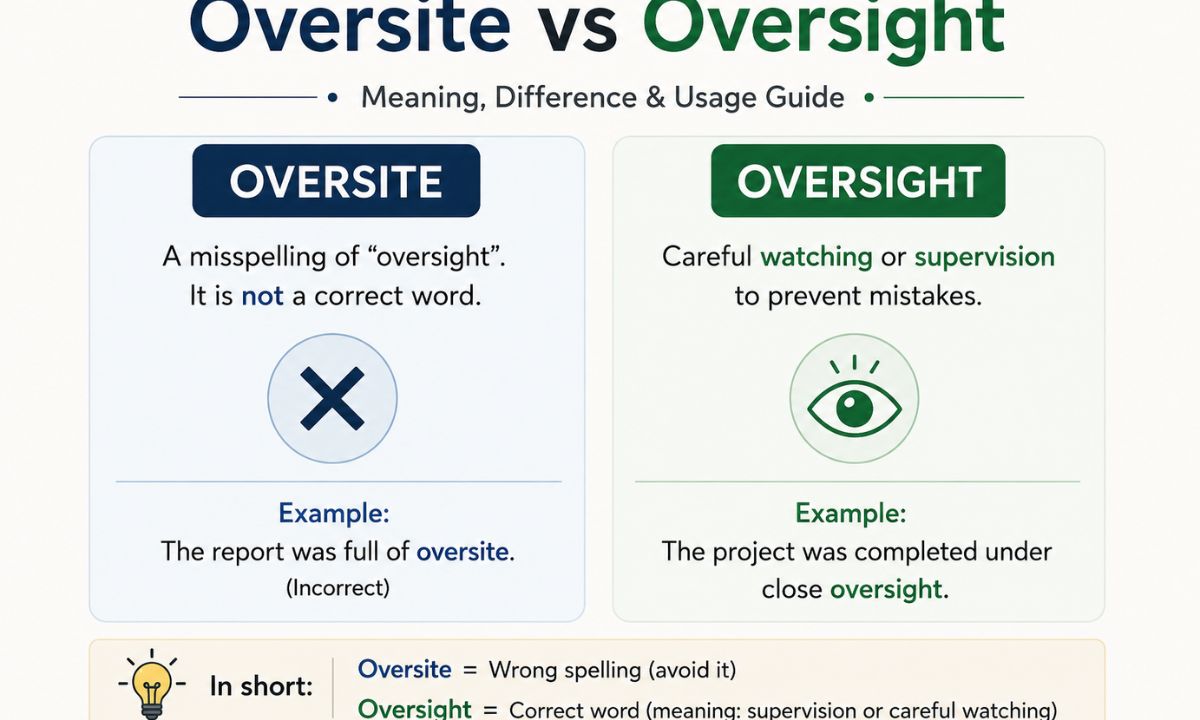
Oversite vs oversight is a common spelling confusion in English. The two forms look almost identical, but they do not have the same standard usage.
If you want to describe supervision, monitoring, or an unintentional mistake, the correct word is usually oversight. The spelling includes “ght” at the end.
For example:
“The manager provides oversight for the entire project.”
However, oversight has another important meaning. It can also describe something that someone accidentally failed to notice or consider.
For instance:
“Leaving the attachment out of the email was an oversight.”
So, what about oversite? Although you may see this spelling occasionally, it is not the standard word for these common meanings. In most situations, using oversight will make your writing clearer and more accurate.
What Does “Oversight” Mean?
Oversight is a noun with two major meanings. The meaning depends on the context.
First, it can mean supervision or careful monitoring. Second, it can mean an accidental mistake caused by failing to notice something.
These meanings may seem opposite at first. However, context makes the intended meaning clear.
Supervision or Monitoring
In one sense, oversight means supervising or monitoring a person, activity, project, or organization.
This meaning often appears in business, government, education, healthcare, and professional settings.
For example:
“The committee provides oversight of the new program.”
Here, oversight means that the committee monitors the program and makes sure it operates properly.
More examples include:
- “The director has oversight of the department.”
- “Financial oversight helps organizations manage resources responsibly.”
- “The project requires regular oversight.”
- “The board provides oversight of company operations.”
In everyday conversation, you might say:
“Who has oversight of this project?”
This simply asks who supervises or monitors it.
An Unintentional Mistake
Oversight can also mean an accidental mistake that happens because someone fails to notice something.
For example:
“Forgetting to include the final page was an oversight.”
The person did not necessarily intend to make the mistake. Instead, they accidentally missed something.
Here are some everyday examples:
- “I forgot to attach the document. That was an oversight.”
- “Missing the deadline was an unfortunate oversight.”
- “The incorrect date appeared because of an oversight.”
- “Leaving her name off the list was a simple oversight.”
This meaning commonly appears when someone wants to describe a minor or accidental error without suggesting deliberate wrongdoing.
Why “Oversite” Is Often Used Incorrectly
The spelling oversite looks logical because English contains many words ending in -site, such as website, campsite, and onsite.
However, oversight is the standard spelling for the meanings discussed above.
People may type oversite because they pronounce the two forms similarly or because they associate the word with site.
For example, someone might write:
❌ “The manager provides oversite of the team.”
The standard form is:
✅ “The manager provides oversight of the team.”
Similarly:
❌ “Forgetting the appointment was an oversite.”
Better:
✅ “Forgetting the appointment was an oversight.”
Therefore, when you mean supervision or an accidental omission, remember the spelling oversight.
Oversite vs Oversight: Key Differences
The easiest way to understand the difference is to compare the two forms directly.
| Feature | Oversight | Oversite |
| Standard English word for supervision | Yes | No |
| Standard word for an accidental mistake | Yes | No |
| Common in professional writing | Yes | No |
| Common in everyday English | Yes | Rare/nonstandard for these meanings |
| Example | “The manager provides oversight.” | “The manager provides oversite.” |
| Recommended spelling | Oversight | Usually avoid |
Oversight Has Two Main Meanings
One useful detail makes oversight slightly unusual.
It can refer to:
Supervision:
“Government agencies provide oversight.”
Accidental omission:
“Leaving out the information was an oversight.”
The surrounding sentence tells you which meaning the writer intends.
Common Contexts Where “Oversight” Is Used
The word oversight appears in many different areas of life.
Business
Businesses often use oversight when discussing management and supervision.
“The department needs stronger financial oversight.”
This means someone needs to monitor financial activities more carefully.
Government
Government discussions frequently use the term when describing monitoring and accountability.
“The committee provides oversight of government spending.”
Here, oversight means supervision or review.
Education
Schools and educational organizations can also use the word.
“The principal has oversight of school operations.”
This means the principal supervises or monitors those activities.
Projects
Project managers often talk about oversight when discussing quality, deadlines, and responsibilities.
“The team leader provides oversight throughout the project.”
The word sounds professional and works well in reports and formal communication.
Everyday Life
You do not need to work in a company or government organization to use oversight.
For example:
“I forgot to check the address before sending the package. It was an oversight.”
This is a natural everyday use of the second meaning.
Oversight vs Mistake: Are They the Same?
Not exactly.
A mistake is a broad term for something done incorrectly. An oversight usually points to something that someone failed to notice, remember, check, or include.
Compare these examples:
Mistake:
“I entered the wrong phone number.”
Oversight:
“I forgot to include the phone number.”
Both situations involve errors. However, the second one specifically involves overlooking something.
Therefore, oversight can describe a particular type of mistake rather than every possible error.
Easy Way to Remember the Correct Word
A simple memory trick can help you remember oversight.
Think of the phrase:
“I overlooked it.”
The noun connected with this idea is:
oversight
For example:
“I overlooked the missing page.”
That missing page was an oversight.
Another way to remember it is to focus on the ending:
Oversight = over + sight
The word contains sight, which can remind you of noticing or seeing something.
Although this is only a memory trick and not a complete explanation of the word’s history, it can make the spelling easier to recall.
Quick Memory Rule
When you mean:
- supervision → oversight
- monitoring → oversight
- accidental omission → oversight
Choose oversight.
How to Use “Oversight” Correctly
The word works naturally in several sentence patterns.
When It Means Supervision
“The board provides oversight of the organization.”
“The manager has oversight of daily operations.”
“The project requires independent oversight.”
When It Means an Accidental Mistake
“Leaving out the final figure was an oversight.”
“I missed the meeting because of an oversight in my calendar.”
“The incorrect label resulted from an oversight.”
These examples show why context matters. The same word can describe either monitoring or an accidental omission.
Oversight in Everyday Conversation
Although oversight often appears in formal writing, people also use it in normal conversations.
Imagine someone forgets to bring an important item.
Friend: “Did you bring the keys?”
Person: “No, I forgot them. That was an oversight.”
Another situation could involve work:
Coworker: “Who is checking the final report?”
Manager: “I have oversight of the final review.”
In the first conversation, oversight means an accidental omission. In the second, it means supervision.
This makes the word useful in both casual and professional contexts.
Why Spelling Accuracy Matters
Correct spelling helps readers understand your meaning quickly.
A misspelled word can make professional writing look less polished. This matters especially in:
- Emails
- Resumes
- School assignments
- Business reports
- Articles
- Websites
- Official documents
Writing oversight instead of oversite also helps you avoid confusion.
For example:
“The manager has oversight of the project.”
looks natural and professional.
By contrast:
“The manager has oversite of the project.”
may cause the reader to wonder whether you intended a different word.
Therefore, accurate spelling supports both clarity and credibility.
Is “Oversite” Ever Used?
You may encounter oversite in some specialized names, proper nouns, or informal writing. However, that does not make it the standard replacement for oversight.
If you are writing a normal English sentence about monitoring or an accidental omission, choose oversight.
When a particular organization, product, location, or technical term intentionally uses Oversite as its name, the situation can differ. Proper names follow their own spelling conventions.
For ordinary English usage, however, oversight remains the reliable choice.
Common Mistakes With Oversight
One frequent mistake involves using oversite instead of oversight.
Another mistake occurs when writers use oversight without making the context clear.
For example:
“The company needs more oversight.”
This usually means more supervision or monitoring.
But:
“The missing information was an oversight.”
Here, it clearly means an accidental omission.
Understanding the surrounding context makes the meaning easy to identify.
FAQs About Oversite vs Oversight
Is “oversite” a real English word?
Oversite can appear in certain specialized contexts or names, but it is not the standard spelling for supervision or an accidental omission. For ordinary English usage, oversight is the correct choice.
What is the correct spelling: oversite vs oversight?
The standard spelling is oversight. Use it when you mean supervision, monitoring, or an accidental failure to notice something.
Can “oversight” mean a mistake?
Yes. Oversight can describe an unintentional mistake caused by overlooking, forgetting, or failing to notice something.
Why do people confuse oversite vs oversight?
People often confuse them because they sound similar and because site appears in many familiar English words. However, the established spelling for these meanings is oversight.
Is oversight formal or informal?
Oversight works in both formal and everyday English. It appears frequently in professional contexts, but people can also use it casually to describe an accidental omission.
What is the difference between oversight and overlooking?
Overlooking describes the action of failing to notice something, while oversight can describe the resulting omission or mistake. For example, forgetting an important detail can be called an oversight.
Conclusion
When choosing between oversite vs oversight, the correct option for standard English is usually oversight.
It has two important meanings. First, it can refer to supervision or monitoring, as in “the committee provides oversight.” Second, it can describe an accidental omission or mistake, as in “forgetting the attachment was an oversight.”
Although you may occasionally see oversite, it should not normally replace oversight in standard writing.
The easiest rule is simple:
Supervision = oversight.
Accidental omission = oversight.
Remembering these two meanings will help you use the word confidently in emails, schoolwork, professional documents, websites, and everyday conversations.