

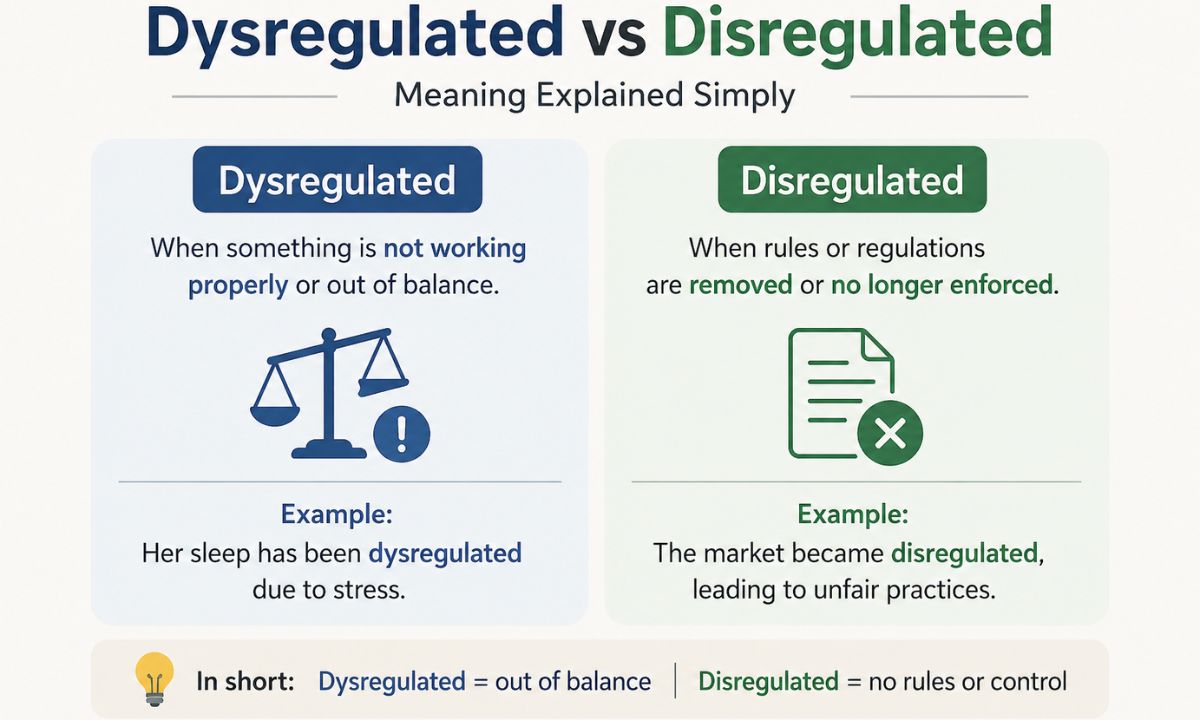
Have you ever seen the words dysregulated vs disregulated and wondered which one is correct? The confusion is understandable because both words look similar. However, they do not have the same status or usage in modern English.
Dysregulated is the standard and widely accepted term when you mean that a system, process, or emotional response has moved away from normal regulation. It commonly appears in psychology, medicine, biology, and everyday discussions about emotions.
Disregulated, on the other hand, appears occasionally, but it is much less common and often gets used when someone intends to write dysregulated.
Understanding this difference can make your writing clearer, especially when discussing emotional dysregulation, stress, behavior, or biological processes.
What Does Dysregulated Mean? (Correct Term)
Dysregulated means that something is not being controlled, balanced, or regulated in the usual way.
The word comes from dysregulation, which describes a problem or disruption in normal regulation. The prefix dys- generally suggests something that is difficult, abnormal, impaired, or not functioning properly.
For example:
- “The child became emotionally dysregulated after the argument.”
- “Stress can leave a person feeling dysregulated.”
- “The body may become dysregulated when normal processes are disrupted.”
In simple terms, dysregulated means out of balance or having difficulty managing a normal process.
The word does not automatically mean that something is permanently wrong. Instead, it often describes a temporary or ongoing difficulty with regulation.
Dysregulated in Different Contexts
You may encounter the word in several fields:
| Context | Meaning |
| Emotions | Difficulty managing emotional responses |
| Psychology | Problems controlling or balancing emotional reactions |
| Biology | A biological process that does not function normally |
| Medicine | A regulatory system that has become disrupted |
| Everyday speech | Feeling overwhelmed or unable to regain emotional balance |
So, although dysregulated can sound technical, people increasingly use it in everyday conversations too.
Is “Disregulated” a Real Word?
Disregulated does appear in English writing, but it is not the usual choice when discussing emotional or biological regulation.
In many modern contexts, dysregulated is the clearer and more established term.
This distinction matters because people sometimes assume that adding dis- to “regulated” creates the correct opposite. English does not always work that way. Prefixes have different meanings and histories, so the most logical looking formation is not necessarily the standard word.
For example, someone might write:
“I feel disregulated today.”
However, in a psychological or emotional context, dysregulated would normally communicate the intended meaning more accurately.
Therefore, if you are writing an article, school assignment, professional document, or social media post about emotional regulation, dysregulated is generally the safer choice.
Why Dysregulation Happens in the First Place
Dysregulation can happen when a person or system struggles to maintain normal balance.
In emotional situations, several factors may contribute to difficulty regulating responses. These can include stress, lack of sleep, overwhelming situations, major changes, frustration, or intense conflict.
For example, imagine someone has had a stressful day at school or work. Then, a small problem occurs at home. Although the problem itself may seem minor, the person’s already high stress level can make the emotional response much stronger.
That person might say:
“I was so overwhelmed that I couldn’t calm down.”
In everyday language, someone might describe that experience as feeling dysregulated.
However, dysregulation does not only relate to emotions. The concept of regulation appears throughout biology and medicine because many systems need constant adjustment to remain stable.
How Emotional Dysregulation Looks in Real Life
Emotional dysregulation refers to difficulty managing emotional reactions in a balanced or expected way.
Everyone experiences strong emotions sometimes. Therefore, having an intense reaction once does not automatically mean someone has emotional dysregulation.
In everyday life, a person might describe feeling dysregulated when they:
- Become overwhelmed during a stressful situation
- Find it difficult to calm down after an argument
- React much more strongly than they expected
- Feel unable to focus because emotions are intense
- Need time and space before they can think clearly
- Experience several strong emotions close together
Daily Life Example
Imagine a student preparing for an important exam. They have slept poorly and already feel nervous. Then they discover that they forgot an important assignment.
Instead of calmly solving the problem, they become extremely overwhelmed and struggle to think clearly.
A friend might later ask:
“What happened?”
The student could respond:
“I was really dysregulated because everything felt like too much at once.”
Here, dysregulated describes a temporary difficulty managing the emotional response.
Dysregulated vs Disregulated: Key Difference
The simplest distinction is this:
| Word | Common Status | Meaning | Recommended? |
| Dysregulated | Standard and widely used | Not functioning within normal regulation | Yes |
| Disregulated | Rare/uncommon in this sense | Sometimes used to suggest disrupted regulation | Usually avoid |
| Dysregulation | Standard noun | A state or process involving disrupted regulation | Yes |
| Regulated | Standard adjective | Controlled or maintained within normal limits | Yes |
Therefore, when you want to describe someone as having difficulty managing emotions or a biological system as having disrupted regulation, dysregulated is usually the appropriate term.
Why People Get Confused Between the dysregulated vs disregulated
The confusion mainly comes from the prefixes dys- and dis-.
English speakers often recognize dis- as a prefix that can indicate separation, reversal, removal, or an opposite condition.
For instance:
- agree → disagree
- connect → disconnect
- appear → disappear
Because of this pattern, someone may naturally assume:
regulated → disregulated
But established English terminology does not always follow a simple prefix rule.
The word dysregulated developed as the established term for disrupted or abnormal regulation. As a result, familiarity with the word dis- can lead people toward the less appropriate form.
Dysregulated vs Disregulated in Everyday Conversation
In casual conversation, people increasingly use dysregulated to describe emotional experiences.
For example:
Person A: “Why are you so overwhelmed?”
Person B: “I’ve had a stressful day. I feel completely dysregulated.”
Another example:
“After the unexpected change, I felt emotionally dysregulated for a while.”
These sentences use dysregulated as an adjective describing a person’s current emotional state.
However, you do not need to use the word in every emotional situation. Sometimes simpler language works better.
Instead of:
“I’m dysregulated.”
You could simply say:
“I’m overwhelmed.”
“I need a little time to calm down.”
“I’m having trouble handling everything right now.”
The best word depends on the audience and context.
How to Use Dysregulated Correctly
Use dysregulated when you want to describe something that has difficulty maintaining normal regulation.
Here are several natural examples:
- “She felt emotionally dysregulated after the stressful conversation.”
- “Too much stress can make people feel dysregulated.”
- “The situation left him feeling overwhelmed and dysregulated.”
- “Researchers examined how the process becomes dysregulated.”
- “The system became dysregulated after the normal controls stopped working.”
Notice that the word can describe both emotional experiences and non-emotional systems.
Common Sentence Patterns
You will often see structures such as:
- feel dysregulated
- become dysregulated
- emotionally dysregulated
- a dysregulated system
- dysregulated responses
- dysregulated processes
These patterns can help you recognize and use the word naturally.
Dysregulated vs Dysregulation: What Is the Difference?
These two words are closely related, but they have different grammatical roles.
Dysregulated is an adjective.
Example:
“He felt dysregulated.”
Dysregulation is a noun.
Example:
“Emotional dysregulation can make stressful situations harder to manage.”
Think of it this way:
Dysregulation = the condition or process
Dysregulated = the description of something experiencing that condition
This distinction is useful when writing academic or professional English.
Is Dysregulated Always About Mental Health?
No. Dysregulated does not exclusively refer to mental health.
The broader idea involves regulation, so the term can appear in discussions about biological, physiological, psychological, and other systems.
For example, scientific writing may describe a biological pathway or cellular process as dysregulated.
In everyday language, however, the word often appears in conversations about emotions and stress.
That is why someone might say:
“I feel emotionally dysregulated today.”
The surrounding context determines exactly what the word means.
Practical Tips to Remember the Correct Word
A simple memory trick can help:
Dysregulated = regulation is disrupted or not working normally.
Remember the related noun:
dysregulation
If you see discussions about emotional regulation, biological regulation, or disrupted processes, dysregulated is usually the word you want.
Another useful strategy is to remember common phrases:
- emotional dysregulation
- emotionally dysregulated
- dysregulated system
- dysregulated response
Seeing these combinations repeatedly makes the correct spelling easier to remember.
Quick Memory Rule
If you mean “having trouble with normal regulation,” choose “dysregulated.”
That simple rule will work in most everyday writing situations.
Common Mistakes to Avoid
One common mistake is assuming that disregulated must be correct because dis- often creates an opposite meaning.
Another mistake is using the words interchangeably without considering context.
For example:
❌ “I feel disregulated after the stressful event.”
✅ “I feel dysregulated after the stressful event.”
The second sentence uses the standard term for the intended meaning.
Also, avoid assuming that every strong emotional reaction represents a psychological condition. People can experience temporary stress or overwhelm without having a disorder.
When Should You Use Dysregulated?
Use dysregulated when:
- You are discussing emotional regulation.
- You are describing a disrupted regulatory process.
- You are writing about psychology or biology.
- You want a precise term for difficulty maintaining normal regulation.
- The context already involves regulation or dysregulation.
For informal conversations, simpler alternatives can sometimes sound more natural.
For example:
Technical: “I feel emotionally dysregulated.”
Everyday: “I feel really overwhelmed.”
Both can communicate a similar idea, but they suit different audiences.
FAQs dysregulated vs disregulated
Is “disregulated” correct in English?
“Disregulated” does appear in some English sources, but it is uncommon for the meaning usually intended by people discussing emotional or biological regulation. Dysregulated is the standard and more widely used term in these contexts.
What does dysregulated mean in simple words?
Dysregulated means that something is having difficulty staying balanced, controlled, or normally regulated. For emotions, it can mean feeling overwhelmed or struggling to manage an emotional response.
Is emotional dysregulation a disorder?
No. Emotional dysregulation itself is a description of difficulty managing emotional responses, not automatically a diagnosis. It can occur in many different situations and contexts.
Why do people confuse dysregulated and disregulated?
People often confuse them because dis- commonly appears in English words that express reversal or opposition. However, dys- is the established prefix in the term dysregulated.
Where is the word dysregulated used most?
You can find dysregulated in psychology, medicine, biology, neuroscience, and everyday conversations about emotions and stress.
What is the noun form of dysregulated?
The related noun is dysregulation. For example, “emotional dysregulation” refers to difficulty regulating emotional responses.
Conclusion
So, dysregulated vs disregulated is not an equally balanced spelling choice.
When you mean that someone, a process, or a system is experiencing disrupted or abnormal regulation, dysregulated is the standard term to use. It is especially common in phrases such as emotionally dysregulated, emotional dysregulation, and dysregulated responses.
Although disregulated can appear in English, it is much less common and may confuse readers when you intend the established psychological or scientific meaning.
The easiest rule to remember is:
Use “dysregulated” when something has difficulty maintaining normal regulation.
Once you remember the related word dysregulation, choosing the correct form becomes much easier. Whether you are writing an academic article, having an everyday conversation, or simply checking your spelling, dysregulated is generally the clearer choice.