

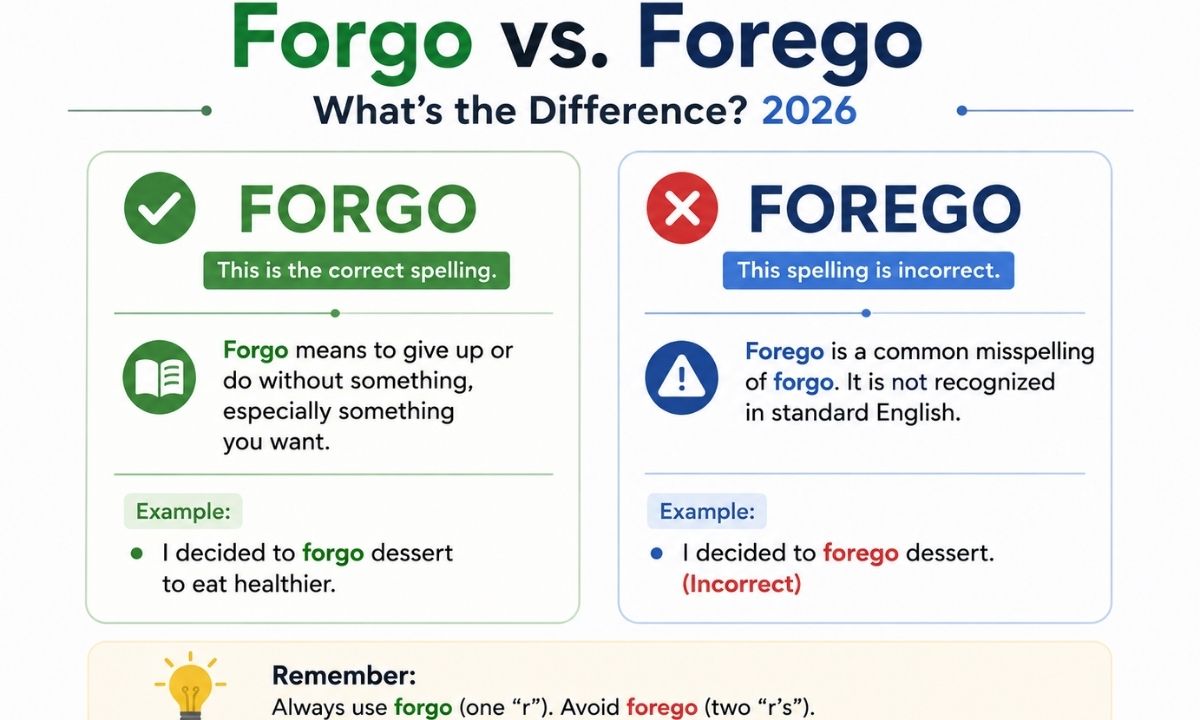
Forgo vs. forego look almost identical, so many English learners and even native speakers mix them up. However, these words have different meanings and grammatical uses. Forgo usually means to give something up, skip something, or choose to do without it. Forego, on the other hand, means to go before or come earlier. The noun phrase “foregone conclusion” comes from this older meaning.
Knowing this small difference can make your writing more precise. Whether you are writing an email, an academic assignment, a business message, or an everyday sentence, choosing the right word matters.
What Do Forgo and Forego Actually Mean?
The easiest way to understand forgo vs. forego is to look at their meanings separately.
Forgo Meaning
Forgo is a verb that means to give up, skip, or decide not to have or do something.
For example:
- Maya decided to forgo dessert after dinner.
- We chose to forgo the usual meeting this week.
- He will forgo the opportunity because of his busy schedule.
- I decided to forgo my usual coffee this morning.
In each example, someone chooses not to have, use, or do something.
You can use forgo in everyday conversation, although skip, give up, or do without often sounds more natural in casual speech.
For example:
“I’ll skip dessert tonight.”
This sounds more conversational than:
“I’ll forgo dessert tonight.”
Still, forgo works perfectly in both formal and informal writing.
Forego Meaning
Forego is a different verb. It traditionally means to go before, come before, or precede something.
For example:
- A short introduction foregoes the main discussion.
- The events that forewent the ceremony shaped the final decision.
However, this word appears much less often in modern everyday English.
You may encounter forego in historical, literary, or formal writing. You will also see its past participle foregone in the familiar expression “foregone conclusion.”
That phrase means an outcome that seems certain or already decided.
For example:
- Her victory seemed like a foregone conclusion.
- Given the team’s performance, their success looked like a foregone conclusion.
The Basic Difference
Think of the distinction this way:
Forgo = give up or go without something.
Forego = go before something.
That one distinction solves most spelling and grammar questions involving these words.
Forgo vs. Forego: Key Differences Explained
Although forgo and forego differ by only one letter, their meanings are not interchangeable.
| Word | Main meaning | Typical use | Example |
| Forgo | Give up or skip | Choosing not to have or do something | She decided to forgo the trip. |
| Forego | Go before or precede | Something occurring earlier | The introduction foregoes the main section. |
| Foregone | Already determined or preceded | Common in “foregone conclusion” | The result was a foregone conclusion. |
Forgo Shows a Choice
Forgo usually involves a decision.
Imagine that you planned to buy a new phone but decide to save your money instead. You could say:
- I decided to forgo the new phone.
The word highlights the choice to do without something.
Other examples include:
- The family forwent a vacation to save money.
- She forgoes snacks during her study sessions.
- They decided to forgo unnecessary expenses.
- He forwent the invitation because he had another commitment.
Notice that forgo changes form like an irregular verb:
- Present: forgo
- Third person: forgoes
- Past: forwent
- Past participle: forgone
Forego Shows Order
Forego focuses on something coming earlier.
For example, if one event happens before another, you can describe the earlier event as preceding it.
The forms include:
- Present: forego
- Third person: foregoes
- Past: forewent
- Past participle: foregone
However, modern writers usually choose precede instead of forego when they want to express the idea of coming earlier.
For instance:
- “The introduction precedes the main chapter.”
sounds much more natural today than:
- “The introduction foregoes the main chapter.”
Therefore, forego has a legitimate meaning, but you should not automatically use it whenever you mean forgo.
Why the Confusion Happens
The confusion comes from their similar spelling and pronunciation. Both words begin with for-, and their forms overlap in some contexts.
The most common mistake occurs when someone wants to say “give up” but writes forego.
Incorrect for that meaning:
- She decided to forego the opportunity.
Better:
- She decided to forgo the opportunity.
If you mean “give up,” choose forgo.
How to Use Forgo and Forego Correctly in a Sentence
The easiest way to choose between the two words is to identify the meaning you want.
Use Forgo for “Give Up”
Use forgo when a person decides not to take, use, enjoy, or do something.
Examples:
- I will forgo the extra dessert.
- They chose to forgo the expensive package.
- We had to forgo our weekend plans.
- She decided to forgo the chance to argue.
- He forwent his usual lunch break.
- The company may forgo the annual celebration.
These sentences all describe something that someone skips or gives up.
Use Forego for “Come Before”
Use forego when you specifically want to express the idea of something coming before another thing.
For example:
- The opening remarks forego the main presentation.
- Several events forewent the final announcement.
That said, precede usually provides a clearer modern alternative.
Compare:
- The introduction precedes the conclusion.
- The introduction foregoes the conclusion.
The first sentence sounds more natural to most modern readers.
Common Everyday Situations
You might encounter forgo in situations involving money, food, plans, entertainment, or opportunities.
For example:
Money:
“We decided to forgo the expensive hotel.”
Food:
“She chose to forgo dessert.”
Plans:
“He had to forgo the concert.”
Shopping:
“I’ll forgo the new shoes and save my money.”
Work:
“The team decided to forgo the meeting.”
In everyday conversation, people often replace forgo with simpler expressions such as skip, give up, or do without.
For example:
- “I’ll skip lunch today.”
- “I’ll do without dessert.”
- “We gave up the idea.”
However, forgo works especially well when you want your writing to sound concise and polished.
Simple Tricks to Remember the Difference Every Time
A simple memory trick can help you keep these words apart.
Remember: Forgo = Give Up
Think of forgo as meaning “go without.”
If you can replace the word with skip, give up, or do without, then forgo is usually the right choice.
For example:
- “She decided to forgo the invitation.”
You could say:
- “She decided to skip the invitation.”
The meaning remains similar.
Remember: Forego = Go Before
The prefix fore- often relates to something being in front or before.
You can see this idea in words such as:
- forehead
- foreground
- foremost
- foreword
So, when forego carries its traditional meaning, think:
Fore = before → forego = go before
This trick also helps explain foregone in foregone conclusion.
A Quick Test
Ask yourself:
Am I talking about giving something up?
Use forgo.
Am I talking about something coming before something else?
Use forego.
For example:
“The player decided to ___ the final opportunity.”
The intended meaning is “give up,” so forgo fits.
Now consider:
“The opening section ___ the main discussion.”
The intended meaning is “comes before,” so forego can fit, although precedes sounds more natural in modern English.
FAQ Which Is Correct, Forego or Forgo?
Which is correct, forego or forgo?
Both words are correct, but they have different meanings. Forgo means to give up, skip, or do without something. Forego means to go before or precede something.
Can forgo and forego be used interchangeably?
No. Their traditional meanings differ. Forgo refers to giving something up, while forego refers to coming before something. Replacing one with the other can change the meaning or create an incorrect sentence.
What does “foregone conclusion” mean?
A foregone conclusion describes an outcome that seems certain before the final result occurs. For example, if one team clearly dominates a competition, people might describe its victory as a foregone conclusion.
Is forego even used anymore?
Yes, but forego is much less common in modern everyday English than forgo. Writers often use precede when they mean “come before.” You are more likely to encounter foregone in the established phrase “foregone conclusion.”
How do I remember which one to use?
Use forgo when you mean give up or skip. Remember forego with fore = before. If someone chooses not to have something, choose forgo. If something comes earlier, forego may express that meaning.
Our Vision
Our goal is to make English grammar simple, practical, and easy to understand. We explain commonly confused words with clear definitions, useful examples, and everyday usage so readers can choose the right word with confidence.
Forgo and forego look almost identical, so many English learners and even native speakers mix them up. However, these words have different meanings and grammatical uses. Forgo usually means to give something up, skip something, or choose to do without it. Forego, on the other hand, means to go before or come earlier. The noun phrase “foregone conclusion” comes from this older meaning.
Knowing this small difference can make your writing more precise. Whether you are writing an email, an academic assignment, a business message, or an everyday sentence, choosing the right word matters.
What Do Forgo and Forego Actually Mean?
The easiest way to understand forgo vs. forego is to look at their meanings separately.
Forgo Meaning
Forgo is a verb that means to give up, skip, or decide not to have or do something.
For example:
- Maya decided to forgo dessert after dinner.
- We chose to forgo the usual meeting this week.
- He will forgo the opportunity because of his busy schedule.
- I decided to forgo my usual coffee this morning.
In each example, someone chooses not to have, use, or do something.
You can use forgo in everyday conversation, although skip, give up, or do without often sounds more natural in casual speech.
For example:
“I’ll skip dessert tonight.”
This sounds more conversational than:
“I’ll forgo dessert tonight.”
Still, forgo works perfectly in both formal and informal writing.
Forego Meaning
Forego is a different verb. It traditionally means to go before, come before, or precede something.
For example:
- A short introduction foregoes the main discussion.
- The events that forewent the ceremony shaped the final decision.
However, this word appears much less often in modern everyday English.
You may encounter forego in historical, literary, or formal writing. You will also see its past participle foregone in the familiar expression “foregone conclusion.”
That phrase means an outcome that seems certain or already decided.
For example:
- Her victory seemed like a foregone conclusion.
- Given the team’s performance, their success looked like a foregone conclusion.
The Basic Difference
Think of the distinction this way:
Forgo = give up or go without something.
Forego = go before something.
That one distinction solves most spelling and grammar questions involving these words.
Forgo vs. Forego: Key Differences Explained
Although forgo and forego differ by only one letter, their meanings are not interchangeable.
| Word | Main meaning | Typical use | Example |
| Forgo | Give up or skip | Choosing not to have or do something | She decided to forgo the trip. |
| Forego | Go before or precede | Something occurring earlier | The introduction foregoes the main section. |
| Foregone | Already determined or preceded | Common in “foregone conclusion” | The result was a foregone conclusion. |
Forgo Shows a Choice
Forgo usually involves a decision.
Imagine that you planned to buy a new phone but decide to save your money instead. You could say:
- I decided to forgo the new phone.
The word highlights the choice to do without something.
Other examples include:
- The family forwent a vacation to save money.
- She forgoes snacks during her study sessions.
- They decided to forgo unnecessary expenses.
- He forwent the invitation because he had another commitment.
Notice that forgo changes form like an irregular verb:
- Present: forgo
- Third person: forgoes
- Past: forwent
- Past participle: forgone
Forego Shows Order
Forego focuses on something coming earlier.
For example, if one event happens before another, you can describe the earlier event as preceding it.
The forms include:
- Present: forego
- Third person: foregoes
- Past: forewent
- Past participle: foregone
However, modern writers usually choose precede instead of forego when they want to express the idea of coming earlier.
For instance:
- “The introduction precedes the main chapter.”
sounds much more natural today than:
- “The introduction foregoes the main chapter.”
Therefore, forego has a legitimate meaning, but you should not automatically use it whenever you mean forgo.
Why the Confusion Happens
The confusion comes from their similar spelling and pronunciation. Both words begin with for-, and their forms overlap in some contexts.
The most common mistake occurs when someone wants to say “give up” but writes forego.
Incorrect for that meaning:
- She decided to forego the opportunity.
Better:
- She decided to forgo the opportunity.
If you mean “give up,” choose forgo.
How to Use Forgo and Forego Correctly in a Sentence
The easiest way to choose between the two words is to identify the meaning you want.
Use Forgo for “Give Up”
Use forgo when a person decides not to take, use, enjoy, or do something.
Examples:
- I will forgo the extra dessert.
- They chose to forgo the expensive package.
- We had to forgo our weekend plans.
- She decided to forgo the chance to argue.
- He forwent his usual lunch break.
- The company may forgo the annual celebration.
These sentences all describe something that someone skips or gives up.
Use Forego for “Come Before”
Use forego when you specifically want to express the idea of something coming before another thing.
For example:
- The opening remarks forego the main presentation.
- Several events forewent the final announcement.
That said, precede usually provides a clearer modern alternative.
Compare:
- The introduction precedes the conclusion.
- The introduction foregoes the conclusion.
The first sentence sounds more natural to most modern readers.
Common Everyday Situations
You might encounter forgo in situations involving money, food, plans, entertainment, or opportunities.
For example:
Money:
“We decided to forgo the expensive hotel.”
Food:
“She chose to forgo dessert.”
Plans:
“He had to forgo the concert.”
Shopping:
“I’ll forgo the new shoes and save my money.”
Work:
“The team decided to forgo the meeting.”
In everyday conversation, people often replace forgo with simpler expressions such as skip, give up, or do without.
For example:
- “I’ll skip lunch today.”
- “I’ll do without dessert.”
- “We gave up the idea.”
However, forgo works especially well when you want your writing to sound concise and polished.
Simple Tricks to Remember the Difference Every Time
A simple memory trick can help you keep these words apart.
Remember: Forgo = Give Up
Think of forgo as meaning “go without.”
If you can replace the word with skip, give up, or do without, then forgo is usually the right choice.
For example:
- “She decided to forgo the invitation.”
You could say:
- “She decided to skip the invitation.”
The meaning remains similar.
Remember: Forego = Go Before
The prefix fore- often relates to something being in front or before.
You can see this idea in words such as:
- forehead
- foreground
- foremost
- foreword
So, when forego carries its traditional meaning, think:
Fore = before → forego = go before
This trick also helps explain foregone in foregone conclusion.
A Quick Test
Ask yourself:
Am I talking about giving something up?
Use forgo.
Am I talking about something coming before something else?
Use forego.
For example:
“The player decided to ___ the final opportunity.”
The intended meaning is “give up,” so forgo fits.
Now consider:
“The opening section ___ the main discussion.”
The intended meaning is “comes before,” so forego can fit, although precedes sounds more natural in modern English.
FAQ Which Is Correct, Forego or Forgo?
Which is correct, forego or forgo?
Both words are correct, but they have different meanings. Forgo means to give up, skip, or do without something. Forego means to go before or precede something.
Can forgo and forego be used interchangeably?
No. Their traditional meanings differ. Forgo refers to giving something up, while forego refers to coming before something. Replacing one with the other can change the meaning or create an incorrect sentence.
What does “foregone conclusion” mean?
A foregone conclusion describes an outcome that seems certain before the final result occurs. For example, if one team clearly dominates a competition, people might describe its victory as a foregone conclusion.
Is forego even used anymore?
Yes, but forego is much less common in modern everyday English than forgo. Writers often use precede when they mean “come before.” You are more likely to encounter foregone in the established phrase “foregone conclusion.”
How do I remember which one to use?
Use forgo when you mean give up or skip. Remember forego with fore = before. If someone chooses not to have something, choose forgo. If something comes earlier, forego may express that meaning.
Our Vision
Our goal is to make English grammar simple, practical, and easy to understand. We explain commonly confused words with clear definitions, useful examples, and everyday usage so readers can choose the right word with confidence.