

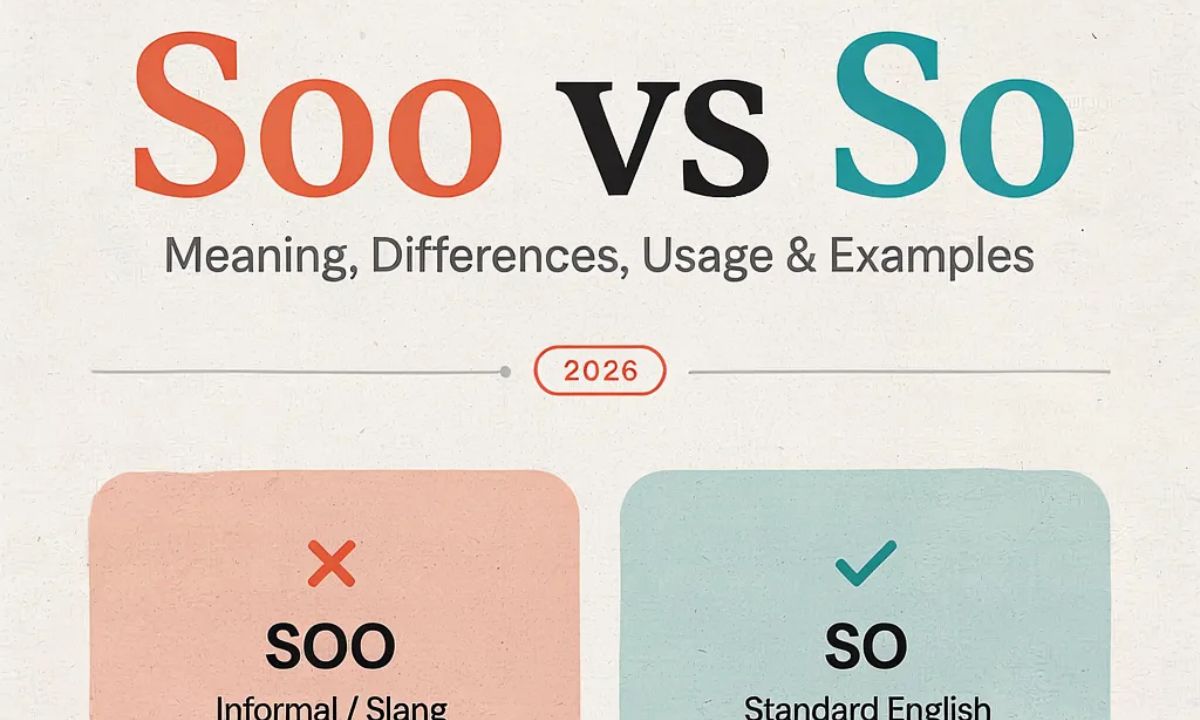
At first glance, Soo vs So appear to be almost identical. The only visible difference is the addition of one extra letter “o.” However, this small spelling change significantly affects how the word is perceived in different forms of communication. In modern English, “so” is the only grammatically correct spelling accepted in dictionaries, educational institutions, professional workplaces, and formal publications. It performs several important grammatical functions, such as acting as an adverb to increase intensity, a conjunction to connect ideas, and even a discourse marker in everyday speech. Examples include, “The exam was so difficult,” and “It was raining, so we stayed indoors.”
By contrast, “soo” belongs to the world of internet communication. It has become popular because people like to stretch words to express stronger emotions. Someone texting “I’m soo happy!” is not using a different word they are simply adding extra emphasis. This style has become common on platforms like TikTok, Instagram, WhatsApp, Discord, and Snapchat, where expressive language often replaces strict grammar rules.
Although most readers immediately understand what “soo” means, it should not be confused with standard English. Choosing between so and soo depends entirely on your audience and purpose. If you’re writing a school assignment, business proposal, email, or article, so is always the correct choice. If you’re chatting with friends or posting casually on social media, soo may help make your message sound more enthusiastic or playful. Understanding this distinction improves your writing and helps you communicate more effectively across different situations.
“So” Why It’s Always Correct
The word “so” has been part of the English language for centuries and remains one of its most versatile words. It is recognized by every major dictionary and follows all standard grammar rules. Because of its flexibility, writers and speakers use so in countless situations every day. It can intensify an adjective, connect two ideas, introduce a conclusion, or emphasize an opinion. These different grammatical roles make it one of the most frequently used words in spoken and written English.
For example:
- She was so excited about the concert.
- I studied hard, so I passed the exam.
- The weather wasn’t great, so we stayed home.
In each sentence, so serves a different purpose while remaining grammatically correct. This consistency is one reason English learners are taught to use so instead of experimenting with informal spellings.
Another important reason so is always correct is its universal acceptance. Teachers, employers, editors, journalists, and publishers expect proper spelling in formal communication. Using so demonstrates attention to detail and respect for your audience. It also improves readability because readers instantly recognize the word without hesitation.
As online language evolves, many slang spellings appear and disappear. Despite these trends, so has remained unchanged because it is part of standard English grammar. Whether you’re writing a research paper, professional email, resume, legal document, or business report, so is always the safest and most appropriate choice.
Is “Soo” a Real Word or Just Internet Slang?
Although “soo” appears frequently on the internet, it is not considered an official English word. Major dictionaries such as Oxford, Cambridge, Merriam-Webster, and Collins do not list soo as a standard spelling. Instead, it belongs to a category known as internet slang, where users intentionally alter spelling to make messages sound more expressive.
People often repeat letters to imitate spoken language. When someone says “I’m so excited” aloud, they might naturally stretch the vowel for emphasis. Online, writers recreate that same effect by typing “I’m soo excited!” or even “I’m soooo excited!”
This style became popular because digital communication lacks vocal tone and facial expressions. Without hearing someone’s voice, readers might miss emotional cues. Adding extra letters helps communicate excitement, surprise, affection, frustration, or humor more effectively.
Despite its popularity, soo should never replace so in situations requiring correct grammar. Universities, employers, publishers, and professional organizations expect standard English spelling. Using soo in those settings may reduce credibility or make writing appear careless.
Language constantly changes, and internet slang plays an important role in modern communication. However, slang should complement not replace standard grammar. Understanding when to switch between formal and informal writing is a valuable communication skill.
The Urban Dictionary Definition of Soo vs So
Urban Dictionary describes “soo” as an exaggerated spelling of “so” used to express stronger emotion or emphasis. Unlike traditional dictionaries, Urban Dictionary documents expressions created by internet users rather than establishing official grammar rules. Because online communities constantly invent new slang, the website acts as a record of how people communicate informally.
According to common online usage, soo often expresses feelings that are difficult to convey through plain text. Consider these examples:
- I’m soo excited!
- You’re soo funny.
- This movie is soo good.
- I’m soo tired today.
Notice that replacing soo with so doesn’t change the meaning of the sentence. Instead, it changes the emotional intensity. The extra letter simply makes the expression feel stronger and more dramatic.
However, readers should remember that Urban Dictionary reflects internet culture rather than official language standards. Just because a slang expression appears there does not mean it is appropriate in professional writing. Writers should always consider their audience before choosing informal spellings.
Soo vs So Key Differences
Although so and soo express similar meanings, they differ significantly in grammar, context, credibility, and audience expectations. The easiest way to understand the difference is to remember that so belongs to standard English, while soo belongs to internet culture.
So appears in dictionaries, grammar books, academic writing, newspapers, professional emails, contracts, books, and official communication. It is accepted everywhere because it follows established spelling conventions.
Soo, however, exists primarily in informal digital conversations. It is commonly used in texting, memes, online gaming, YouTube comments, TikTok captions, Instagram posts, and private chats. Readers interpret it as emotional emphasis rather than a different vocabulary word.
Another important distinction involves professionalism. Employers and educators usually expect proper spelling. A resume containing “soo experienced” may appear unprofessional, whereas “so experienced” demonstrates careful writing.
Finally, search engines and grammar-checking software recognize so as the correct word. Most spell-checkers automatically flag soo unless it appears inside informal conversations.
Understanding these differences helps writers choose language that matches both their audience and communication goals.
The Emotional Impact Difference
One reason soo remains popular is its emotional effect. Digital communication often lacks voice, facial expressions, and body language. As a result, writers invent creative ways to make text feel more expressive. Repeating letters has become one of the easiest techniques for showing emotion.
Compare these examples:
- I’m so happy.
- I’m soo happy.
- I’m soooo happy!
Each sentence communicates happiness, but the emotional intensity increases with each additional letter. Readers naturally imagine the speaker sounding more excited or enthusiastic.
Psychologically, stretched words make messages feel more personal and conversational. They imitate natural speech patterns, where people often hold vowel sounds when expressing strong emotions. This explains why words like nooo, yesss, pleeease, and sooo have become common online.
While this technique works well in casual conversations, it should be used sparingly. Overusing exaggerated spellings can reduce readability and make writing appear immature in professional environments.
When Context Changes Everything
Context is the deciding factor when choosing between so and soo. The same spelling can be appropriate in one situation but inappropriate in another. Understanding your audience is therefore more important than simply knowing grammar rules.
Imagine sending a message to your best friend saying, “I’m soo excited for the weekend!” Most people would view this as friendly and expressive. Now imagine writing the same sentence in a scholarship application or business proposal. The tone immediately feels less professional.
Formal communication values precision, consistency, and credibility. Informal communication values personality, emotion, and connection. Because the goals are different, the language naturally changes as well.
Successful writers constantly adjust their vocabulary depending on where they’re writing. A social media caption may intentionally sound casual, while an academic essay should always follow standard grammar conventions. Knowing when to switch between these styles is an important communication skill in today’s digital world.
When to Use “So” (And When to Avoid “Soo”)
Whenever clarity, professionalism, or credibility matters, so should always be your first choice. It is appropriate for academic assignments, business correspondence, resumes, reports, legal documents, research papers, newspapers, books, and professional websites. Readers expect correct grammar in these settings, and using standard spelling helps establish trust.
In contrast, soo works best when the goal is to create an informal, friendly, or humorous tone. Personal text messages, social media posts, gaming communities, online forums, and private chats often encourage expressive spelling because it reflects natural conversation.
A useful rule is simple:
- If someone is grading your writing, use so.
- If someone is hiring you, use so.
- If you’re representing a business, use so.
- If you’re chatting casually with friends, soo can be acceptable.
Making the right choice improves communication because readers immediately recognize the intended tone.
The Credibility Factor of Soo vs So
Correct spelling influences how readers evaluate your expertise. Research consistently shows that grammar mistakes affect first impressions, especially in professional environments. Employers, professors, editors, and clients often associate accurate writing with competence and attention to detail.
Using soo in an important document may unintentionally suggest carelessness, even if the rest of the content is excellent. Although many readers understand internet slang, they still expect professional communication to follow standard language conventions.
Credibility becomes especially important in industries such as education, journalism, healthcare, finance, law, and government, where precision matters. Even small spelling choices contribute to the overall quality of your writing.
For this reason, experienced writers carefully separate casual language from professional communication. Choosing so consistently demonstrates respect for your audience and strengthens your reputation as a clear communicator.
When “Soo” Actually Works (Social Media & Casual Texts)
Despite being grammatically incorrect, soo has a clear place in digital communication. Social media encourages authenticity, personality, and emotional expression. Users often write exactly as they speak, making stretched words feel natural rather than incorrect.
Examples include:
- I’m soo excited for this trip!
- You’re soo sweet.
- This pizza is soo good.
- I’m soo ready for vacation.
These examples sound conversational because they imitate spoken emphasis. Similar spellings include sooo, yesss, nooo, pleaseee, and okayyy.
However, moderation is important. Filling every sentence with exaggerated spellings can reduce readability and distract readers from the message itself. Using expressive language occasionally creates a stronger impact than using it constantly.
How Brands Use “Soo” Strategically
Modern brands understand that language influences customer perception. Companies targeting younger audiences sometimes use playful spellings like soo, yaaay, or omg in social media campaigns to create a friendly and relatable personality. These expressions help brands sound less formal and more conversational, especially on platforms where casual communication is expected.
For example, a clothing brand might post, “We’re soo excited to launch our summer collection!” or a café could share, “These cookies are soo delicious!” Such wording can encourage engagement because it feels similar to the language customers use with friends.
However, successful brands know when to switch back to standard English. Their websites, contracts, product descriptions, press releases, and customer support emails almost always use so instead of soo. This balance helps maintain professionalism while still building a warm and approachable brand voice. The most effective marketing strategies adapt language to the platform, ensuring messages feel authentic without sacrificing credibility.
The Origin of the Word “So”
The word “so” has a long and fascinating history that stretches back more than a thousand years. It originated from the Old English word “swā,” which was used to express meanings such as in this way, to this extent, or therefore. Over time, the pronunciation and spelling gradually changed as the English language evolved through the Middle English period.
By the time Modern English developed, “so” had become one of the most versatile and frequently used words in the language. Today, it appears in everyday conversations, literature, academic writing, journalism, business communication, and digital content. Its popularity comes from its flexibility because it can connect ideas, strengthen descriptions, introduce conclusions, or replace repeated information in a sentence.
Unlike many words that have fallen out of use over the centuries, “so” has remained an essential part of English grammar. Its continued relevance demonstrates how certain simple words become indispensable because they perform multiple grammatical functions while making communication clearer, smoother, and easier to understand.
How “So” Evolved in Modern English
As English developed into its modern form, the role of “so” expanded far beyond its original meaning. It became an important adverb used to emphasize adjectives and adverbs, as in “The book was so interesting.” It also became a conjunction that links causes and effects, such as “It started raining, so we canceled the picnic.
“ In spoken English, “so” even functions as a conversational marker that helps speakers introduce new topics or summarize previous ideas. You may hear someone begin a presentation with, “So, let’s discuss today’s agenda.” Although some people criticize this conversational use, it has become a natural feature of modern communication.
In digital writing, “so” remains equally important because it helps create logical flow and readability. Its adaptability has allowed it to survive centuries of language change while remaining one of the most recognizable and useful words in English. Few words perform as many grammatical functions while staying so simple and widely understood.
Common Grammar Mistakes with “So”
Although “so” is a simple word, many writers misuse it without realizing it. One of the most common mistakes is confusing “so” with the internet spelling “soo.” Since “soo” is not recognized in standard English, replacing “so” with it in formal writing creates a spelling error rather than a stylistic choice. Another frequent mistake is overusing “so” as a filler word. Many people begin nearly every sentence with “So…” during conversations or presentations.
While this may sound natural in speech, excessive repetition can weaken written content. Writers also misuse “so” by creating incomplete sentences, such as “I was tired. So because I slept early.” This construction lacks grammatical balance and can confuse readers. Another issue is unnecessary emphasis. Repeating “so” multiple times in a paragraph reduces its impact and makes writing feel repetitive. Learning these common mistakes helps writers produce cleaner, more professional, and more engaging content that communicates ideas effectively without distracting the reader.
Examples of Correct vs. Incorrect Usage
Looking at examples is one of the easiest ways to understand proper usage. Compare these sentences:
Correct: I was so happy to receive your message.
Incorrect: I was soo happy to receive your message. (Formal writing)
Correct: The meeting ended early, so everyone went home.
Incorrect: The meeting ended early soo everyone went home.
Correct: She is so talented that everyone admires her work.
Incorrect: She is soo talented. (Appropriate only in casual texting)
Another common mistake is using “so” too often in a single paragraph. For example:
Poor: The movie was so funny, and the actors were so amazing, and the ending was so perfect.
Better: The movie was extremely funny, the actors delivered outstanding performances, and the ending was memorable.
These comparisons show that correct grammar depends not only on spelling but also on sentence structure, word choice, and context. Using “so” appropriately improves readability and helps your writing appear polished and professional.
Why “Soo” Became Popular Online
The popularity of “soo” is closely connected to the rapid growth of digital communication. Before smartphones and social media became part of everyday life, most written communication followed traditional grammar rules. However, texting introduced a faster and more casual style of writing. People began experimenting with spelling to express emotions that plain text could not easily convey.
Adding extra letters became a creative way to imitate spoken language. Instead of writing “I’m so excited,” users typed “I’m soo excited!” to show greater enthusiasm. This trend spread quickly because it felt more personal and expressive. As internet culture evolved, exaggerated spellings became part of online identity. Writers discovered that simple spelling changes could make messages feel friendlier, funnier, or more dramatic without changing the actual meaning.
Today, “soo” is recognized by millions of internet users even though it remains grammatically incorrect. Its popularity highlights how digital communication often values emotional expression and personality over strict adherence to traditional language rules.
The Influence of Internet Culture
Internet culture has transformed the way people write, especially on social media and messaging platforms. Websites and apps such as TikTok, Instagram, X, Discord, Snapchat, Facebook, WhatsApp, and Messenger encourage quick, informal conversations where creativity is often more important than grammatical perfection. Users regularly stretch words like sooo, nooo, yesss, pleaseee, and okayyy to imitate spoken emphasis and make their messages feel more expressive.
These spellings help compensate for the lack of facial expressions, tone of voice, and body language in text-based communication. Memes, viral videos, and influencer content have further accelerated this trend by exposing millions of users to similar writing styles every day. Younger audiences, in particular, often adopt these expressions because they reflect current internet culture and create a sense of community. While these spellings are perfectly acceptable in casual online conversations, they should still be avoided in professional, academic, or business writing where standard grammar remains the expectation.
Frequently Asked Questions (FAQs)
Is “soo” a real English word?
No, “soo” is not an officially recognized English word. Standard dictionaries such as Oxford, Cambridge, and Merriam-Webster do not list it as a correct spelling. Instead, it is considered an informal internet slang variation of “so.”
Can I use “soo” in formal writing?
No. In formal writing, you should always use “so.” Whether you’re writing a business email, research paper, resume, report, or academic assignment, “so” is the grammatically correct spelling.
Why do people write “soo” instead of “so”?
People write “soo” to make their messages sound more expressive or emotional. Repeating the letter “o” mimics the way people naturally stretch words when speaking with excitement, surprise, happiness, or affection.
Is it okay to use “soo” on social media?
Yes. “Soo” is widely accepted on social media platforms such as Instagram, TikTok, X (formerly Twitter), Facebook, Snapchat, and WhatsApp. It helps create a casual, friendly, and conversational tone that many users enjoy.
What’s the easiest way to remember when to use “so”?
A simple rule is to think about your audience. If you’re writing for school, work, business, or any professional purpose, always use “so.”
Do “so” and “soo” mean the same thing?
Yes. Both “so” and “soo” generally express the same meaning. The difference is in tone rather than definition. “So” is the standard English spelling used in all formal situations, while “soo” is an informal variation that adds emotional emphasis.
Does using “soo” affect SEO?
Yes, it can. If you’re writing content for a website or blog, using the correct spelling “so” is generally better for SEO because it matches standard search intent and user expectations.
Final Thoughts
Although “so” and “soo” look similar, they serve different purposes in modern communication. “So” is the only grammatically correct spelling recognized in standard English, making it the right choice for academic writing, business communication, professional emails, official documents, and published content. It is versatile, widely accepted, and essential for clear, credible writing.
“Soo,” on the other hand, is an informal internet slang variation used to add emotion and personality to casual conversations. It has become popular through texting, memes, and social media because it helps writers express enthusiasm, excitement, or affection in a way that plain text sometimes cannot. While it works well in relaxed digital settings, it should not replace “so” in formal contexts.
The best approach is to choose your spelling based on your audience and purpose. Use “so” whenever accuracy, professionalism, and credibility matter. Reserve “soo” for friendly chats, social media captions, or other informal interactions where a playful tone is appropriate. By understanding the difference between these two spellings, you can communicate more effectively, make a stronger impression, and adapt your writing style to suit any situation in 2026 and beyond.