

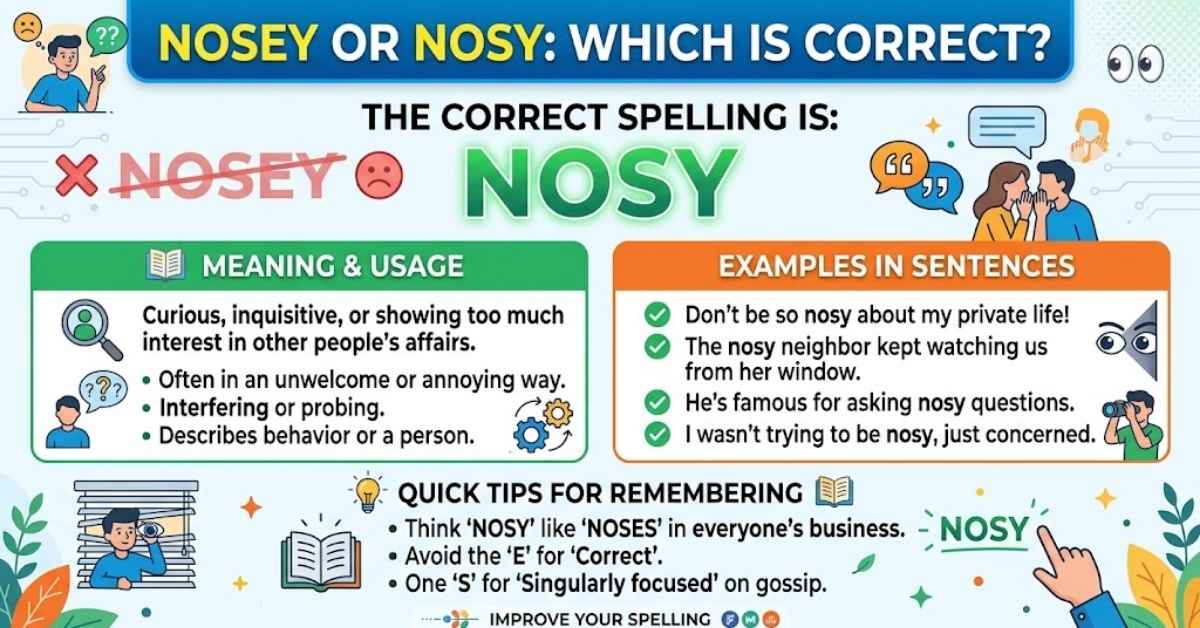
Nosey or nosy—which is correct? Both nosy and nosey are accepted English spellings of the same word, meaning overly curious about other people’s private affairs. However, nosy is the preferred choice for most American English writing, while nosey is a recognized alternative spelling.
The two forms have the same basic meaning and pronunciation, so the main decision is which spelling best suits your audience.
Nosey or Nosy: Which Spelling Is Correct?
Both spellings are correct, but they are not equally preferred in every context. If you are writing for an American audience, nosy is the safest default.
| Spelling | Correct? | Meaning | Best use |
|---|---|---|---|
| Nosy | Yes | Too interested in other people’s private affairs | Preferred for most US writing |
| Nosey | Yes | Same meaning as nosy | Accepted alternative spelling |
For example:
- My nosy neighbor keeps asking about my personal life.
- My nosey neighbor keeps asking about my personal life.
Both sentences are correct. The spelling changes, but the meaning does not.
If you are writing a school assignment, professional email, article, or website for readers in the United States, choose nosy and use it consistently throughout the text.
What Does Nosy or Nosey Mean?
Nosy is an adjective used to describe someone who shows too much interest in other people’s private matters. A nosy person may ask intrusive questions, listen to conversations that do not concern them, or try to discover personal information without being invited.
For example:
- My neighbor is so nosy that she wants to know everyone else’s business.
- It was nosy of him to ask how much money I earn.
- I don’t want to sound nosy, but why are you moving?
- The reporter asked a few questions that some people considered nosey.
The adjective often carries a mildly negative or disapproving tone. It suggests that someone’s curiosity has crossed a boundary.
However, context matters. Asking a personal question is not automatically nosy. The word usually implies that the question or behavior is unnecessarily intrusive.
Nosy meaning in simple English
In simple English, nosy means too interested in things that are private or do not concern you.
Imagine a coworker repeatedly asking about your salary, a neighbor questioning everyone who visits your house, or an acquaintance demanding details about your relationship. People might describe that behavior as nosy.
The key difference is between ordinary curiosity and unwanted interference in someone else’s business.
Why Do Nosy and Nosey Both Exist?
The confusion makes sense because both spellings look reasonable.
The word is connected to nose and the figurative idea of putting your nose into someone else’s business. Because nose ends with a silent e, some writers naturally retain that letter when forming nosey.
The shorter form, nosy, is the conventional spelling to prefer in American English. The alternative nosey has also remained in use and is recognized by dictionaries.
English spelling does not always follow one perfectly consistent rule. Some words retain letters that others drop when endings are added, and established variants can survive alongside a preferred form.
For that reason, it is better to understand nosey as a recognized variant rather than automatically correcting it as a typo.
Nosey vs. Nosy: Examples in Everyday English
The easiest way to understand the nosey or nosy spelling difference is to see both forms in natural sentences.
Talking about a neighbor
- Nosy: Our nosy neighbor always wants to know who is visiting.
- Nosey: Our nosey neighbor always wants to know who is visiting.
Both sentences communicate the same idea.
Talking about a coworker
- Nosy: My coworker was nosy about my salary.
- Nosey: My coworker was nosey about my salary.
Both are understandable and accepted, but nosy is the preferred choice for standard American writing.
Talking about personal questions
- Nosy: That was a nosy question to ask on our first date.
- Nosey: That was a nosey question to ask on our first date.
Again, the meaning remains the same.
Using the word politely
Sometimes, people use nosy when they want to acknowledge that a question might be too personal.
For example:
“Sorry if this sounds nosy, but are you planning to move?”
This phrasing recognizes a personal boundary and can make a sensitive question sound less abrupt. However, the wording alone does not guarantee that the question will be welcome.
Is Nosy American or British English?
Nosy is the preferred spelling for most American English writing. Nosey is also recognized, and it is often associated with British usage.
The distinction is a matter of spelling preference, not a difference in meaning. Neither form is exclusive to one country.
For a US-based website, school assignment, or professional document, use nosy as your default. If you are following a British publication’s house style or quoting a source that uses nosey, retaining that spelling may be appropriate.
Consistency is more important than switching between the two spellings without a reason.
Nosy vs. Noisy: What’s the Difference?
Nosy and noisy look similar, but they have completely different meanings.
- Nosy: Too interested in other people’s private affairs.
- Noisy: Making a lot of sound.
Compare these examples:
| Word | Example | Meaning |
|---|---|---|
| Nosy | The nosy neighbor asked about my visitors. | The neighbor was too curious. |
| Nosey | The nosey neighbor asked about my visitors. | Same meaning as nosy. |
| Noisy | The noisy neighbors played music all night. | The neighbors made too much sound. |
A useful way to remember the difference is to connect nosy with someone who interferes in other people’s business and noisy with loud sounds.
Do not confuse nosey with noisy. The first is an accepted variant of nosy, while the second is a separate word.
Related Words: Nosier, Nosiest, and Nosiness
Learning the related forms makes it easier to use the word correctly.
| Word | Part of speech | Meaning | Example |
|---|---|---|---|
| Nosy | Adjective | Too curious about private matters | He is nosy. |
| Nosey | Adjective | Alternative spelling of nosy | She is nosey. |
| Nosier | Comparative adjective | More nosy | My new neighbor is nosier than the last one. |
| Nosiest | Superlative adjective | The most nosy | He is the nosiest person in the office. |
| Nosiness | Noun | The habit of being nosy | Her nosiness annoyed her friends. |
| Nosily | Adverb | In a nosy manner | He nosily asked about their plans. |
Notice that the comparative and superlative forms are normally written nosier and nosiest, not noseyer and noseyest.
For most everyday writing, use nosy, nosier, nosiest, and nosiness.
LEARN MORE: Emerse or Immerse
How to Remember the Correct Spelling
If you keep wondering how to spell nosey or nosy, use this straightforward rule:
For American English, remember “nosy” without the extra e.
You can connect the word with the familiar expression “stick your nose into someone else’s business.” The expression explains the meaning, while the shorter spelling nosy is the form to use in most US writing.
Keep nosey in mind as an accepted alternative, rather than treating it as a completely different word.
If you are editing an article or formal document, choose one spelling and remain consistent. That makes the text easier to read and keeps your editorial style predictable.
Frequently Asked Questions
Is it spelled nosey or nosy?
Both nosey and nosy are accepted spellings. Nosy is the preferred default for most American English writing, while nosey is a recognized variant.
Is nosey a real word?
Yes. Nosey is a recognized alternative spelling of nosy. It means being overly interested in other people’s private affairs.
What is the definition of nosy?
Nosy is an adjective describing someone who is too curious about other people’s personal matters or who asks intrusive questions.
How do you spell nosey or nosy in American English?
For most American English writing, spell it nosy: N-O-S-Y. The alternative nosey is accepted, but nosy is the safer default for a US audience.
Are nosy and nosey pronounced the same?
Yes. In American English, both are pronounced /ˈnoʊ.zi/. The extra e in nosey does not change the pronunciation.
Is nosy a rude word?
It can be. Calling someone nosy usually suggests that their curiosity is intrusive or unwelcome. The tone depends on the context, the relationship, and how the word is used.
What is the difference between nosy and curious?
Curious usually describes a desire to learn or understand something and can be positive or neutral. Nosy suggests excessive interest in other people’s private matters and usually carries a negative tone.
For example, a curious student asks how a machine works. A nosy acquaintance keeps asking for details about someone else’s finances.
What is the difference between nosy and noisy?
Nosy means overly interested in other people’s business. Noisy means making a lot of sound. They are different words with different meanings.
Conclusion
When choosing between nosey or nosy, remember that both spellings are correct and share the same meaning. However, nosy is the preferred choice for most American English writing, while nosey is an accepted variant.
Use nosy when describing someone who asks intrusive questions or takes too much interest in other people’s private affairs. Remember the difference between nosy and noisy, and keep your spelling consistent throughout your writing.