

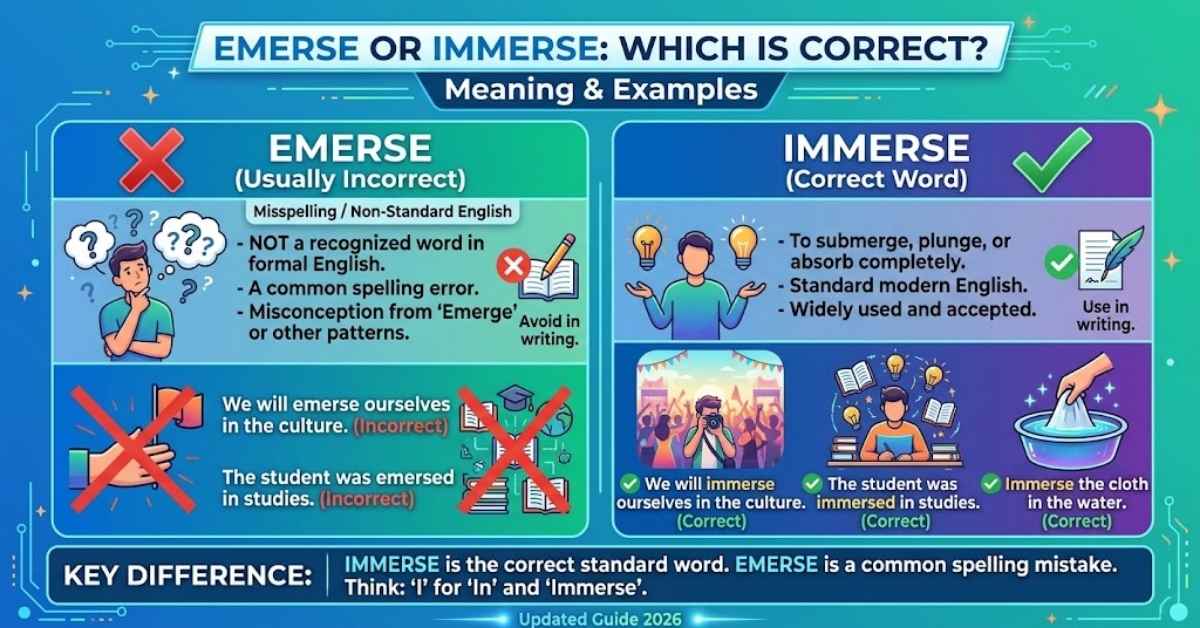
Emerse or immerse—which is correct? For ordinary modern English, immerse is the correct word when you mean to put something completely into a liquid or become deeply involved in an activity. Emerse is not the standard spelling for those meanings.
However, the related word emersed is used in specialized botanical contexts. Understanding the difference between immerse, emerge, and emersed will help you choose the right word.
Emerse vs. Immerse: Which Spelling Is Correct?
Immerse is the word you want in everyday writing when describing deep involvement, complete absorption, or placing something under a liquid.
| Word | Meaning | Everyday usage |
|---|---|---|
| Immerse | To put something under liquid or become deeply involved | Common and standard |
| Emerse | Not the standard everyday word for these meanings | Rare or specialized |
| Emerge | To come out, appear, or become known | Common and standard |
| Emersed | Rising above the surface of water, especially in botanical terminology | Specialized |
For example:
- Incorrect for the intended meaning: I want to emerse myself in learning English.
- Correct: I want to immerse myself in learning English.
- Correct: The swimmer emerged from the water.
- Correct in a botanical context: The pond contains emersed aquatic plants.
The key is to choose the word based on its meaning, not just its appearance.
What Does Immerse Mean?
Immerse is a verb with two main meanings. It can describe physically placing something under a liquid, or becoming completely involved in an activity, subject, or experience.
1. Immerse means to put something under liquid
In its literal sense, immerse means to place something completely below the surface of a liquid.
Examples:
- Immerse the cloth in warm water before washing it.
- The technician immersed the sensor in a container of water.
- Immerse the vegetables briefly in boiling water.
- The instructions say to immerse the object completely.
This meaning is often used in cooking, cleaning, laboratory work, and other practical situations.
2. Immerse means to become deeply involved
The word also has a figurative meaning. When you immerse yourself in something, you give it sustained attention and become deeply involved in it.
Examples:
- She immersed herself in her studies before the final exams.
- He spent the summer immersed in learning Spanish.
- I like to immerse myself in a good book after work.
- The documentary immerses viewers in the history of ancient Rome.
In these sentences, nobody is physically going underwater. The word describes attention, involvement, and absorption.
What does “immersed in something” mean?
The phrase immersed in something means being deeply involved in an activity, subject, or experience.
For example, “She was immersed in her research” means she was concentrating heavily on her work.
The expression is common in education, professional writing, reading, travel, language learning, and everyday conversation.
Emerse or Immerse: Correct and Incorrect Examples
The quickest way to learn the difference is to compare the words in complete sentences.
| Incorrect or unsuitable | Better wording |
|---|---|
| I want to emerse myself in English. | I want to immerse myself in English. |
| He immersed from the swimming pool. | He emerged from the swimming pool. |
| She is emersed in her studies. | She is immersed in her studies. |
| The teacher asked us to emerse the paper in water. | The teacher asked us to immerse the paper in water. |
| New facts immersed during the investigation. | New facts emerged during the investigation. |
Notice that the right correction depends on what the sentence is trying to say.
If someone goes into water, immerse may fit. The If someone comes out of water, emerge is usually the right word. If someone becomes deeply involved in an activity, use immerse or immersed.
Immerse vs. Emerge: What’s the Difference?
Immerse and emerge are easy to confuse because they look similar, but their everyday meanings differ.
- Immerse: Go into something or become deeply involved.
- Emerge: Come out, appear, or become known.
Think about a swimmer entering a pool and then climbing out.
| Word | Example | What it means |
|---|---|---|
| Immerse | She immersed herself in the water. | She went into the water. |
| Emerge | She emerged from the water. | She came out of the water. |
| Immerse figuratively | He immersed himself in his work. | He became deeply involved in his work. |
| Emerge figuratively | New evidence emerged. | New evidence became known. |
A simple memory trick is immerse = go in; emerge = come out.
This is a practical guide to their modern meanings, not a complete explanation of their word histories.
Immerse vs. Submerge
Immerse and submerge can both describe placing something under water, but they are not always interchangeable.
Submerge strongly emphasizes going below the surface. Immerse can describe that physical action too, but it is also widely used for figurative involvement.
Compare these sentences:
- The diver submerged himself beneath the surface.
- The scientist immersed the sample in a liquid.
- She immersed herself in learning a new language.
- He became immersed in the novel.
The last two sentences use immerse figuratively. In these contexts, submerge would usually sound unnatural or change the intended meaning.
Is Emerse Ever a Real Word?
The answer needs a little care.
For ordinary writing, emerse is generally not the word you want when you mean immerse or emerge. However, it is too broad to claim that every related form is meaningless or that specialist vocabulary follows the same rules as everyday usage.
The related word emersed has a recognized botanical meaning: rising above the surface of water. It is used to describe certain aquatic plants or plant parts. The American Heritage Dictionary and Texas A&M University’s aquatic plant glossary document this specialist usage.
For example:
“The pond contains submerged and emersed vegetation.”
In this sentence, submerged and emersed describe different positions relative to the water surface.
This does not make emerse a standard alternative to immerse in everyday English. If you are writing about studying, reading, learning a language, or putting an object into water, immerse is the appropriate choice.
Is Emerse a British or American Spelling?
No. Immerse is the standard spelling in both American and British English.
Unlike words such as color and colour, this is not a regional spelling difference. You should use immerse in American school assignments, professional emails, essays, articles, and general writing.
Examples:
- American English: She immersed herself in the course.
- British English: She immersed herself in the course.
The spelling does not change with the audience.
LEARN MORE: Beaf or Beef
How to Remember the Correct Spelling of Immerse
If you frequently confuse emerse and immerse, use this simple memory trick:
Immerse starts with “im,” as in “into.”
Imagine placing a cup into a bowl of water. You immerse the cup in the water.
Then remember the contrast:
- Immerse: Go in.
- Emerge: Come out.
- Emersed: Above the water in specialist botanical usage.
You can also remember the common phrase “immerse yourself in learning.” It is a natural expression used when someone becomes deeply involved in a subject or activity.
The most useful approach is to connect each word to a clear mental picture rather than memorizing the letters alone.
Frequently Asked Questions
Is it emerse or immerse?
Immerse is the correct everyday word when you mean to put something under a liquid or become deeply involved in something. Emerse is not the standard alternative for these meanings.
How do you spell immerse correctly?
The correct spelling is I-M-M-E-R-S-E. It begins with im and contains two consecutive m’s.
What does immerse mean in simple English?
To immerse something means to put it completely under a liquid. To immerse yourself in something means to become deeply involved in it.
What is the difference between immerse and emerge?
Immerse means to put something into a liquid or become deeply involved. Emerge means to come out, appear, or become known.
Is emerse a British spelling?
No. Immerse is the standard spelling in both American and British English. There is no standard US-versus-UK spelling distinction here.
What does immersed in something mean?
It means being deeply involved or absorbed in a subject, activity, or experience. For example, someone immersed in a book is giving it their full attention.
What is the difference between immerse and submerge?
Both can describe putting something under water. Submerge emphasizes going below the surface, while immerse also commonly describes deep involvement in a subject or activity.
What does emersed mean?
In botanical terminology, emersed describes something that rises above the surface of water, such as an aquatic plant growing with parts above the waterline. This specialist meaning is different from the everyday verb immerse.
Conclusion
When choosing between emerse or immerse, use immerse for ordinary writing about putting something under liquid or becoming deeply involved in an activity. Use emerge when something comes out, appears, or becomes known.
The word emersed has a legitimate specialist use in botany, but it is not a replacement for immerse. Remember the simple distinction—immerse means go in, while emerge means come out—and you will avoid the most common confusion.