

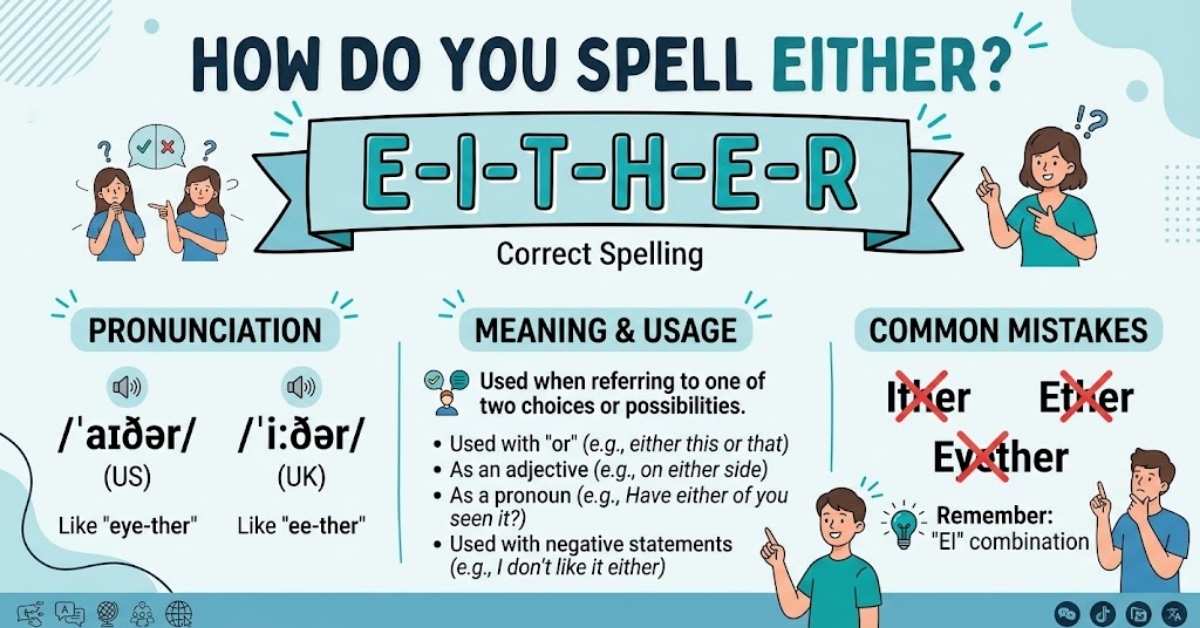
How do you spell either? The correct spelling is either, written E-I-T-H-E-R. It is a common English word used to talk about two choices, refer to one of two possibilities, or add information to a negative statement.
Although people sometimes write it as eather, ither, or aither, these are not standard spellings of the word. Once you remember the six letters in either, you can spell it confidently in texts, emails, school assignments, and professional writing.
How Do You Spell Either Correctly?
The correct spelling is either.
Spell it letter by letter: E – I – T – H – E – R.
| Spelling | Is it correct? |
|---|---|
| Either | Correct |
| Eather | Incorrect |
| Ither | Incorrect |
| Aither | Incorrect |
| Eiter | Incorrect |
The spelling remains the same in American and British English. The pronunciation can vary, but you do not need to change the letters based on how you say the word.
Example: You can choose either the blue shirt or the black one.
In this sentence, either introduces two available options.
How to Remember the Spelling of Either
If you often forget how to spell either, use a simple visual memory trick: remember the opening E-I and the ending T-H-E-R.
Break the word into two parts:
- EI — the first two letters.
- THER — the final four letters.
Put them together: EI + THER = EITHER.
You can also connect the spelling to the familiar expression “either … or.” For example, “Either we leave now, or we will miss the bus.” Remembering the phrase helps you recall the word in context.
Another useful technique is to write the word three times while saying each letter aloud. Then use it in a sentence without looking at your notes.
These are memory aids, not formal spelling rules. The important thing is to learn the complete letter sequence rather than guess from pronunciation.
Common Misspellings of Either
The word either can be confusing because its vowel sounds differ among speakers. That can make it tempting to substitute a different vowel or leave out a letter.
Here are several incorrect forms and their corrections:
| Incorrect spelling | Correct spelling |
|---|---|
| Eather | Either |
| Ither | Either |
| Aither | Either |
| Eiter | Either |
| Eaither | Either |
When proofreading, check that the word begins with EI, contains TH, and ends with ER.
Do not confuse a spelling mistake with a pronunciation difference. Both common pronunciations of either use the same spelling.
What Does Either Mean?
Either generally refers to one of two people or things, whichever one is chosen or considered. Depending on the sentence, it can also refer to each of two sides or be used to connect alternatives.
For example:
- One of two choices: Either answer is acceptable.
- A choice between alternatives: You can travel either by bus or by train.
- Each of two sides: There are trees on either side of the road.
- Agreement in a negative sentence: I don’t like the movie either.
The exact meaning depends on the grammatical structure and context. Understanding these uses makes it easier to spell and use the word correctly.
How to Use Either in a Sentence
The word either serves several grammatical purposes. Here are the main uses with practical examples.
1. Either as a determiner
A determiner comes before a noun and helps identify it. When either refers to a choice between two options, it commonly comes before a singular countable noun.
Examples:
- Either restaurant would be a good choice.
- You can take either route to get there.
- Either candidate could qualify for the position.
- You may select either option on the form.
In each example, the speaker is saying that one choice or the other is acceptable.
2. Either as a pronoun
A pronoun can replace a noun or noun phrase. Either can stand alone when the available choices are already clear.
Examples:
- “Would you like tea or coffee?” “Either is fine.”
- “Which jacket do you prefer?” “Either will work.”
- You can choose the red one or the blue one; either is available.
Here, either replaces the name of the selected item.
3. Either … or as a conjunction
The expression either … or presents two alternatives. It can connect words, phrases, or clauses.
Examples:
- You can either walk or take a taxi.
- Either Maya or Daniel will lead the meeting.
- We must either finish the report today or request an extension.
- Either you call ahead, or you may have to wait.
For clear writing, keep the two alternatives grammatically parallel whenever possible. For example, “either walking or driving” is parallel, while mixing an -ing form with an unrelated grammatical structure can make a sentence awkward.
4. Either in negative sentences
In negative sentences, either can mean that something is also not true or does not apply to another person.
Examples:
- I don’t drink coffee, and my sister doesn’t either.
- He wasn’t at the meeting, and I wasn’t either.
- The hotel wasn’t expensive either.
- “I haven’t finished.” “I haven’t either.”
In these sentences, either often appears at the end of the statement.
How Do You Pronounce Either in American English?
In American English, either has two common pronunciations. One begins with the long E sound, as in sheep. The other begins with the vowel sound in eye.
Both pronunciations are accepted, and neither requires a different spelling. Cambridge Dictionary lists both pronunciations for US English. See the Cambridge pronunciation guide.
The important distinction is between how a word sounds and how it is written. Someone may pronounce either differently from you without spelling it incorrectly.
If you are learning English, listen to speakers from different regions and practice both versions. In writing, continue to use the standard spelling either.
Either vs. Neither vs. Both
These three words are related, but they express different ideas.
| Word | Meaning | Example |
|---|---|---|
| Either | One or the other of two choices | Either answer is acceptable. |
| Neither | Not one and not the other | Neither answer is correct. |
| Both | The two together | Both answers are correct. |
Consider a question about two restaurants:
- Either restaurant is fine: You are happy with one choice or the other.
- Neither restaurant is suitable: You do not want either of the two restaurants.
- Both restaurants are suitable: You consider the two restaurants acceptable.
A useful way to remember the distinction is that either presents a choice, neither rejects both alternatives, and both includes the two together.
These words are not interchangeable, so choosing the correct one matters as much as spelling it correctly.
LEARN MORE: Modelling or Modeling
Is Either Singular or Plural?
The answer depends on how either is used in the sentence.
Either before a singular noun
When either means one or the other and comes before a singular countable noun, the noun is singular.
- Either option is acceptable.
- Either candidate has the required experience.
- Either route takes about an hour.
Either of + plural noun
In a phrase such as either of the options, the noun after of is plural. In formal writing, a singular verb is generally recommended when either is the subject.
Examples:
- Either of the options is acceptable.
- Either of the candidates has the required experience.
Plural verbs are also used in some informal contexts, particularly in speech. If you want to follow a more formal style, a singular verb is the safer choice.
Either … or and subject–verb agreement
When either … or connects two subjects, the verb can depend on the subject closest to it, especially when the subjects differ in number.
Examples:
- Either the manager or the assistant is attending.
- Either the assistant or the managers are attending.
For complex sentences, restructuring the sentence can sometimes make the agreement clearer.
Frequently Asked Questions About Spelling Either
How do you spell either?
The correct spelling is either, with six letters: E-I-T-H-E-R.
Is it spelled either or eather?
Either is correct. Eather is a misspelling when the intended word is either.
Does either start with E or I?
It starts with E, followed immediately by I. The opening letters are E-I.
Is either pronounced EE-ther or EYE-ther?
Both are common pronunciations in American English. The pronunciation varies, but the spelling remains either.
What is the difference between either and neither?
Either generally refers to one of two choices or alternatives. Neither means not one and not the other. For example, “Either choice works” expresses acceptance, while “Neither choice works” rejects both choices.
Can either mean both?
In certain expressions, yes. For example, “There were houses on either side of the road” means there were houses on each of the two sides. However, either does not simply replace both in every sentence.
How do you use either or in a sentence?
Use either … or to present alternatives. For example: “You can either call me tonight or send me an email tomorrow.”
Is the spelling of either different in American and British English?
No. The standard spelling is either in both American and British English. Pronunciation can vary between speakers and regions.
What is an easy way to remember either?
Remember the first two letters, E-I, followed by T-H-E-R. Then practice the word in the familiar expression “either … or.”
Final Answer: How Do You Spell Either?
The correct spelling is either — E-I-T-H-E-R.
Use either when referring to one of two choices, presenting alternatives with or, or adding information to a negative statement. If you are unsure about the spelling, remember the opening letters E-I and check the complete six-letter word before submitting your writing.
With the spelling, meaning, and examples in mind, you can use either confidently in everyday American English.