

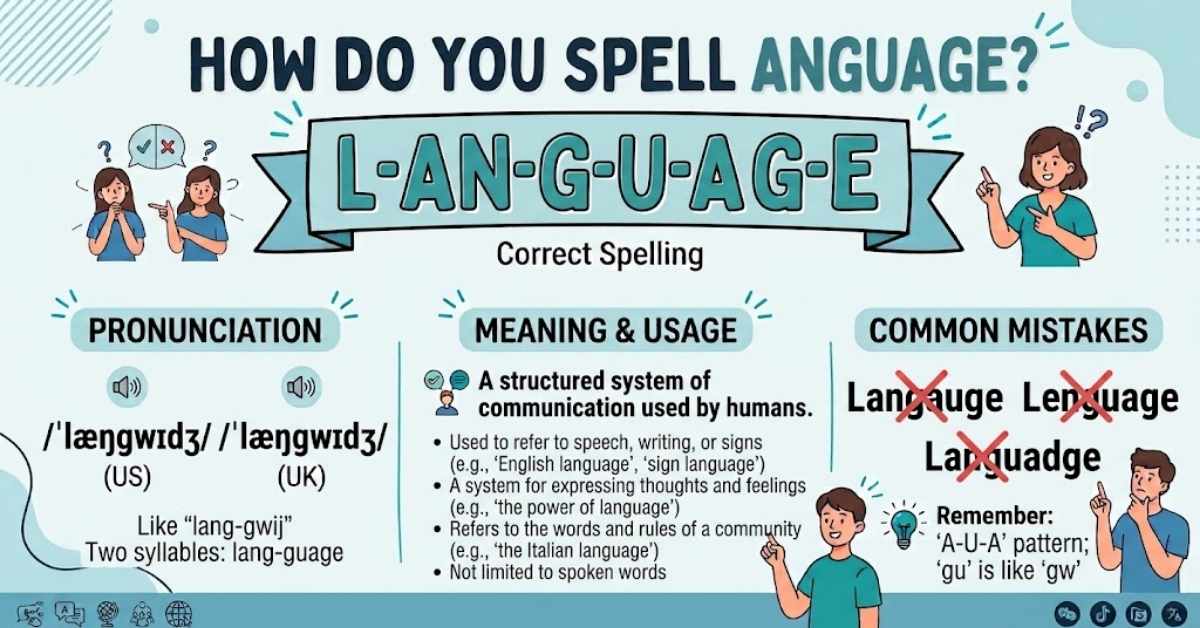
How to spell language? The correct spelling is language, written L-A-N-G-U-A-G-E. It contains eight letters. The word refers to a system of communication, such as English, Spanish, or American Sign Language. For example, “English is the main language used in this class.”
The spelling can be tricky because the middle gu and the ending -age do not look exactly the way some people expect them to sound. If you have ever written langauge, laguage, or lannguage, you are not alone. The easiest way to remember the correct spelling is to break the word into three parts: lang + u + age.
How Do You Spell Language Correctly?
The correct spelling is language.
Here is the word letter by letter:
L – A – N – G – U – A – G – E
Remember these details:
- Correct spelling: language
- Number of letters: 8
- Part of speech: Noun
- Plural form: languages
- Main spelling challenge: Keeping the U after the first G and remembering the final AGE.
The correct spelling is the same in American and British English. You do not need to choose between two regional spellings, as you would with words such as color and colour.
A simple trick to remember language
Break the word into three chunks:
LANG + U + AGE = LANGUAGE
The middle U is easy to overlook when you write quickly. By separating the word into these chunks, you can focus on the letter order instead of trying to spell the whole word from memory.
Try writing it once while looking at the correct spelling, then cover the word and write it again from memory. Finally, check each letter. This quick exercise helps you practice the exact sequence.
Language vs. Langauge: Which Spelling Is Correct?
Language is correct. Langauge is a common misspelling in which the U and A appear in the wrong order.
Here are other spelling errors to avoid:
| Spelling | Correct? | Explanation |
|---|---|---|
| language | Yes | Standard English spelling |
| langauge | No | The U and A are reversed |
| laguage | No | The N is missing |
| lannguage | No | An extra N has been added |
| lanugage | No | The U and N are in the wrong order |
| languaje | No | The final G has been replaced with J |
These errors often happen because writers try to spell the word based only on how it sounds. The pronunciation of language can make the middle letters feel less obvious, especially when the word is spoken quickly.
A practical way to avoid the mistake is to remember G-U-A in the middle of the word. When proofreading, check that the U appears after the first G and before the second A.
What Does Language Mean?
Language is a system of communication that uses words, sounds, signs, symbols, or other agreed forms to express thoughts and share information. Human languages have patterns and conventions that help people understand one another.
The word can have several related meanings depending on the context.
1. A spoken or signed system of communication
Examples include English, Spanish, French, Mandarin Chinese, and American Sign Language.
Example: “She is learning a new language before traveling abroad.”
Language is not limited to speech. Signed languages have their own structures and rules and are full languages in their own right.
2. The words and expressions used by a group
The word can also describe the way a community or group communicates.
Example: “The technical language in the manual was difficult for beginners to understand.”
3. A particular style of expression
Language can refer to the words someone chooses and how they use them.
Example: “The teacher encouraged students to use respectful language during the discussion.”
4. A system used by computers
In computing, a programming language is a formal system used to write instructions that a computer can process.
Example: “Python is a popular programming language.”
Understanding these meanings makes it easier to recognize how the word works in different sentences.
Examples of Language in a Sentence
Reading examples is a useful way to remember both the spelling and the meaning of a word.
Everyday examples
- English is the primary language spoken in many parts of the United States.
- Learning a new language can help you communicate with more people.
- The child is developing language skills.
- Clear language makes instructions easier to follow.
- Music can sometimes express feelings beyond spoken language.
School and workplace examples
- Students studied the structure of the English language.
- The company uses simple language in its customer instructions.
- The report explains why precise language matters in legal documents.
- She speaks more than one language fluently.
- The teacher asked the class to identify figurative language in the poem.
Technology examples
- JavaScript is a programming language used in web development.
- The course introduces the basics of a computer language.
- The software supports several languages in its settings.
Notice that the word is spelled language in every example. The plural form adds an S: languages.
Why Is Language So Easy to Misspell?
The word language can be confusing because English spelling does not always match pronunciation in a simple, letter-for-letter way.
Three details cause particular difficulty.
The middle U is easy to overlook
When people say language quickly, the middle sequence may not sound like three distinct letters. A writer may accidentally switch the A and U, producing langauge.
Tip: Remember the sequence G-U-A, not G-A-U.
The ending sounds different from its spelling
The final -age is pronounced with a sound similar to the ending in village or message. It is not pronounced as the separate letter names A, G, and E.
This is why trying to write the word purely by sound may lead to errors.
English spelling is not always phonetic
English uses spelling conventions shaped by the history of words, and the relationship between letters and sounds is not always straightforward. The British Council explains that English sounds can be represented by different spellings, which is one reason spelling may be difficult for learners.
The practical lesson is simple: use pronunciation to help you recognize a word, but check the written form when the letter sequence is uncertain.
How to Pronounce Language
In American English, language is commonly pronounced /ˈlæŋ.ɡwɪdʒ/. The stress falls on the first syllable.
A helpful approximation is LANG-gwij.
You can hear the American pronunciation in the Cambridge Dictionary entry for language.
The middle sounds may blend together in ordinary conversation, which can make the spelling seem less obvious. However, pronunciation differences between speakers do not change the standard spelling.
LEARN MORE: How to Spell People
Language vs. Languages
Language is singular, while languages is plural.
Use language when referring to one language or to the general concept of communication.
- “Spanish is a widely spoken language.”
- “The study of language is important in linguistics.”
Use languages when referring to more than one language.
- “The school offers classes in several languages.”
- “The website is available in ten languages.”
To form the plural, add -s to the end of language: language → languages.
Frequently Asked Questions
How do you spell language correctly?
The correct spelling is language, spelled L-A-N-G-U-A-G-E. It has eight letters.
Is it language or langauge?
Language is correct. Langauge is a misspelling in which the U and A are in the wrong order.
How many letters are in language?
The word language contains eight letters: L, A, N, G, U, A, G, and E.
What is the meaning of language?
A language is a system of communication that uses sounds, words, signs, symbols, or other agreed forms to express meaning. The word can also describe a style of expression or a formal computer system.
What is the plural of language?
The plural is languages. For example, “The students are learning three languages.”
Is language spelled differently in American and British English?
No. Language has the same spelling in standard American and British English.
Why is language spelled with a U?
The standard spelling includes the sequence G-U-A. Remembering the middle U helps distinguish language from the common misspelling langauge.
What is a synonym for language?
Depending on the context, related words include speech, tongue, vernacular, dialect, and lingo. They are not always interchangeable. For example, dialect refers to a particular variety of a language, while lingo is informal and may refer to specialized vocabulary.
Is language a noun or a verb?
Language is primarily a noun. It names a communication system, a style of expression, or a formal system such as a programming language.
How can I remember how to spell language?
Break it into three parts: lang + u + age. Then practice writing L-A-N-G-U-A-G-E from memory and check the middle U before finishing.
Final Answer: How to Spell Language
The correct spelling is language: L-A-N-G-U-A-G-E. It contains eight letters and is spelled the same way in American and British English.
To avoid common mistakes such as langauge and laguage, remember the middle sequence G-U-A and the ending -age. With that simple memory trick and a little practice, you can spell language correctly in essays, emails, reports, and everyday writing.