

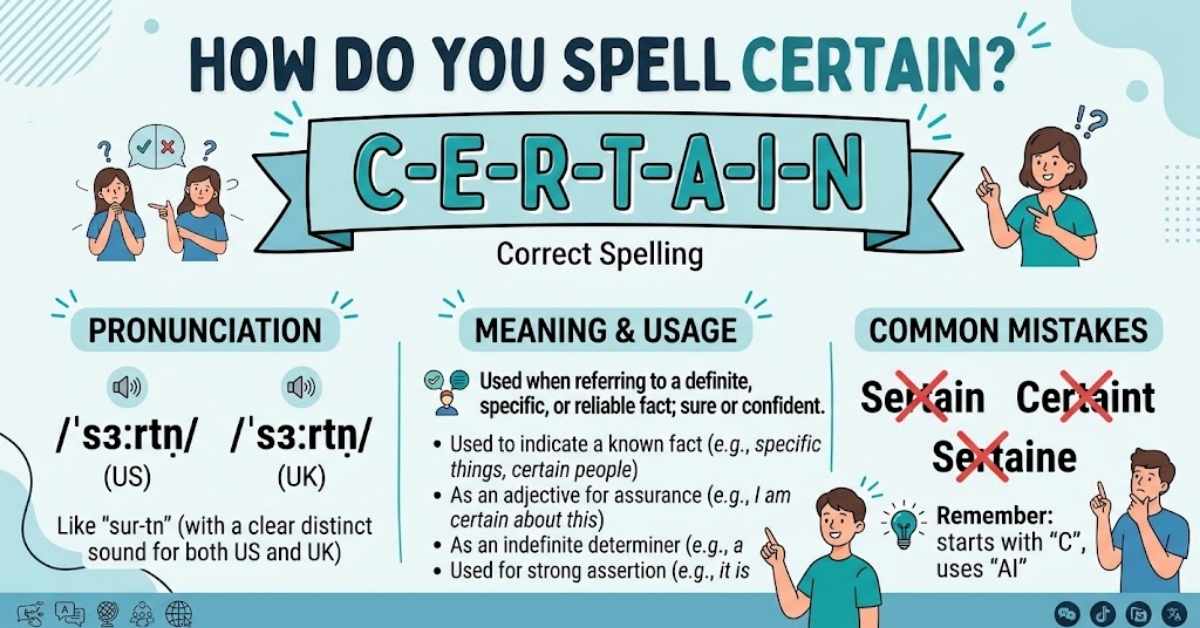
How to spell certain? The correct spelling is certain — C-E-R-T-A-I-N. It has seven letters, and the easiest way to remember it is to keep the R before the T and the A before the I in the final part of the word.
Common misspellings include certian, ceratin, and certean. Whether you are writing an email, completing a school assignment, or checking a professional document, learning the correct spelling of certain will help you communicate clearly and confidently.
How Do You Spell Certain Correctly?
The correct spelling is certain.
Spell it letter by letter: C – E – R – T – A – I – N.
| Spelling | Correct or incorrect? |
|---|---|
| Certain | Correct |
| Certian | Incorrect |
| Ceratin | Incorrect |
| Certein | Incorrect |
| Certean | Incorrect |
The word certain is commonly used to describe something known to be true, something someone feels sure about, or a particular person or thing that is not being specifically identified.
Examples:
- I am certain that I locked the door.
- Certain rules apply to all applicants.
- She is certain about her decision.
- We need a certain amount of time to finish the project.
The spelling is the same in American and British English. You do not need to change the letters depending on which variety of English you use.
How to Remember the Spelling of Certain
If you often confuse the letters in certain, focus on the two places where spelling mistakes commonly occur: the order of R and T, and the order of A and I.
The correct sequence is:
C-E-R-T-A-I-N
Try these three memory techniques:
1. Remember “CERT” at the beginning
The first four letters are C-E-R-T. Keep the R before the T.
You can connect this sequence to familiar words such as certificate and certainly. The words are related in spelling, making the opening letters easier to recall.
2. Remember “TAIN” at the end
After CERT, add A-I-N.
Put the two parts together:
CERT + AIN = CERTAIN
This is a practical way to remember the letter sequence without relying entirely on pronunciation.
3. Connect certain with certainty
The related word certainty can help reinforce the spelling. Both certain and certainty contain the sequence C-E-R-T-A-I-N before the ending changes.
Practice writing these two words together:
- Certain
- Certainty
Then use certain in a sentence from memory. This helps you learn the spelling in context instead of memorizing isolated letters.
Common Misspellings of Certain
The word certain is sometimes misspelled because writers remember the general sound but mix up the order of letters.
Here are common errors to watch for:
| Incorrect spelling | Correct spelling |
|---|---|
| Certian | Certain |
| Ceratin | Certain |
| Certein | Certain |
| Certean | Certain |
| Certen | Certain |
For example:
Incorrect: I am not certian about the meeting time.
Correct: I am not certain about the meeting time.
Incorrect: She was ceratin that she had submitted the application.
Correct: She was certain that she had submitted the application.
When proofreading, check the word’s middle letters carefully. The correct sequence is C-E-R-T-A-I-N, not C-E-R-A-T-I-N or C-E-R-T-I-A-N.
What Does Certain Mean?
According to Cambridge Dictionary, certain is an adjective that can express confidence or lack of doubt. It can also refer to particular people or things without identifying them specifically.
The word has several common meanings.
1. Certain means sure or confident
Use certain when someone has no doubt, or feels confident, about something.
Examples:
- I am certain that I sent the email.
- She is certain she made the right decision.
- Are you certain this is the correct address?
- We are not certain when the package will arrive.
In this sense, certain is similar to sure, confident, and convinced.
2. Certain means definite or established
The word can describe something regarded as definite, established, or expected to happen.
Examples:
- Success is not certain.
- The project will require a certain amount of preparation.
- It is certain that the deadline is approaching.
- No outcome is absolutely certain.
This meaning often appears in discussions about plans, predictions, evidence, and results.
3. Certain means particular or specific
Sometimes certain refers to a particular person, group, or thing without naming it directly.
Examples:
- Certain employees must complete the training.
- The policy applies in certain circumstances.
- Certain books are available only through the library.
- We noticed certain differences between the two reports.
In these sentences, certain does not necessarily mean that someone is sure. Instead, it identifies a particular but unspecified group or category.
How to Use Certain in a Sentence
Understanding the word’s meaning makes it easier to use correctly. Here are examples from everyday American English.
Examples in everyday conversation
- I am certain that I left my keys on the table.
- Are you certain you want to cancel the reservation?
- She feels certain that everything will work out.
- I am not certain what time the store closes.
Examples in school and academic writing
- Certain factors can affect the results of the experiment.
- The researcher identified certain limitations in the study.
- It is not certain whether the treatment will produce the same results.
- Students must follow certain instructions during the examination.
The Examples in business and professional writing
- Certain documents are required before approval.
- Please make certain that all information is accurate.
- We are certain that the report has been received.
- The agreement includes certain conditions that must be met.
Examples with “a certain”
The phrase a certain often refers to a particular but unnamed person or thing, or an unspecified amount or degree.
- A certain customer requested a refund.
- We need a certain level of experience for this position.
- There is a certain charm to the old building.
- At a certain point, we decided to change our approach.
These examples show why context matters when interpreting the word.
Certain vs. Certian: Which Spelling Is Correct?
Certain is the correct spelling. Certian is a common letter-order mistake.
The difference is small but important:
- Correct: C-E-R-T-A-I-N
- Incorrect: C-E-R-T-I-A-N
The mistake happens when the A and I are placed in the wrong order. To avoid it, remember that the word contains TAIN, not TIAN.
Examples:
Incorrect: I am certian that the answer is correct.
Correct: I am certain that the answer is correct.
Incorrect: We were certian the package would arrive today.
Correct: We were certain the package would arrive today.
If you have trouble remembering the order, write CERT + AIN before using the complete word.
Certain vs. Sure vs. Confident
These words have similar meanings, but they are not always interchangeable.
| Word | Main meaning | Example |
|---|---|---|
| Certain | Having no doubt, or referring to a particular thing | I am certain the file was saved. |
| Sure | Confident that something is true or will happen | Are you sure you locked the door? |
| Confident | Feeling or showing belief in your ability or a likely outcome | She is confident about her presentation. |
Certain can also refer to particular things, as in “certain conditions apply.” In that context, sure and confident would not work as direct replacements.
Choose the word that matches the intended meaning rather than treating all three as identical synonyms.
How Do You Pronounce Certain?
In American English, certain is commonly pronounced with two syllables, with the stress on the first syllable. The final vowel is relatively weak.
Cambridge Dictionary provides a US pronunciation guide and audio for the word. You can listen to it in the Cambridge Dictionary entry for certain.
Pronunciation can vary slightly by accent. Some speakers pronounce the final syllable more clearly, while others use a reduced sound. These differences do not affect the spelling.
If pronunciation is making the spelling difficult, concentrate on the written sequence C-E-R-T-A-I-N rather than trying to spell the word exactly as it sounds.
What Is the Difference Between Certain and Certainly?
Certain is an adjective, while certainly is an adverb.
- Certain: I am certain that the information is correct.
- Certainly: She certainly knows the answer.
Use certain to describe a person, belief, condition, or degree of confidence. Use certainly to modify a verb, adjective, or statement.
More examples:
- We are certain about the schedule.
- We will certainly attend the meeting.
- Certain rules must be followed.
- The plan will certainly require more time.
Remembering the related word certainly can also help reinforce the spelling of certain.
What Is the Opposite of Certain?
The most direct opposite of certain is uncertain when referring to doubt or lack of confidence.
Examples:
- Certain: She is certain about the answer.
- Uncertain: She is uncertain about the answer.
Other opposites depend on context. These include unsure, doubtful, unclear, and indefinite.
For example, “certain results” may mean definite results, while “uncertain results” may mean results that are not yet known. The best antonym depends on the sentence’s intended meaning.
LEARN MORE: How Do You Spell Either?
Is Certain Spelled Differently in American and British English?
No. Certain is spelled the same way in American English and British English.
Unlike words such as color/colour and center/centre, certain does not have a standard US-versus-UK spelling difference.
You can use the same spelling in:
- American school assignments
- British academic writing
- Professional emails
- Formal reports
- Everyday messages
The word’s pronunciation may vary slightly across speakers and accents, but its standard spelling remains unchanged.
Frequently Asked Questions About How to Spell Certain
How do you spell certain correctly?
The correct spelling is certain, written C-E-R-T-A-I-N. It has seven letters.
Is it certain or certian?
Certain is correct. Certian is a misspelling caused by reversing the positions of A and I.
How many letters are in certain?
The word certain contains seven letters: C, E, R, T, A, I, and N.
What is an easy way to remember certain?
Break the word into CERT + AIN. Remember that R comes before T and A comes before I.
What does certain mean?
Certain can mean sure, definite, or known to be true. It can also refer to particular but unspecified people or things, as in “certain rules.”
Is certain an adjective?
Yes. Certain is commonly used as an adjective, as in “a certain answer” or “I am certain.” It can also function as a determiner before a noun in expressions such as “certain people.”
What is the difference between certain and certainly?
Certain is an adjective, while certainly is an adverb. For example, “I am certain” describes confidence, while “I will certainly go” modifies the statement about going.
What is the opposite of certain?
The most direct opposite is uncertain. Depending on context, other alternatives include unsure, doubtful, unclear, and indefinite.
Is certain the same in American and British English?
Yes. The spelling is certain in both varieties of English. There is no standard American-versus-British spelling difference for this word.
Final Answer: How to Spell Certain
The correct spelling is certain — C-E-R-T-A-I-N.
Remember the sequence CERT + AIN to avoid common mistakes such as certian and ceratin. Use certain when describing confidence, something definite, or a particular but unspecified person or thing.
Whether you are writing a casual message, a school assignment, or a professional document, learning the correct spelling and seeing it in context will help you use certain accurately and confidently.