

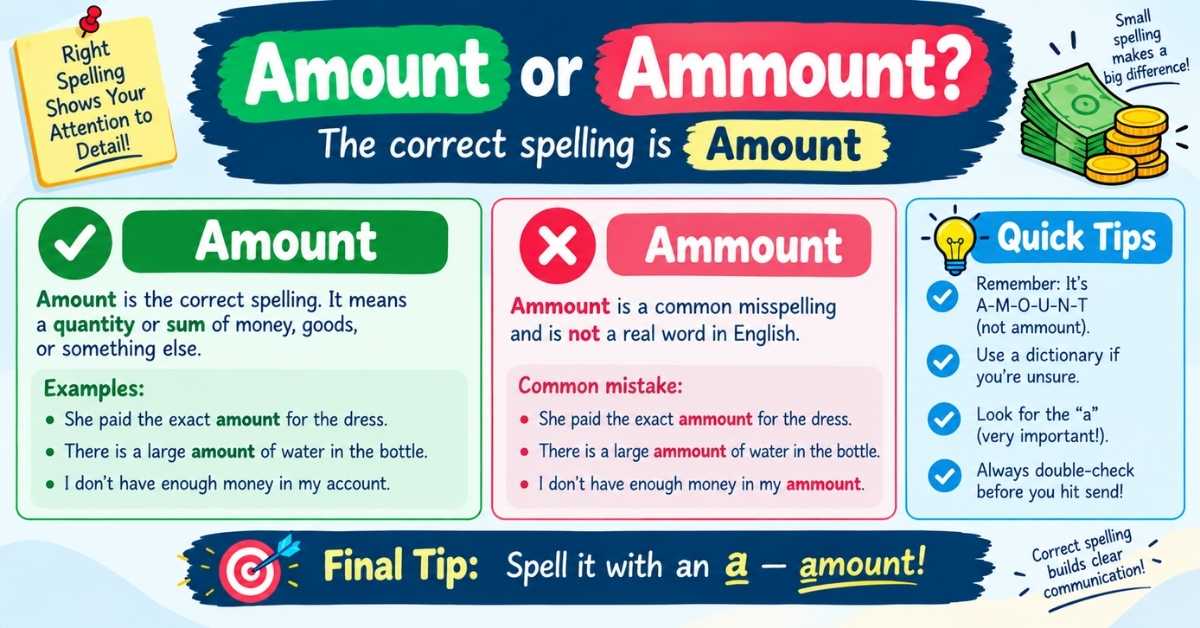
Amount or ammount—which spelling is correct? Amount is the only standard spelling, while ammount is a misspelling. Spell it a-m-o-u-n-t, with one m. As a noun, amount usually means a quantity or total; as a verb, it can mean to add up to or be equivalent to something.
Amount or Ammount: Quick Answer
| Form | Correct? | Meaning | Example |
|---|---|---|---|
| amount | Yes | A quantity or total; to add up to | Please confirm the total amount. |
| ammount | No | No standard English meaning | Please confirm the total ammount. ❌ |
If you are asking amount or ammount which is correct, always choose amount.
How to spell amount letter by letter
A-M-O-U-N-T
There is only one m.
Why Ammount Looks Plausible but Is Wrong
English contains many words with doubled consonants, so ammount may look familiar at first glance. Fast typing can also cause an accidental repeated m. However, the established word has never needed that extra letter in modern standard spelling.
Compare the forms visually:
- amount ✓
- ammount ✗
The pronunciation does not contain a doubled m sound. In American English, amount is commonly pronounced uh-MOUNT, approximately /əˈmaʊnt/.
What Does Amount Mean?
Amount as a noun
As a noun, amount refers to a quantity, total, sum, value, or extent.
- Add a small amount of sugar.
- The total amount due is $240.
- We spent a considerable amount of time reviewing the report.
- The storm produced a record amount of rainfall.
It can also refer to a particular sum of money:
- Enter the payment amount.
- The refund amount will appear in your account.
Amount as a verb
As a verb, amount is usually followed by to.
It can mean add up to a total:
- The repairs amounted to $1,200.
- The fees amount to ten percent of the purchase price.
It can also mean be equivalent to or have the effect of:
- Ignoring the warning would amount to negligence.
- The two proposals amount to the same thing.
How to Remember Amount vs Ammount
Use this simple visual split:
a + mount = amount
The familiar word mount already begins with one m. Add a in front, and you can see the correct sequence: amount.
Another quick reminder is:
One amount, one m.
Practice the correct form in a useful phrase: the total amount due.
Amount vs. Number
Traditional edited English generally uses amount with mass or uncountable nouns and number with plural countable nouns.
| Use | Preferred word | Example |
|---|---|---|
| An undivided quantity | amount | a large amount of water |
| Time, money, information, energy | amount | a small amount of time |
| Individually countable items | number | a large number of students |
| Separate files, reasons, books | number | the number of files |
Use:
- amount of information, not usually number of information
- number of emails, rather than amount of emails in careful formal prose
- amount of money, because money is treated as a mass concept even though dollars can be counted
Merriam-Webster notes that amount sometimes appears with count nouns when the items are viewed collectively or as a mass. In formal writing, however, number remains the safest choice for separate countable items.
Forms of Amount
| Form | Function | Example |
|---|---|---|
| amount | Singular noun/base verb | The amount is correct. |
| amounts | Plural noun/third-person verb | Small amounts can add up. |
| amounted | Past-tense verb | The bill amounted to $80. |
| amounting | Present participle | Fees amounting to $80 were charged. |
Avoid invented forms such as ammounting and ammounted. The correct forms retain one m: amounting and amounted.
Common Phrases With Amount
- large amount
- small amount
- significant amount
- total amount
- full amount
- exact amount
- amount of time
- amount of money
- amount due
- amount paid
- amount owed
- amount to the same thing
Examples:
- Please pay the full amount by Friday.
- The task requires a significant amount of time.
- Enter the exact amount shown on the invoice.
Amount in Business and Finance
Accuracy matters when the word appears next to a price or legal obligation.
| Phrase | Meaning |
|---|---|
| invoice amount | The sum charged on an invoice |
| amount due | The money currently owed |
| amount paid | The money already submitted |
| outstanding amount | The unpaid balance |
| principal amount | The original sum borrowed or invested |
| refund amount | The sum returned to a customer |
Example email:
Please confirm that the amount due is $750 and that the payment deadline is October 15.
Before sending an invoice or payment request, verify both the spelling and the number. A correctly spelled label cannot compensate for an incorrect financial figure.
LEARN MORE: Inportant or Important
Amount in American and British English
The spelling is amount in both American English and British English. Ammount is not a regional variant. Use amount in schoolwork, business documents, invoices, websites, and casual messages throughout the United States.
A Five-Second Proofreading Check
- Search your document for ammount.
- Replace it with amount.
- Search for ammounts, ammounted, and ammounting.
- Check whether a plural count noun needs number instead of amount.
- Review invoices, tables, image text, filenames, alt text, and metadata.
Spell-check normally flags ammount, but a manual search is valuable when text appears inside a design or accounting template.
Quick Practice Test
Choose the best answer.
- Please enter the correct amount / ammount.
- We received a large amount / number of applications.
- Add a small amount / number of water.
- The charges amounted / ammounted to $90.
- Several small amounts / ammounts were deducted.
Answers: 1. amount; 2. number; 3. amount; 4. amounted; 5. amounts.
Frequently Asked Questions
Amount or ammount?
Amount is correct. Ammount is a misspelling.
Is it amount or ammount?
Use amount, with one m, in every standard English context.
How do you spell amount?
Spell it a-m-o-u-n-t.
Is ammount a real word?
No. When you mean a quantity, total, or sum, the correct word is amount.
What does amount mean?
As a noun, amount means a quantity or total. As a verb, it means to add up to or be equivalent to something.
Is amount a noun or a verb?
It can be both. “The amount is correct” uses a noun. “The fees amount to $50” uses a verb.
Can amount be plural?
Yes. Use amounts for multiple quantities: “Small amounts of salt were added.”
What is the difference between amount and number?
Use amount mainly with mass nouns such as water, time, and money. Use number with plural count nouns such as students, files, and reasons.
What does amount to mean?
It can mean add up to a total or be equivalent in effect: “The costs amount to $500” or “That would amount to fraud.”
Is amount spelled differently in the UK?
No. Amount is standard in both American and British English.
Final Verdict
In amount vs ammount, only amount is correct. Remember a + mount = amount, use amount mainly for quantities and mass nouns, choose number for separate countable items, and keep one m in every related form: amounts, amounted, and amounting.