

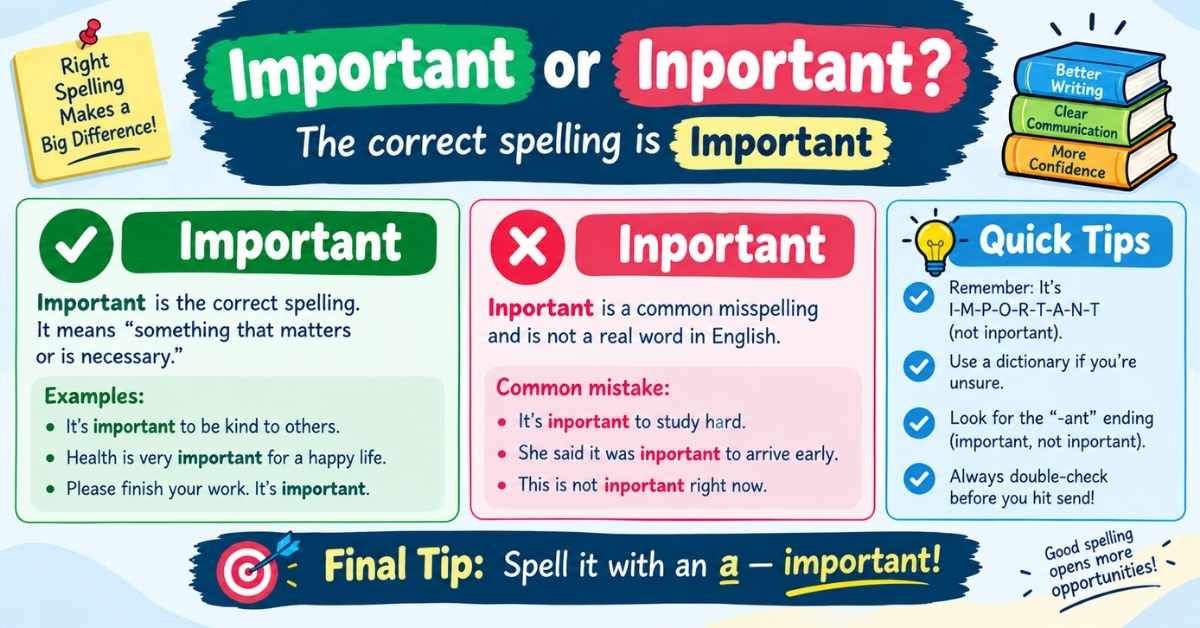
Inportant or important—which spelling is correct? Important is the only standard spelling, while inportant is a misspelling. Write it i-m-p-o-r-t-a-n-t. The adjective important describes someone or something with great value, significance, influence, or a strong need for attention.
Inportant or Important: Quick Answer
| Word | Correct? | Meaning | Example |
|---|---|---|---|
| important | Yes | Significant, valuable, influential, or necessary | This is an important decision. |
| inportant | No | No standard meaning; a misspelling of important | This is an inportant decision. ❌ |
If you are asking is it inportant or important, choose important in every standard English context.
How to spell important letter by letter
I-M-P-O-R-T-A-N-T
The key sequence is MP, not NP.
Why Important Uses M, Not N
The spelling inportant often appears because someone types quickly or expects the beginning to sound like in-. In the correct form, however, m comes directly before p:
important
This mp pairing is easy to say because both sounds are formed near the front of the mouth. English has many words with a similar pattern, including impossible, impatient, imperfect, and importance.
This is a memory pattern, not a rule for every English word. For this word, simply remember:
IMPortant begins with IMP.
Inportant or Important Meaning
People searching for inportant or important meaning are usually asking about the correctly spelled word important. It is an adjective with two closely related uses.
Significant, valuable, or necessary
Something is important when it matters, deserves attention, or can affect an outcome.
- Sleep is important for good health.
- Please read the important information before applying.
- Choosing a college can be an important decision.
- It is important to back up your files.
Influential or high-ranking
Important can also describe a person or position with considerable authority or influence.
- Several important officials attended the meeting.
- She became an important voice in the community.
In some contexts, calling yourself important can sound self-promoting. The related adjective self-important describes someone who behaves as though they deserve more attention than others.
How to Remember Inportant vs Important
Use one of these quick cues:
- Highlight the correct pair: iMPortant.
- Connect it to the noun: important → importance.
- Use the phrase: “It is important to remember MP.”
- Associate it with familiar imp- words: impossible, impatient, and imperfect.
Do not memorize the wrong form by repeatedly writing it. Practice the correct spelling in a complete sentence instead:
This is an important message.
The Important Word Family
| Word | Part of speech | Meaning | Example |
|---|---|---|---|
| important | Adjective | Significant or valuable | This is important. |
| importance | Noun | The quality of being important | We understand its importance. |
| importantly | Adverb | In an important way; used to emphasize a key point | More importantly, everyone is safe. |
| unimportant | Adjective | Not important | The minor error was unimportant. |
| self-important | Adjective | Having an exaggerated sense of importance | His self-important tone annoyed the team. |
Avoid related misspellings such as importence and inportantly. The correct forms keep import-: importance and importantly.
How to Use Important in Sentences
School and education
- Regular practice is important for language learning.
- The teacher highlighted the most important chapter.
- It is important to cite your sources.
Work and business
- We have an important meeting at 10 a.m.
- The email contains important information about the deadline.
- Customer trust plays an important role in long-term growth.
Everyday life
- Family is important to her.
- Exercise is important for overall health.
- Please remember this important detail.
Important To vs. Important For
Both expressions are correct, but their meanings often differ.
Important to someone
Use important to when a person values or cares about something.
- Honesty is important to me.
- This tradition is important to our family.
Important for someone or something
Use important for when something is beneficial, necessary, or affects a result.
- Sleep is important for students.
- Accurate data is important for the report.
Compare:
- Education is important to Maya. She personally values it.
- Education is important for Maya. It benefits her future.
More Important vs. More Importantly
Use more important when the phrase functions as an adjective or when you mean “what is more important.”
- Accuracy is more important than speed.
- More important, the data is reliable.
Use more importantly as an adverbial phrase commenting on the statement that follows.
- More importantly, the data is reliable.
Both introductory forms have established use, although some editors prefer more important as shorthand for “what is more important.” Follow your publication’s style guide and stay consistent.
Synonyms for Important
Choose a synonym that matches the intended strength and context.
| Synonym | Best use |
|---|---|
| significant | Having notable meaning, size, or effect |
| essential | Absolutely necessary |
| crucial | Decisive to an outcome |
| vital | Necessary for success, health, or survival |
| influential | Able to affect people or decisions |
| valuable | Worthwhile or useful |
| key | Central to a plan or explanation |
| consequential | Producing serious results or consequences |
Do not replace important mechanically. For example, an important person may be influential, while an important safety step may be essential or crucial.
Important in American and British English
The correct spelling is important in both American English and British English. Inportant is not a regional variation. Use important in formal documents, casual messages, academic work, and online content in the United States.
A Five-Second Proofreading Check
Before sending or publishing your work:
- Search for inportant.
- Replace it with important.
- Search for related errors such as importence and inportantly.
- Check headings, image text, alt text, filenames, and metadata—not only the article body.
- Confirm whether your sentence needs important to or important for.
Spell-checkers usually detect inportant, but a manual search catches mistakes embedded in design files or website fields.
LEARN MORE: Guidance or Guidence
Quick Practice Test
Choose the correct option.
- This is an important / inportant update.
- Sleep is important to / for good health.
- This cause is important to / for me personally.
- We recognize the importance / importence of accuracy.
- More importantly / More inportantly, everyone arrived safely.
Answers: 1. important; 2. for; 3. to; 4. importance; 5. More importantly.
Frequently Asked Questions
Is it inportant or important?
Important is correct. Inportant is a spelling error.
Is inportant a real English word?
No. It is not the standard word for something significant, valuable, or influential. Use important.
How do you spell important correctly?
Spell it i-m-p-o-r-t-a-n-t. Remember the mp sequence.
Why do people write inportant?
It commonly appears as a typing mistake or because a writer expects an n sound before p. The established spelling uses m.
What does important mean?
Important means having great significance, value, influence, or an effect that deserves attention.
Is important an adjective?
Yes. Important is an adjective. Importance is the noun, and importantly is the adverb.
What is the opposite of important?
The direct opposite is unimportant. Depending on context, minor, insignificant, or trivial may also work.
Is it important to me or important for me?
Use important to me for something you value. Use important for me for something beneficial or necessary to your situation.
Is important spelled differently in the UK?
No. Important is the standard spelling in both U.S. and U.K. English.
Final Verdict
In the comparison inportant vs important, important is always the correct standard spelling. Remember IMPortant begins with IMP, keep the same import- base in importance and importantly, and use a quick document search to remove the incorrect form before publishing.