

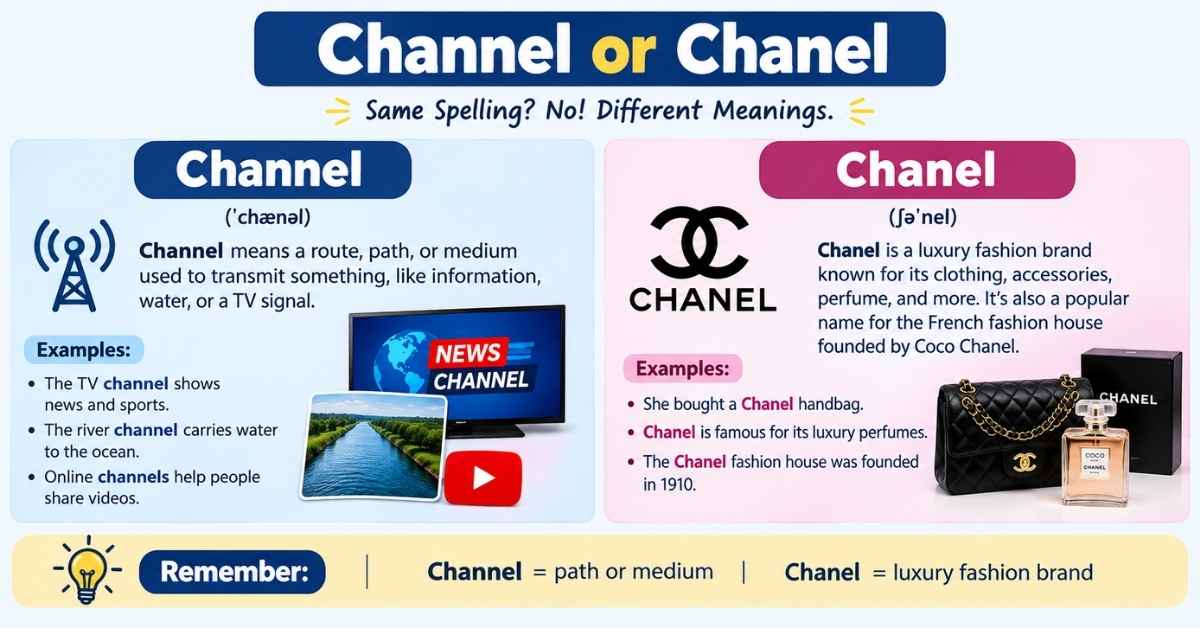
Channel or chanel—which spelling should you use? Choose channel when you mean a TV station, YouTube page, communication method, route, waterway, or the act of directing something.
Choose Chanel when you mean the proper name, especially the French fashion house or a person named Chanel. Both forms are correct, but they are not interchangeable.
Channel or Chanel: The Quick Answer
The difference comes down to meaning, grammar, capitalization, and pronunciation:
| Feature | Channel | Chanel |
|---|---|---|
| Spelling | C-H-A-N-N-E-L | C-H-A-N-E-L |
| Middle letters | Two n’s | One n |
| Word type | Common noun or verb | Proper noun |
| Main meaning | A route, passage, medium, or act of directing | A name, most famously the luxury fashion house |
| Capitalization | Usually lowercase | Capitalized |
| U.S. pronunciation | CHAN-uhl | shuh-NEL |
| Example | Change the channel. | She bought Chanel perfume. |
So, channel or chanel—which is correct? If you are discussing television, YouTube, communication, marketing, water, or direction, the answer is channel. If you are naming the fashion brand or a person, use Chanel.
Is It Channel or Chanel? Use This Three-Second Test
When you are unsure, do not guess from appearance. Ask what the word means in your sentence.
- Can you replace it with route, pathway, medium, or direct? Use channel.
- Are you naming the fashion house or a person? Use Chanel.
- Check the middle letters. The ordinary English word has two n’s: channel.
Try the test:
- “Email is our main communication ___.” The word means medium, so write channel.
- “She wore a vintage ___ jacket.” The blank names a fashion house, so write Chanel.
- “He ___ his frustration into exercise.” The word means directed, so write channeled in American English.
A simple memory trick
Think: A channel needs two n’s to carry information in and out. For the fashion name, remember the familiar one-n spelling: Chanel.
What Does Channel Mean?
Channel is a standard English word that works as both a noun and a verb. Its different uses share one central idea: a channel is a path through which something moves, or to channel is to direct something along such a path.
Channel as a noun
As a noun, channel can mean a station, route, medium, passage, or defined band of frequencies.
Television and online media
A TV channel carries programs to viewers. Online platforms use the same pathway idea: a YouTube channel is a page through which a creator publishes videos to an audience.
- What channel is the basketball game on?
- She launched a cooking channel on YouTube.
- Subscribe to our channel for weekly lessons.
Writing “YouTube chanel” is incorrect unless Chanel is part of a specific proper name.
Communication and business
A communication channel is a route through which information travels. In business, a company may also use sales, marketing, support, or distribution channels.
- Email is the fastest channel for routine updates.
- The company opened a new online sales channel.
- Please send the complaint through the proper channels.
This usage appears often in professional writing, which makes the double n worth checking before you publish.
Waterways and physical passages
A channel can be the bed of a stream, the deeper part of a river or harbor, or a narrow body of water between land areas.
- The boat stayed inside the marked channel.
- Heavy rain cut a narrow channel through the soil.
- They crossed the English Channel by ferry.
In English Channel, the capital letter appears because the full phrase is a geographical proper name. The spelling still contains two n’s.
Radio and technical pathways
In broadcasting and technology, a channel may be a frequency band or a path that carries a signal or data.
- The crew switched to a secure radio channel.
- Each audio channel carries a separate signal.
Channel as a verb
As a verb, channel means to direct energy, money, attention, emotion, information, or resources toward a person, place, or purpose.
- She channeled her nervous energy into preparation.
- The nonprofit channels donations into local food programs.
- We should channel customer feedback to the product team.
The verb helps explain all the noun senses: something moves in a chosen direction.
What Does Chanel Mean?
Chanel is a proper noun, not an alternative spelling of the common word channel. It is most strongly associated with the French luxury fashion house named for Gabrielle “Coco” Chanel. You may see it with products such as perfume, handbags, clothing, jewelry, and cosmetics.
- She wore a black Chanel dress.
- Chanel No. 5 is a well-known fragrance name.
- The exhibit explored the work of Coco Chanel.
Chanel can also be a surname or given name. That is why it is more accurate to call Chanel a proper name than to say it is “only a brand.” When the word identifies a specific company or person, capitalize it.
Do not write:
- She bought a Channel handbag. ❌
- The boutique sells chanel perfume. ❌
Write:
- She bought a Chanel handbag. ✅
- The boutique sells Chanel perfume. ✅
Channel vs. Chanel Pronunciation
The words look similar, but in standard American English, they are not pronounced the same.
- Channel: CHAN-uhl — /ˈtʃænəl/. It begins with the sound in chair, and the first syllable is stressed.
- Chanel: shuh-NEL — commonly /ʃəˈnɛl/ in English. It begins with the sound in shoe, and the second syllable is stressed.
Listen for two contrasts:
- Beginning sound: /tʃ/ in channel versus /ʃ/ in Chanel.
- Stress: CHAN-uhl versus shuh-NEL.
This pronunciation difference is another useful clue. If you hear the fashion name shuh-NEL, spell it with one n and a capital C.
Correct and Incorrect Examples
Television
- Correct: Please change the channel.
- Incorrect: Please change the chanel.
The sentence refers to a television station, so the common noun needs two n’s.
YouTube
- Correct: Our YouTube channel reached a new audience.
- Incorrect: Our YouTube Chanel reached a new audience.
Here, channel means an online publishing page, not a proper name.
Marketing
- Correct: Paid search is one of our strongest marketing channels.
- Incorrect: Paid search is one of our strongest marketing chanels.
The plural keeps the full base spelling: channels.
Direction
- Correct: He channeled his focus into the final project.
- Incorrect: He Chaneled his focus into the final project.
The verb means “directed,” so it comes from channel.
Geography
- Correct: The vessel entered a narrow channel.
- Incorrect: The vessel entered a narrow Chanel.
A water passage is a channel.
Fashion
- Correct: The museum displayed a classic Chanel suit.
- Incorrect: The museum displayed a classic channel suit.
The sentence names the fashion house, so use Chanel.
A person’s name
- Correct: Chanel submitted her application yesterday.
Because Chanel identifies a specific person here, it is a proper noun and begins with a capital letter.
Channel or Chanel in American English
For a U.S. audience, these are the usual forms of the common English word:
| Form | American English example |
|---|---|
| Base verb | channel |
| Third-person verb | channels |
| Past tense | channeled |
| Present participle | channeling |
| Noun plural | channels |
American writing generally uses channeled and channeling with one l at the ending. British English commonly uses channelled and channelling with two l’s. This regional difference affects the ending, not the base spelling: channel still has two n’s.
Chanel does not follow these verb patterns because it is a proper name in this comparison.
LEARN MORE: Staring or Starring
Why Are Channel and Chanel Easy to Confuse?
The confusion is understandable because the spellings share nearly all the same letters. When people type quickly, the second n in channel can disappear. Brand familiarity can also make the one-n form look correct in an unrelated sentence.
Historically, English channel came through French and ultimately traces to Latin canalis, connected with the idea of a pipe or groove. Modern Chanel, by contrast, functions as a proper name. Similar appearance does not make the two forms interchangeable.
The safest approach is to connect spelling to meaning:
- Pathway or direction = channel
- Name or fashion house = Chanel
A Proofreading Checklist for Writers
Before publishing, check these five points:
- Meaning: Is this a route, medium, passage, frequency, or directing action? Use channel.
- Identity: Does it name the fashion house or a person? Use Chanel.
- Letters: The common English word is spelled with two n’s.
- Capitalization: Chanel is a proper noun. Channel is normally lowercase unless grammar or a full proper name requires a capital.
- Pronunciation: CHAN-uhl signals channel; shuh-NEL signals Chanel.
For product pages, confirm the brand spelling against the product itself. For professional documents, search the draft for both “chanel” and “channel” so you can inspect each use in context.
Frequently Asked Questions
Channel or Chanel—which is correct?
Both can be correct, but they mean different things. Use channel for a route, passage, medium, TV station, waterway, or directing action. Use Chanel for the proper name, especially the fashion house or a person.
Is it channel or Chanel for TV?
Use channel with two n’s: TV channel. Chanel is not the standard word for a television station.
How do you spell YouTube channel?
The correct phrase is YouTube channel. The platform name and the common noun form a two-word phrase; channel keeps two n’s.
Is Chanel a word or a name?
In this comparison, Chanel is a proper name. It is famous as the name of a French fashion house and also occurs as a surname or given name.
Are channel and Chanel pronounced the same?
No, not in standard American English. Channel is pronounced CHAN-uhl, while Chanel is pronounced approximately shuh-NEL.
Does channel have one n or two?
Channel has two n’s in the middle: C-H-A-N-N-E-L. Chanel has one n: C-H-A-N-E-L.
Is channeling or channelling correct in the United States?
Channeling is the usual American spelling. Channelling is common in British English. Both come from the base word channel.
Final Rule to Remember
If the word describes a path or the act of directing something, write channel with two n’s. If it names the fashion house or a person, write Chanel with one n and a capital C.