

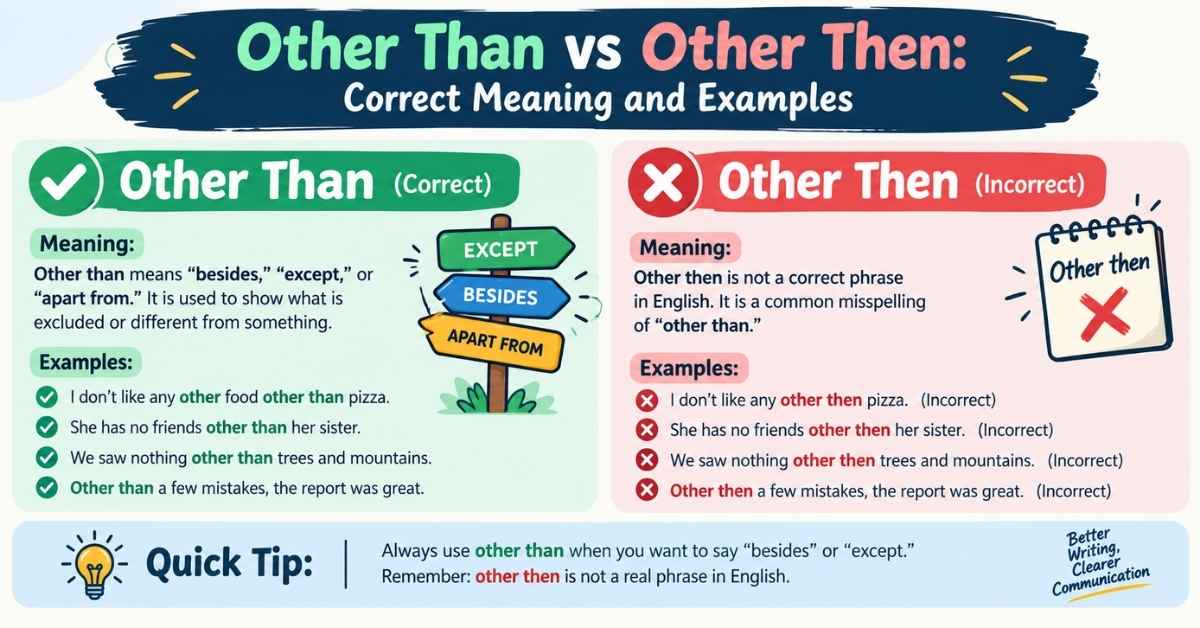
Other than vs other then has one clear winner: other than is the correct phrase when you mean except for, apart from, besides, or different from. Other then is normally a spelling or word-choice error because then concerns time, order, or consequence—not exclusion.
- Correct: I do not need anything other than water.
- Incorrect: I do not need anything other then water.
If you are wondering, “Is it other than or other then?”, use other than in nearly every exception or exclusion sentence.
Other Than or Other Then: Quick Comparison
| Expression | Meaning | Standard phrase? | Example |
|---|---|---|---|
| Other than | Except for, apart from, besides, or different from | Yes | Everyone other than Leo arrived. |
| Other then | No established meaning as a fixed phrase | No | Everyone other then Leo arrived. |
| Then | At that time, next, or in that case | Yes, when used appropriately | We ate and then left. |
The simplest answer to “other than or other then which is correct?” is therefore other than.
What Does Other Than Mean?
The other than or other then meaning becomes easier to understand when you replace the expression with another phrase.
Other than can mean:
- Except for
- Apart from
- Besides
- Different from
- In any way except
Other Than Meaning “Except For”
Everyone other than Mia submitted the assignment.
This means everyone submitted it except for Mia.
The laptop works well other than one faulty key.
The faulty key is the only stated exception.
Other Than Meaning “Besides”
Do you have any interests other than photography?
The speaker is asking whether the person has interests besides photography.
Be careful with besides, however. Depending on the sentence, it may mean either except for or in addition to.
Other Than Meaning “Different From”
The result was other than we expected.
This means the result was different from what we expected. In everyday writing, “The result was different from what we expected” may sound more natural.
Why Other Then Is Usually Wrong
The mistake comes from confusing than with then.
Then usually refers to:
- A point in time: “Things were different then.”
- A sequence: “Finish the report, then email it.”
- A consequence: “If the figures are correct, then we can proceed.”
None of those meanings creates an exception after other. That is why the following sentence is incorrect:
I want nothing other then an honest answer.
The writer is not describing when something happened or what happened next. The intended meaning is nothing except an honest answer, so the correct sentence is:
I want nothing other than an honest answer.
Can Other Then Ever Be Correct?
Other then is not correct as a fixed phrase meaning “except for.” However, other and then can occasionally appear next to each other while performing separate jobs.
We knew each other then, although we lost contact later.
Here:
- other completes each other.
- then means at that time.
Another possible structure is:
Choose one option or the other; then submit the form.
The punctuation makes the separation especially clear. The words happen to be near each other, but they do not form the expression other then.
This distinction is important because saying “the two words can never appear together” is too absolute. They can be adjacent; they simply do not form the exception phrase you need in sentences such as “everyone other than Sam.”
Than vs. Then: The Underlying Rule
Use Than for Comparison or Exception
Use than when comparing or distinguishing:
- Ava is taller than Noah.
- This option costs less than the first.
- I would rather call than text.
- Nobody other than the manager can approve it.
In other than, than helps express an exception, exclusion, or difference.
Use Then for Time, Order, or Result
Use then when discussing what happened at a particular time or what happens next:
- I lived in Chicago back then.
- Read the instructions, then begin.
- If the store is closed, then we will return tomorrow.
A common mnemonic is:
- ThAn relates to compArison.
- ThEn relates to timE or what happens nExt.
The mnemonic is helpful, but remember that than also appears in exception expressions such as other than.
The Three-Second “Except” Test
When you cannot decide between other than or other then, replace the disputed words with except for.
Nobody other ___ Jordan knew the password.
Test it:
Nobody except for Jordan knew the password.
The replacement makes sense, so write:
Nobody other than Jordan knew the password.
Now consider:
We spoke often back ___.
The word except cannot replace the blank. The sentence concerns time, so use then:
We spoke often back then.
The Decision Framework
Ask these questions in order:
- Does the sentence identify an exception? Use other than.
- Could “except for” preserve the meaning? Use other than.
- Does the sentence refer to time or what happens next? Use then.
- Are “other” and “then” serving separate grammatical roles? Keep them separate and check the punctuation.
How to Use Other Than Correctly
The expression can introduce several kinds of grammatical units.
Other Than + Noun
I packed nothing other than clothing.
Here, clothing is the noun representing the only included category.
Other Than + Pronoun
No one other than her knew the answer.
In ordinary American English, the object form her is natural after the prepositional use of other than.
Other Than + Infinitive
We had no choice other than to wait.
This construction explains the only available action.
Other Than + Gerund or Noun Phrase
Other than working late, I have no plans tonight.
Other than a short meeting, my schedule is clear.
Both examples introduce an exception to the main statement.
Other Than + Clause
The policy cannot be changed other than as the law permits.
This more formal construction is common in legal, administrative, and professional writing. Dictionaries recognize other than in both prepositional and conjunction-like uses. Merriam-Webster
Correct and Incorrect Examples
Workplace Examples
Incorrect:
Other then the budget issue, the proposal is ready.
Correct:
Other than the budget issue, the proposal is ready.
Incorrect:
We received no feedback other then Dana’s comments.
Correct:
We received no feedback other than Dana’s comments.
School Examples
Incorrect:
I have no homework other then the history worksheet.
Correct:
I have no homework other than the history worksheet.
Incorrect:
Everyone other then Marcus passed the quiz.
Correct:
Everyone other than Marcus passed the quiz.
Everyday Examples
Incorrect:
She drinks nothing other then coffee.
Correct:
She drinks nothing other than coffee.
Incorrect:
Other then a little rain, the trip was perfect.
Correct:
Other than a little rain, the trip was perfect.
Email and Text Examples
Incorrect:
Other then that, everything looks good.
Correct:
Other than that, everything looks good.
Incorrect:
I don’t need anything other then the final invoice.
Correct:
I don’t need anything other than the final invoice.
Can Other Than Begin a Sentence?
Yes. Other than can correctly begin a sentence when it introduces an exception.
Other than the delayed flight, our vacation went smoothly.
Other than her opening paragraph, the essay is well organized.
Other than that, I have no concerns.
The opening phrase should connect logically to the main clause. An incomplete construction such as “Other than finished the project” does not work because the phrase lacks a clear grammatical relationship.
Do You Need a Comma After Other Than?
A comma is often used when an introductory other than phrase comes before the main clause:
Other than a minor typo, the report is accurate.
Other than working late on Friday, I am available all week.
The comma helps readers see where the introductory exception ends.
When the phrase appears later and is essential to the sentence, a comma is usually unnecessary:
I have no appointments other than my annual checkup.
Nobody other than the owner can authorize a refund.
The familiar expression other than that normally takes a comma when it begins a sentence:
Other than that, the presentation was excellent.
Is Other Than One Word, Two Words, or Hyphenated?
In normal usage, write other than as two separate words:
- Correct: other than
- Incorrect: otherthan
- Incorrect for exceptions: other then
Hyphenation may appear when the expression is deliberately used as part of a compound modifier before a noun:
The experiment produced other-than-expected results.
That construction is possible, but it can look heavy. A clearer rewrite is often preferable:
The experiment produced results different from those expected.
Other Than vs. Similar Expressions
Other Than vs. Except For
These expressions are frequently interchangeable:
Everyone other than Priya attended.
Everyone except for Priya attended.
Except for can be more direct. Other than may work particularly well when presenting alternatives or broader distinctions.
Other Than vs. Apart From
Apart from can mean except for:
Apart from one delay, the event went well.
It can also mean in addition to:
Apart from teaching, she writes novels.
Because of that double meaning, use other than or except for when an ambiguous interpretation would cause confusion.
Other Than vs. Besides
Besides often means in addition to:
Besides coffee, we also serve tea.
But it can sometimes introduce an exception or alternative:
Who besides Jordan has the key?
Check the surrounding sentence before treating it as an exact synonym.
Other Than vs. Rather Than
These phrases perform different jobs:
- Other than identifies an exception.
- Rather than indicates preference, substitution, or contrast between choices.
I invited everyone other than Ben.
I called Ben rather than emailing him.
The first excludes Ben from a group. The second explains which action was chosen.
Common Expressions Using Other Than
Other Than That
Other than that means except for the matter just mentioned.
The room was small, but other than that, the hotel was excellent.
None Other Than
None other than emphasizes the surprising or notable identity of a person or thing.
The guest speaker was none other than the governor.
Write none other than, never none other then.
No Other Than
No other than may introduce the only possible alternative or explanation:
There can be no explanation other than a scheduling error.
In many contexts, none other than and no other … than have different sentence structures, so they should not automatically be exchanged.
Anything Other Than
Anything other than means every possibility except the one mentioned:
The instructions were anything other than clear.
This often creates an emphatic or mildly sarcastic contrast. The sentence means the instructions were not clear at all.
LEARN MORE: Comit or Commit?
Why People Confuse Other Than and Other Then
They Sound Similar
In rapid American speech, unstressed vowels may sound less distinct. That makes than and then easy to confuse when writing from memory.
They Look Similar
Only one letter changes:
- than
- then
Fast typing makes this a particularly easy mistake.
Both Are Real Words
A basic spell-checker may accept then because the word is spelled correctly, even though it is contextually wrong. Grammar tools may catch the phrase, but you should still proofread it manually.
Writers Learn an Incomplete Rule
“Than is for comparison” is helpful but incomplete. Than also participates in established exception phrases, including other than and none other than.
How to Correct the Error Throughout a Document
Use this proofreading workflow:
- Search the document for “other then.”
- Read every result in its full sentence.
- Substitute “except for.”
- If the meaning remains logical, change it to “other than.”
- If the sentence concerns time or sequence, keep then but rewrite the surrounding words.
- Check whether other belongs to an expression such as each other.
- Read the corrected sentence aloud.
- Search for otherthan as a final typo check.
Practical Correction Example
Original:
Other then the delivery delay, the customer was satisfied.
Substitution:
Except for the delivery delay, the customer was satisfied.
Because the substitution works, the correct version is:
Other than the delivery delay, the customer was satisfied.
Quick Practice Test
Choose than or then.
- I need nothing other ___ your approval.
- We completed the interview and ___ discussed the position.
- Nobody other ___ the director knew about the change.
- We understood each other ___ better than we do today.
- Other ___ one spelling error, the article is ready.
Answers
- than — it means except for your approval.
- then — it shows sequence.
- than — it identifies an exception.
- then — each other and then perform separate jobs.
- than — the spelling error is the only exception.
Frequently Asked Questions
Other than or other then—which is correct?
Other than is correct when you mean except for, apart from, besides, or different from. Other then is normally an error.
What is the other than or other then meaning?
Other than expresses an exception, exclusion, or difference. Other then does not have that meaning in standard English.
Is other then ever correct?
Not as a fixed expression meaning except for. The words may occasionally appear together by coincidence, as in “We knew each other then.”
Can other than start a sentence?
Yes:
Other than the weather, the trip was wonderful.
A comma usually separates the introductory phrase from the main clause.
Is other than formal or informal?
It is acceptable in formal, academic, professional, and conversational English. In some sentences, except for may sound more direct.
Is other than an American English expression?
Yes, it is standard in American English. It is also accepted in other major varieties of English.
Is other than one word?
No. It is normally written as two words.
Why doesn’t spell-check catch other then?
Because then is a correctly spelled English word. The error involves context and grammar, not necessarily spelling.
Should I write none other than or none other then?
Write none other than:
The winner was none other than Elena.
What is the easiest way to remember the rule?
Replace the phrase with except for. If the sentence still makes sense, use other than. If you are discussing time or what happens next, use then.
Final Rule to Remember
Use other than for an exception, exclusion, or difference. Use then for time, order, or consequence.
If except for works, choose other than.
That single substitution resolves almost every other than vs. other then decision.